
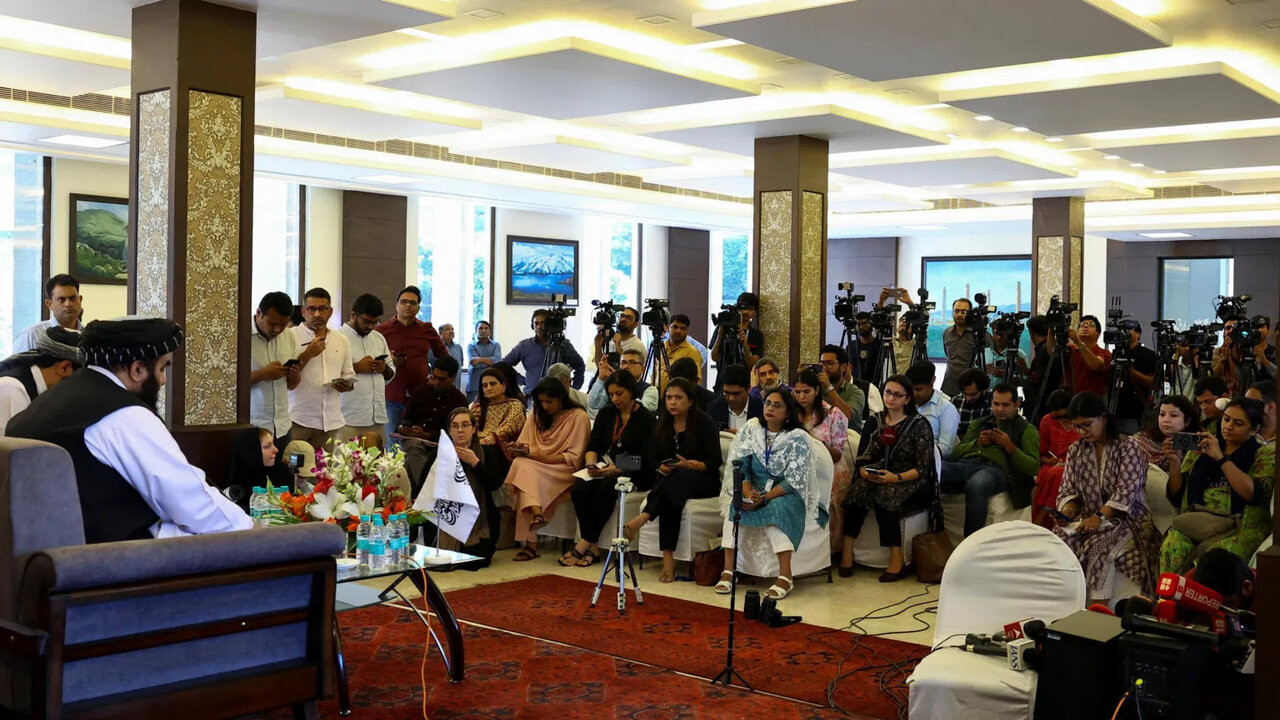
It is often said that a picture is worth a thousand words. An article published in an Indian newspaper on Monday morning showing a female reporter sitting in the front row at the Afghan Taliban’s foreign minister’s press conference in Delhi is certainly one of them.
The meeting, Amir Khan al-Muttaqi’s second press conference in about 48 hours at the Afghan embassy, was called after an uproar over the exclusion of women from the first round of talks on Friday. Muttaki told a press conference on Sunday that the exclusion was not intentional and “unintentional.”
“As for the (Friday) press conference, it was held on short notice, a short list of journalists was decided upon, and the list of participants presented was very specific. “It was rather a technical issue… Our colleagues had decided to send an invitation to a specific list of journalists and there was no other intention,” he added.
The United Nations has described the situation in Afghanistan as “gender apartheid,” with women and girls prohibited from attending secondary school and university, and from going to parks and gyms. The work they are allowed to do is becoming increasingly restricted, and the Taliban government is forcing them to cover themselves from head to toe and restricting their travel.
The Taliban government that took power in 2021 has previously said it respects women’s rights in accordance with Afghan culture and its interpretation of Islamic law, but Western diplomats say restrictions on women are hampering efforts to gain recognition. The suppression of women’s rights under their rule is among the harshest in the world.
Muttaqi arrived in India on Thursday for a week of high-level talks with the Russian government, the only country that so far fully recognizes the government.
Although Delhi does not officially recognize Afghanistan’s de facto rulers, it is one of several countries that maintains some form of diplomatic or informal ties with Afghanistan, maintaining a small mission in Kabul and even sending humanitarian aid there.
The visit is seen as strengthening bilateral relations and is key for both countries. The Taliban government will step up its efforts to win recognition, while India will advance its strategic and security interests. On Friday, Muttaqi met with Foreign Minister S. Jaishankar, who announced that India would reopen its embassy in Kabul, which had been closed after the Taliban returned to power in 2021.
About 16 male reporters attended a press conference later that day, but female reporters were turned away from the embassy gates. Taliban officials confirmed that women were not invited to attend.
India’s Ministry of External Affairs (MEA) said it was “not involved in media relations” as the press conference was held at the Afghan embassy. But sexism in mainland India has infuriated politicians and journalists, who have criticized the government for allowing it to continue.
Opposition leader Rahul Gandhi said that by allowing the event to take place, Indian Prime Minister Narendra Modi is “telling every woman in India that you are too weak to stand up for them.”
The Indian Guild of Editors, the Indian Women Press Corps (IWPC) and the Network of Women in Indian Media (NWMI) issued a strong statement calling the exclusion “highly discriminatory”.
“Diplomatic establishments may claim protection under the Vienna Convention, but this cannot justify blatant sex discrimination in the media in mainland India,” the guild said.
“Whether or not the MEA orchestrated this event, it is deeply disturbing that such discriminatory exclusion was allowed to proceed unchallenged,” it added.
NWMI said the Indian government has a “responsibility to protect the democratic rights and constitutional freedoms of its women citizens, including the right to work and livelihood” and should have questioned such “blatant sexism”.
The group also criticized male journalists who attended Friday’s meeting for not standing up for their female colleagues. “In moments like this, silence can be seen as complicit in the normalization of sexism,” the statement said.
Amid growing anger in India, Muttaqi’s team issued new invitations to Sunday’s meetup, describing it as an “inclusive” event open to all media members.
It is not clear what led to the second press conference, but there is speculation that the Indian government may have intervened, although there has been no official confirmation.
The meeting was well attended and the minister was asked some tough questions about why women were excluded from Friday’s meeting and about the rights of girls and women in Afghanistan.
“There are 10 million students in schools and educational institutions, including more than 2.8 million women and girls. In madrasas, education continues until graduation,” Muttaqi replied. “While there are certain restrictions, we have never declared women’s education to be religiously haram (forbidden), only that it has been postponed until further orders,” he said.
Many journalists present at the press conference questioned the minister’s claims, pointing to the restrictions the Taliban has imposed on girls and women since 2021.
For the past four years, girls over the age of 12 have been banned from education and women’s career options have been severely restricted. In recent weeks, the Taliban government has also removed books written by women from Afghan universities.
The Minister’s response to a follow-up question regarding women’s rights in Afghanistan may not have been satisfactory. However, as some journalists have pointed out, the fact that a second press conference was organized and the minister responded to questions about gender issues could be considered progress in itself.
(Source: BBC)