
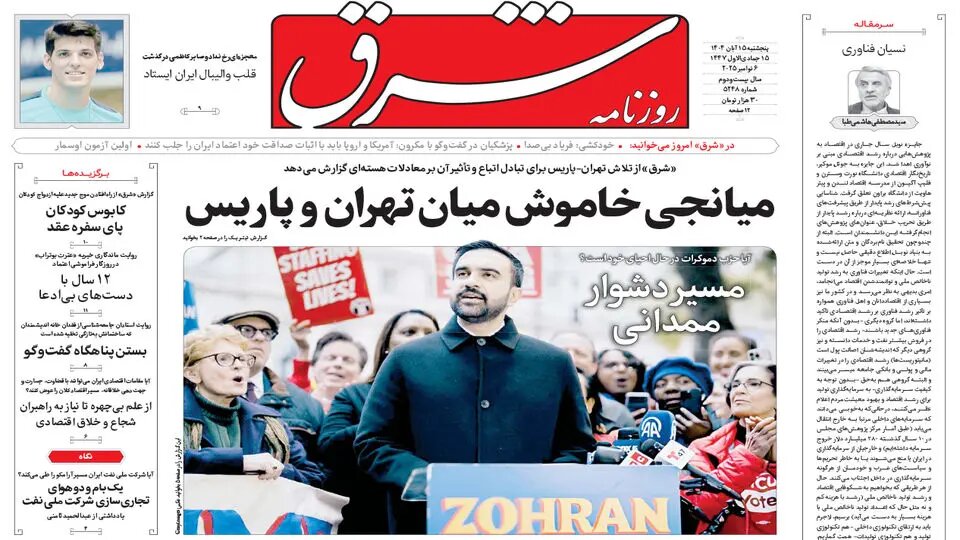
TEHRAN – Shahg examined the diplomatic freeze between Iran and Europe in an interview with senior European affairs analyst Ali Bigdeli.
“After the activation of the snapback mechanism, Iran-Europe relations entered a phase of stagnation and diplomatic freeze,” the newspaper wrote. However, the issue of prisoner exchanges between Iran and some European countries, particularly France, appears to be being pursued as a kind of soft diplomacy. Despite the widespread cooling in diplomatic relations, there are signs of efforts to restart indirect channels and foster humanitarian engagement. Although the French Foreign Minister has emphasized that the issue of the French people is unrelated to the nuclear negotiations, in fact such a gesture could indirectly soften the atmosphere between Iran and the European Union in the short term. Simultaneous and parallel releases of foreign nationals and increased cooperation with the IAEA could help prevent the issuance of new resolutions. However, these measures alone will not be sufficient to revive the negotiation process. To overcome the current impasse, Iran must pursue more active nuclear diplomacy, alongside confidence-building measures to prevent the crisis from escalating into a political and security impasse.
Jam-E-Jam: You closed the door to negotiation, so don’t complain.
Jam-e-Jam criticized the IAEA’s unprofessional conduct and breach of commitments. “From the moment the institution violated its professional principles, the Islamic Republic of Iran can no longer be expected to remain passive against breaches of its commitments and distorted reporting,” the newspaper quoted Esmail Kousari, a member of the parliamentary committee on national security and foreign policy, as saying. If Mr. Grossi and his colleagues are now complaining about testing restrictions, they must realize that this is the result of their own misconduct. They themselves blocked the road, attacked Iran in the middle of negotiations, and committed a serious crime. This occurred despite no changes in Iran’s pre-conflict approach to inspections and cooperation with Iranian authorities. Iran has repeatedly stated that it will not change its policies under pressure. As it stands now, unless the agency admits its mistakes and takes responsibility, it cannot be trusted. But instead of admitting their mistakes, they take pride in their reporting. The agency shared all findings regarding Iran’s nuclear facilities with the United States and the Zionists. Therefore, the core issue is not the technical inspections, but the hegemonic policy of global arrogance led by the United States and the Zionist regime, which uses the inspection agency as a means to put pressure on Iran.
Iran: Trust crisis between Tehran and the IAEA
In a recent analysis, Iranian newspapers highlighted the apparent contradictions in Rafael Grossi’s statements. However, Grossi acknowledged that there is currently no need to refer the Iran case to the UN Security Council. On the other hand, by using phrases such as cooperation must seriously improve, he perpetuates an atmosphere of pressure. None of his statements mentioned a more important issue: attacks by the United States and Israel on protected Iranian nuclear facilities. Based on the IAEA Charter, this incident should be immediately condemned. More importantly, despite the lack of a clear technical framework for inspecting damaged facilities, Grossi expects continued Iranian cooperation with Iranian institutions. This contradiction is at the heart of the trust crisis between the Iranian government and the IAEA. The IAEA calls for full cooperation without first restoring necessary security and technical protocols, while Iran insists on the need to establish a clear framework for the current situation. Until a new monitoring mechanism is determined in the wake of the attack, it is unreasonable to expect full cooperation from Iran.
Mr. Khorasan: Real deterrence comes from missiles, not signed agreements.
The Zionist regime suddenly launched attacks on Iran’s military infrastructure, targeting radar systems, air defense systems, and military headquarters. Israel imagined that Iran would be defeated within hours, but was unable to assess Iran’s missile capabilities. During the 12-day war, Iran’s firepower increased day by day, even though Israel claimed to have destroyed missile launch pads and bases. By the fourth day, Tel Aviv sought a mediator and proposed a ceasefire. Iran agreed to halt the operation in exchange for a final blow. In the early hours of June 24, Iran launched its largest missile barrage ever toward Israel. Since that day, Israel has not dared to repeat its invasion of Iranian territory. In the logic of the Zionist regime, deterrence is not built through diplomacy and agreements, but through real force and mutual response. In times of war, weak pacifism is more of a missed opportunity than a rational strategy. Paper agreements only matter if they are backed by missile capabilities and the will to respond, and this is exactly what must remain at the heart of Iran’s strategic calculations.