
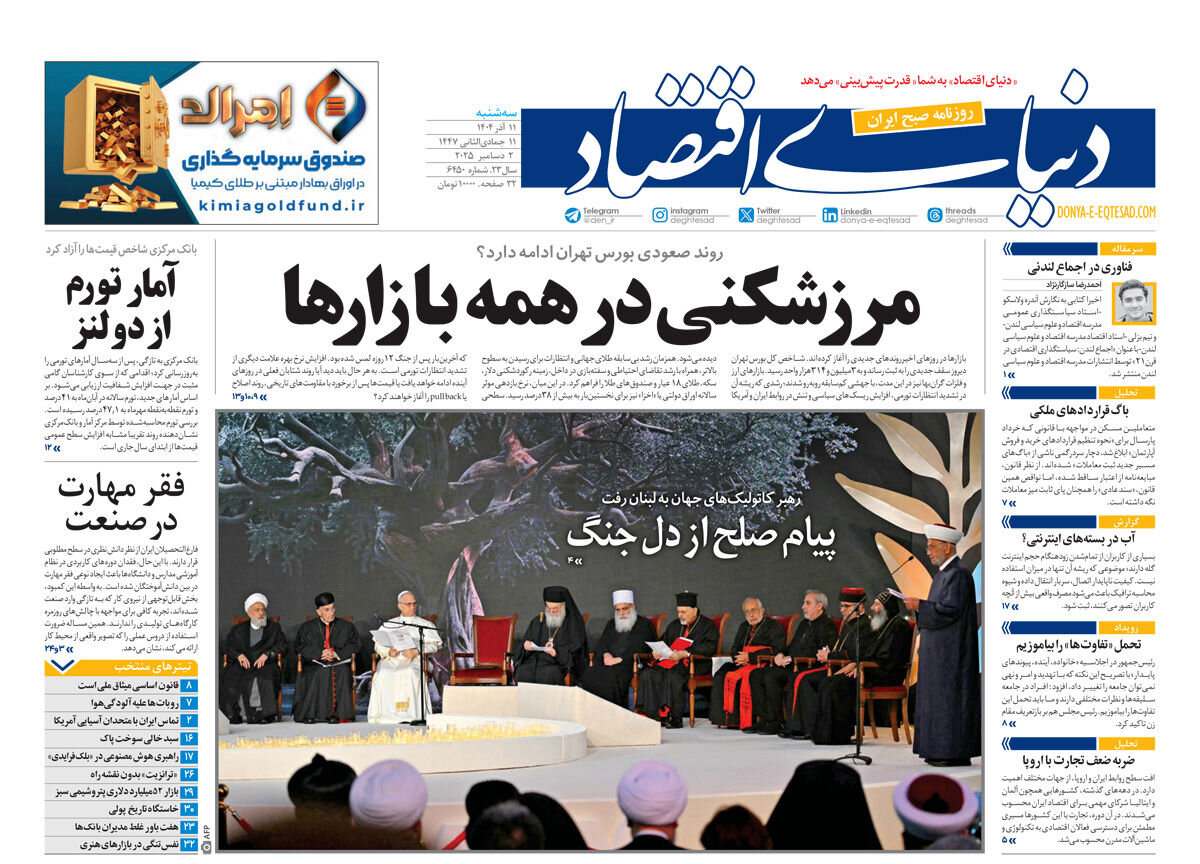
TEHRAN – Donya Ektesad investigated Iran’s simultaneous talks with Japan and South Korea.
The newspaper argued that these parallel talks could be seen as a revitalization of a quiet but purposeful wave of Asian diplomacy. Although this wave does not necessarily take the formal form of “mediation initiatives,” it follows a common logic. It is a genuine concern of Asian powers about the rising tensions in West Asia and its impact on energy security, market stability, and future geopolitical trends. These countries clearly understand that tensions in the Red Sea, the war in Gaza, developments in Lebanon, and instability in the energy market are all directly and indirectly linked to Iran’s nuclear file. From their perspective, a return to nuclear diplomacy is not only a political goal, but also an important means of containing regional tensions and establishing ceilings for crisis management. Therefore, the most important thing for Asian diplomats is to build a platform for dialogue and restore predictability to regional exchanges. Reinstating the JCPOA is just one possible way toward this broader goal.
Sob-e-No: The future of tactical cooperation between Tehran and Ankara
Sob-e-No analyzed recent changes in Tehran-Ankara relations after Foreign Minister Hakan Fidan’s visit to Tehran. The paper wrote that the visit should be seen as a symbol of reinforcing the complex but manageable pattern in Iran-Turkey relations. The two countries are now less of a direct threat to each other and more of a mechanism for managing each other’s environmental risks. The main purpose of this visit can be analyzed on several levels simultaneously. Strengthening cooperation in energy, trade and transport. Including the impact of developments in Syria and the Caucasus. Adjust positions on Gaza and Israel. and seeks to exploit structural gaps in the international system for mutual benefit. Mr. Fidan’s visit is considered an important point in the ongoing recalibration of Tehran-Ankara relations. Although this process still contains elements of conflict and historical mistrust, the need for tactical cooperation and crisis management in the region is at this moment more emphasized than ever. If this trajectory continues, we might expect the balance of power in West Asia to enter a new phase of equilibrium and calculability, at least along the Iran-Turkey axis.
Mr. Farhiktegan: The terms of the negotiation were not intended to be accepted.
In his commentary, Fahiktegan mentioned three conditions set by the United States as preconditions for rapprochement with Iran. The paper points out that the conditions announced by President Trump, such as a complete halt to uranium enrichment in Iran, a complete halt to support for resistance movements in the region, and a reduction in missile range, form a clear picture when considered together. Analyzes say the US is seeking Iranian obedience, not a deal. Accepting and implementing these preconditions would not guarantee that Israel would refrain from destroying the military and economic infrastructure of a country with missiles with a range of 500 kilometers. If the real goal was an agreement, the terms should have been framed in such a way that both sides could negotiate, rather than completely disarming one side and leaving the other in an advantageous position. Iran has no intention of giving in to such demands, and the United States is aware of this stance. Offering such demands not only opens the door to blame-shifting and excuses, but also allows the White House to enter into potential negotiations from a position of superiority and extract greater concessions. These terms and conditions are not intended to be accepted in any way. They are designed to be rejected. Iran’s refusal would give Washington an excuse to label Iran a “negotiator” and continue its path of maximum pressure.
Arman-e-Meri: Iran’s approach is diversifying economic channels
Arman-e-Meri stressed that in the current situation, Iran is not seeking to replace its global partners, but rather to diversify its economic channels. Although this strategy will not completely solve the sanctions challenge, it has the power to ease pressures and create new opportunities in markets, energy, transport and investment. The recent visit to Tehran by Turkish and Saudi delegations should be seen within the framework of reassessing Iran’s regional role, forming multi-layered cooperation, and leveraging geography as an economic tool in the era of sanctions. The declared goal of reaching $30 billion in annual trade between Iran and Turkey has been repeatedly mentioned by officials, but remains far from reality. Nevertheless, Tehran hopes that Hakan Fidan’s visit will help open new trade routes and address economic difficulties in bilateral relations. Some Iran experts believe the visit is part of President Pezeshikian’s “neighborhood diplomacy” strategy. But independent analysts warn that Iran-Turkey relations are entering a phase where the framework and boundaries of cooperation need to be redefined more precisely, and that mismanagement could lead to further misunderstandings.