
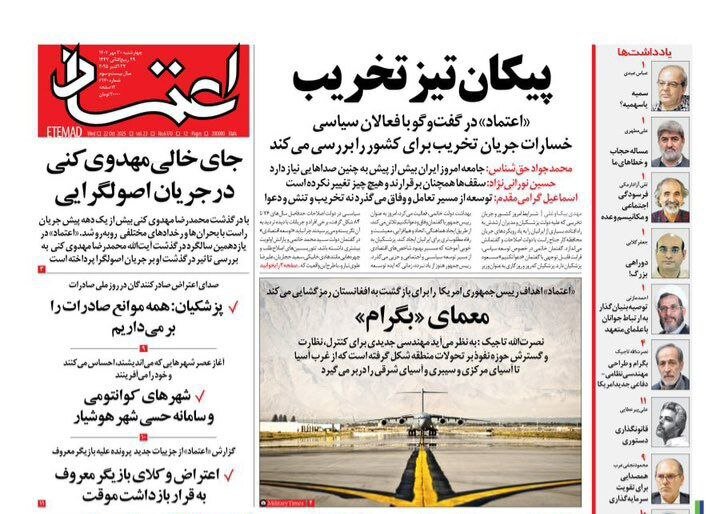
TEHRAN – In a recent article, Mr. Etemad mentioned the ongoing sanctions against Iran and the challenges to overcome them.
October 18, 2025 was the final day for the implementation of UN Security Council Resolution 2231. Although some countries supported calls for Iranian sanctions to be lifted, the reality suggests that Iran’s shadow continues to loom over the country. The reimposition of sanctions through the snapback mechanism initiated by the E3 was the final blow, underscoring that the issue remains unresolved. Iran currently faces three tiers of sanctions: UN sanctions reinstated via the snapback mechanism, unilateral sanctions from the US, and additional restrictions from the European Union and UK. Sanctions have become a powerful tool for blocking a country’s path to development and isolating it from the international community. Facing these pressures requires more than resilience. This requires strong crisis management and a stable economic foundation. Only through sound governance and strategic planning can Iran mitigate the impact of sanctions, protect its currency, and prevent economic collapse.
Ham Mihan: Strategic impact of China and Russia’s support for Iran
In an interview with international affairs analyst Hassan Beheshtipur, Ham Mihan explored the role of Chinese and Russian support in countering sanctions against Iran. Beheshtipur said the international agreement on reinstating sanctions was one of the weakest links the international community had seen in recent years. Russia has made its position clear. Not only does it reject new resolutions, it also considers them to be overdue. Therefore, Moscow does not consider itself obliged to enforce them. China has also expressed its opposition, but has not yet officially declared non-compliance. Nevertheless, there are indications that the Chinese government is unlikely to actually implement sanctions. According to Beheshtipur, Iran can partially control the situation by engaging diplomatically with countries to prevent enforcement. In this regard, close attention must be paid to relations with neighboring countries such as Turkey and the UAE, which are cooperating in the implementation of the resolution. The analyst ultimately stressed that domestic economic reform is essential. Strengthening Iran’s domestic economic structure is an important step toward reducing the impact of external sanctions and increasing the country’s resilience.
Iran: Active economic diplomacy of the 14th government
Iran emphasized the strategic direction of the 14th Iranian government towards active economic diplomacy both regionally and globally. The paper argues that this approach is becoming increasingly prominent in the development of regional economic cooperation. One notable example is Iran’s engagement with Turkey, where trade and economic policy decisions are wisely aligned with neighboring dynamics. This synergy has produced tangible results not only in export and import figures, but also in Iran’s broader economic bargaining power and control over foreign exchange resources. This experience highlights the important insight that while distant markets may be attractive, they cannot substitute for the potential of neighboring countries. Iran’s recent outreach to African countries further illustrates this shift. After the professional trade exhibition, Iran’s trade volume with the continent more than doubled. This surge shows that Africa has the potential to become a major economic partner if Iran pursues a long-term, strategic economic diplomacy and trade plan.
Mr. Khorasan: Poland is aligned with Western pressure
Khorasan verified recent statements by the Polish foreign minister at a meeting in the London parliament, claiming that the drones used by Russia in attacks on Polish territory were manufactured in Iran. Polish officials say the claims are not verified information and appear to reflect political pressure within NATO and the European Union. In recent years, Warsaw has positioned itself as the “front line of Western security,” often amplifying the perceived threat from Russia and Iran. Analysts have suggested that the drone allegations are part of a broader pattern of organized Iranophobia used by certain Western actors as a tool for political influence. Ultimately, Khorasan argues that Poland’s decision to align itself with anti-Iranian rhetoric may bring short-term diplomatic goodwill among Western allies, but risks long-term damage to its international credibility and Poland’s historically friendly relationship with Iran.