
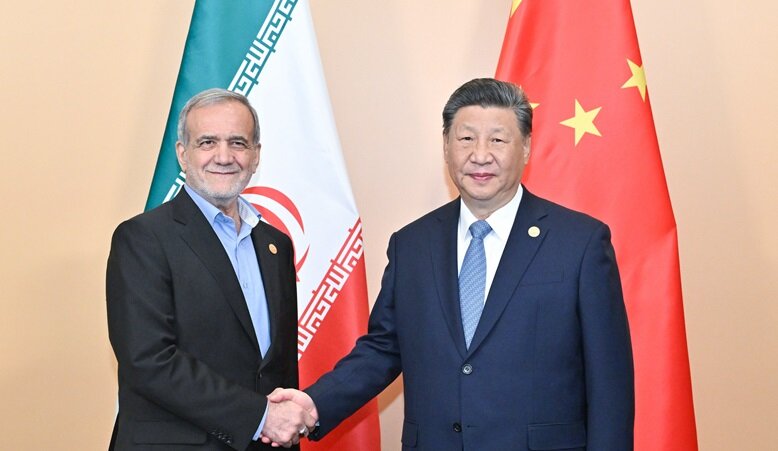
Tehran – China is planning to host two major international events in the near future. It commemorates the Shanghai Cooperation Organization (SCO) Summit and the 80th anniversary of World War II.
These events come when the global order (the very equipment that once relied on structures, norms, and even the previous systems) enters a deep phase of transformation driven by sharp competition between great powers. Various parts of the world, especially Western Asia, experience the often bloody consequences of these complex changes.
The Islamic Republic of Iran is determined to participate at the highest level at these important gatherings, and emphasizes its determination to contribute meaningfully to the formation of a new international order. From this perspective, given the exceptional global situation, the visit of Dr. Masuud Pezeshkian, president of Iran’s Islamic Republic, has considerable weight in terms of international and regional development, and in the context of bilateral relations between Iran and China.
During this visit, Iran’s message, location and expectations regarding global order and regional dynamics will be clearly communicated, and it is expected that a new chapter in bilateral relations with China will be opened. Meetings with Chinese officials are expected to set the foundations to guide an already strong partnership between Tehran and Beijing in a way that reflects the reality and orders of today’s world. The success of this trip, especially bilateral success, depends on Iran’s ability to convincingly convey four important messages to China’s leadership.
1. The political system of Iran’s Islamic Republic is rooted in general legitimacy and supported by both endogenous, hard and soft power, and, even if coordinated with a targeted US strike, is too resilient to shake up Israeli hybrid terrorists and aviation services. The source of Iran’s stability is internal and based on its people and its governance system based on religious democracy.
2. Iran believes that the era of bipolar conflict and the paradigm of globalization, once led by the US, has ended. A new era has begun. It is defined by a fierce strategic competition between key forces. The United States was once a self-proclaimed leader and champion of globalization, and has abandoned the very rules and norms that have once promoted. Today, along with some of its allies, Washington pursues only the preservation of its hegemony. In contrast, the ever-growing nations advocate for a practical transition to a multipolar world that will increase the global South’s status. In line with the fundamental principles of the Islamic Revolution and the will of its people, the Islamic Republic of Iran is ready to play an active role in advancing such a system for the benefit of this bloc.
3. With our support, West Asia has become one of the central areas of conflict between the US and the multipole bloc. Israel’s attack on Iran must be understood in this context. Responding to repeated Israeli violations, including Gaza genocide and atrocities, repeated strikes, continued attacks on Lebanon, and systematic infringement of Syrian territorial integrity through territorial claims against other regional states, cannot be limited to regional frameworks. These actions constitute a global issue. It is therefore mandatory for major powers to defend multipolar world orders to recognize this reality and fulfill their responsibility accordingly.
4. The most serious threat to Iran’s national security and stability lies in its economic vulnerability. This has encouraged the United States and Israel to try new military and security disruptions. The vulnerability has its roots in Iran’s decades of exclusion from the global development corridor and progressive alienation from the global value chain. But today, Iran is working to readjust its development outlook and is trying to adapt to the still unknown requirements of the global order. The strategy depends on exploiting domestic economic strengths while pursuing a winning partnership with the Global South country.
Despite the uncertainty and instability promoted in West Asia by US policies implemented through Israel, and despite Iran’s decision to resist them, Tearan is working to accelerate its development and modernization. To this end, Iran prioritizes the rapid planning and implementation of multilateral cooperation through frameworks such as BRICS and the Shanghai Cooperation Agency, while simultaneously expanding bilateral relations with friendly and like-minded states.
In this context, important questions arise. What role does China envision in this new path chosen by Iran as one of the major forces of the global South? In what terms does Beijing engage in a serious and comprehensive partnership with Tehran? Does it fully attract their shared capabilities and contribute to the realization of a multipolar world order and empowering the global South?