
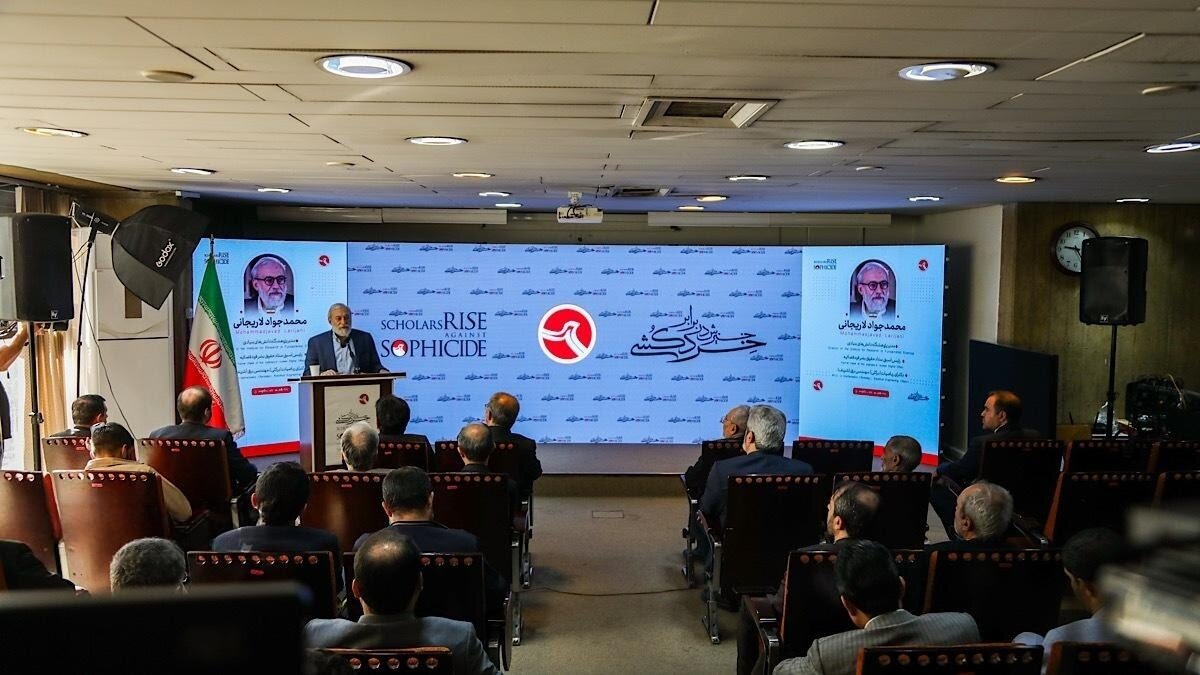
TEHRAN — Leading intellectuals, scientists, philosophers and religious figures from around the world gathered in Tehran on Thursday for an international conference titled “Scholars Rise Against Sophicide” to denounce the deliberate targeting of scientists and thinkers and defend the sanctity of knowledge and scholarship.
The event was hosted by the Institute for Basic Sciences (IPM).
In his keynote address, Dr. Mohammad Javad Larijani, Director of IPM and Chairman of the Conference, emphasized the historical and civilizational importance of protecting intellectuals and scientists from what he described as a “global war for wisdom.”
The concept of Sophicide, literally the “murder of wisdom”, was elaborated by Dr. Yacoub Saraf of Lebanon, who traces its origins to ancient civilizations.
“I personally witnessed the assassination of a key figure in Lebanon,” Saraf said. “This marked the beginning of a widespread campaign of sophicide, a phenomenon seen in ancient Mesopotamia and Greece, and even during the world wars, when scholars were targeted for their intellectual abilities.”
He explained that the term is derived from the suffix – sophia (wisdom) and the suffix -side (to kill), and noted the similarities with genocide, explaining that “repressive powers have long used sophicide as a pretext to eliminate political and strategic adversaries and achieve military objectives.”
He warned that Iran was a major target, with at least 16 scientists assassinated in recent years in an attempt to “thwart Iran’s deterrence and technological development.”
Dr. David Miller, a British academic and former Princeton University professor, spoke of the systematic crackdown on anti-Zionist scholars in Western universities.
“I was fired from Princeton for criticizing the Zionists and supporting Palestine,” he said. “Direct assaults against intellectuals have been witnessed in the UK, while in Gaza Zionists have targeted doctors, journalists and civil servants.”
Mr. Miller accused Zionist organizations of controlling intellectual and media spaces through censorship, firing, and intimidation.
“The British public knows what is happening in Gaza and is watching genocide unfold before their eyes.”
He said the “Greater Israel” project has now entered a new phase in its quest to dominate West Asia, adding that Israel, which has lost its moral legitimacy, is now “eradicating the region’s intellectual elite.”
Miller warned of the possibility of new attacks against Iranian scientists, calling these actions part of a “global sophicide project.”
From China, Dr. Jin Liangxiang, senior fellow at the Center for West Asia and Africa Studies, discussed Western efforts to monopolize science and suppress technological progress in the Global South.
“Western countries are trying to keep knowledge exclusive,” he says. “The only path to progress in the Global South is to break these monopolies and foster open access to knowledge.”
He praised Iran’s scientific independence and resilience, noting that the country’s nuclear and technological advances “challenge Western perceptions of the global intellectual class.”
Abbas Kaabi, a member of the Iranian Council of Experts, condemned the assassinations of Iranian nuclear scientists and intellectuals as “a crime against humanity and an attack on Islamic civilization.”
Recalling historical examples from the destruction of the Library of Alexandria to modern-day assassinations, he said such acts reflected continued attempts to “undermine Islamic thought and rational capacity.”
“Crimes against scholars are not just crimes against humanity, but betrayals of the divine order,” he said, emphasizing the Islamic view of knowledge as sacred.
The cleric added that from the 20th century to the present, the killings of scientists, doctors and researchers have sought to hinder the technological independence of countries and the progress of civilization.
Mr. Kaabi elaborated on Iran’s continued efforts to protect scientists through cybersecurity, data protection, and promotion of scientific culture. He called for international recognition of sophicide as a clear crime under international law, and concluded with a prayer for the martyred scientists, calling their knowledge “the heritage of human civilization.”
Australian political economist Professor Tim Anderson has warned that while the US is no longer the leader in technology, it continues to dominate finance and propaganda.
He criticized Washington-based institutions such as the Institute for Science and International Security (ISIS) for “celebrating the murder of 20 Iranian scientists” during the June attack on Israel, calling it a “grotesque moral reversal.”
“The so-called scientific community in Washington is now supporting the murder of knowledge itself,” he said of a visit to the home of murdered physicist Ahmad Reza Zolfagali Daryani in Tehran.
“Such barbarism is hidden under the false narrative of ‘weapons of mass destruction’ to justify the invasion of Iran.”
Anderson called for global cooperation between independent media and nations to “break the U.S. propaganda monopoly” and “promote a global awakening from Tehran.”
At the conclusion of a series of international speeches, Russian professor Andrei Brozkov pointed out the similarities between attacks on Iranian and Russian scientists.
“The purpose of these acts of terrorism is to halt our progress and to frighten our scientists.” “But they will not succeed. In both Iran and Russia, patriotic young people are ready to replace them.”
He expressed his condolences to the families of the assassinated scientists and expressed confidence that “our country will overcome and build a better, more humane world.”
The event concluded with remarks from US Green Party politician and activist Dr. Ajamu Baraka, followed by the reading of the final resolution, reaffirming the participants’ collective determination to protect scientific freedom, resist knowledge monopolies, and expose perpetrators of “sophicide” around the world.