
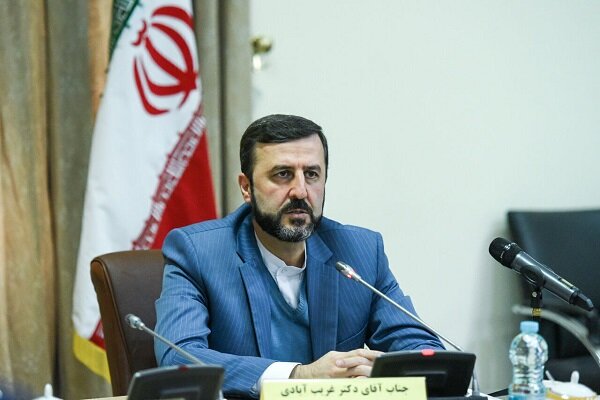
In an interview, Iran’s Deputy Minister of Legal Affairs and International Affairs, Kazem Galibabadi, mentioned the recent UN Security Council vote and said that the process was carried out under resolution 2231 and the JCPOA, but lacked the necessary consensus. Four countries were supported in the vote, two abstained and nine voted against it.
Gallibabadi stressed that the three European countries and the European Union never respected their duties under the JCPOA. Since the US withdrawal from trading in 2018, they have not been able to implement any of their commitments.
He said these countries now claim that Iran is not following its commitment, and they used this pretext to induce an illegal snapback mechanism.
Emphasizing Iran’s diplomatic efforts to prevent this action, Galibabadi said that Tehran has always pursued diplomacy with dignity and authority, and has always acted rationally and responsibly.
He mentioned the recent understanding between Iran and the IAEA in Cairo and the rational proposals presented by the Iranian foreign minister to three European countries that even the French president said were reasonable. The proposal, he said, may have solved the problems surrounding the snapback mechanism, but Europeans rejected it with unfounded excuses.
A senior Iranian diplomat dismissed the allegation that the Iranian foreign minister lacked full authority, emphasizing that the minister would speak with full support for the establishment.
He emphasized that European movements not only undermine diplomacy, but also demonstrate an alliance with unilateral American policies.
Iran condemned the illegal act and said it would call on the international community to reject and deny its legitimacy.
United Nations sanctions are serious, but most are psychological.
In a recent move by three European countries to complete the snapback process and restore UN sanctions that were cancelled, Gallibabadi said sanctions will be reactivated within a week unless new diplomatic developments occur in the next six to seven days.
He pointed out that UN sanctions should not be ignored, but that they cannot rival the one-sided sanctions that Iran has endured throughout its history. Iran is already facing the harshest and most unjust, one-sided sanctions.
According to Galibabadi, UN sanctions do not add any significant additions to Iran’s existing sanctions regime. However, he warned that he would fall into a trap of psychological warfare designed by the Western States and the United States.
Gharibabadi also urged economic experts to provide accurate analysis to make these aspects of sanctions clear to the public, thereby reducing their psychological impact.
Return of UN sanctions will suspend the Iran-Iaa-Cairo Agreement
Gharibabadi warned that if UN Security Council sanctions, which were fired by September 27, 2025, are revived, the agreement signed between Iran and Cairo’s IAEA will be suspended completely.
He stressed that there is still a week left to prevent the sanctions from returning, but halting agreements with the institution would be a logical and inevitable step if no special diplomatic efforts were made and sanctions were reimposed.
He reminded me that after signing the Cairo Accord, the Iranian Foreign Minister clearly stated that hostile actions against Iran, including the return of UN sanctions and the snapback mechanism, would be considered grounds for ending the agreement.
Gharibabadi concluded that the next step in response for Iran is being studied at the level of senior policy making and that decisions will be announced at the appropriate time. He emphasized that Iran acts completely vigilant to hostile behavior and adopts a proportional response.
The statement comes as the UN Security Council prepares to vote on whether to reimpose sanctions against Iran, which were lifted under the 2015 nuclear deal. The UK, France and Germany are pushing for the so-called snapback mechanism to be activated, accusing Iran of not respecting its commitment. Under the JCPOA’s dispute resolution process, parties claiming non-compliance by Iran can call for the restoration of six previous Security Council resolutions adopted between 2006 and 2010. This is because Iran refused to compensate for the US withdrawal in 2018, claiming that Europeans could not evoke mechanisms.
MNA/6594834