
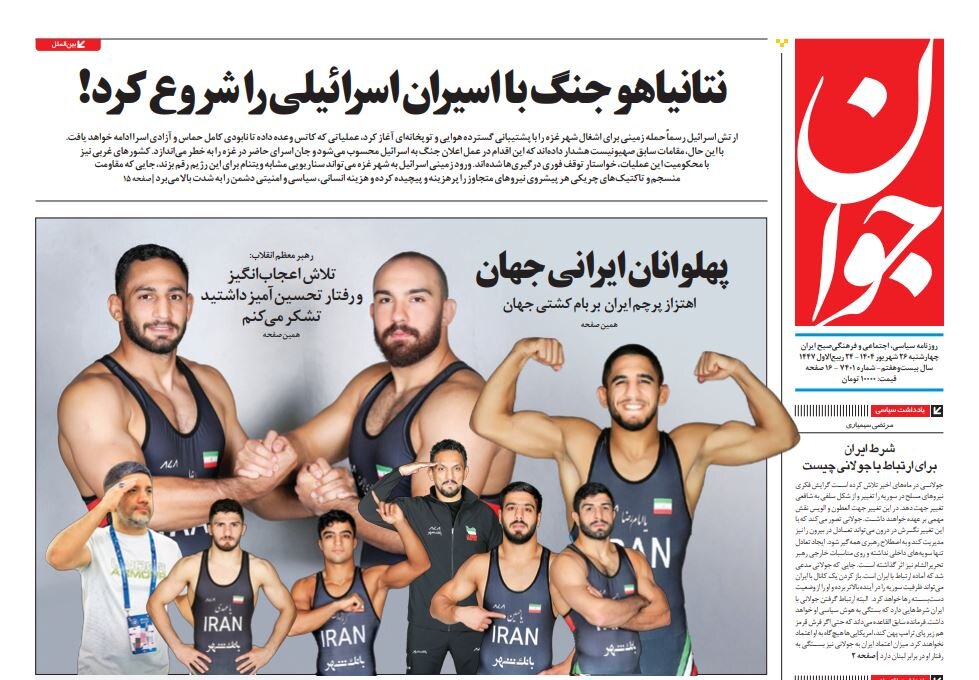
Tehran – In a memo, Javan discussed his visit to Riyadh on the visit of Dr. Ali Larijani, secretary of the Supreme National Security Council, writing: The visit is occurring only hours after the summit of Islamic countries in Doha.
While the Zionist regime as the main enemy of the Islamic world continues to act positively with open support from the West, the silence and passivity of some Islamic states has become increasingly challenging for the unity and political power of the region. In these circumstances, Larijani’s visit to Saudi Arabia should be valued as more than a normal diplomatic trip. It could be a sign of the efforts of the Islamic Republic to bring about real interaction at the regional level beyond diplomacy. Furthermore, it can be assessed not only in terms of strengthening bilateral cooperation, particularly in the economic sector, but also from a strategic perspective.
Sobh-e-no: against common enemies
In his analysis, Sobh-e-No discussed the emergency meeting of Islamic leaders in Doha on September 15th, writing: The conference was a direct response to the Israeli regime’s airstrikes regarding a conference of Palestinian resistance leaders in Qatar. The attacks that the Iranian president called an “attack on diplomacy” exposed the issues that run deep within the international system and emphasized the need to create a common Arab and Islamic unanimity. In his speech, Pezeshkian raised several important points: a strong condemnation of the attack on Doha, a critique of the Israeli regime’s immunity in the international field, and a structured account of Israel’s crimes as part of the doctrine of ethnic cleansing and expanding. This tone indicated that Iran was trying to use historic opportunities to move the conference agenda from the level of symbolic statements to the real world of real decision-making. The emergency summit of Islamic leaders in Doha marked a turning point in the Arab-Islamic conflict with Israel, but the success of this summit will depend on whether the Arab and Islamic countries are willing to pay the price of a critical decision.
Vatan-e-Emrooz: Convergence of Eurasian power
Vatan-e-Emrooz commented on the convergence of power in regions, where China, Russia, North Korea and Iran have shown greater political and military convergence in recent years. From co-operation to economic agreements, the main goal is to reduce dependence on the West and weaken the US position. However, there is also a conflict of interest in this block. Russia and China secretly compete for influence in Central Asia, while Iran and Russia also have conflicting interests in the energy market. This convergence is therefore considered not a long-term strategic alliance but a kind of tactical cooperation with the Western order. The Zionist regime’s attack on Qatar will likely lead regional Arab countries to rethink their policies. They are looking at this issue calmly and trying to reduce the escalation of tensions between Zionists and the US, but they must realize they are alone and think about their new security partners for themselves. This issue could bring them closer to the east and at least think about ways to ensure security through independent and local cooperation.
Donya-eqtesad: Tehran-Riyadh’s Bond Missing Link
Donya Ektesad analyzes the awakened relationship between Iran and Saudi Arabia, writing: Characteristics and requirements of neighbourhood policy. To avoid being caught up in a tense atmosphere, it is necessary for both countries to first reach a common understanding of trust-building measures and then take the first steps towards economic cooperation. Tehran and Riyadh must use Israeli tension building in the region as an opportunity to attract their views closer. In this context, involvement in Iran’s comprehensive regional approach is an important principle. Iran needs to rethink its regional approach and move towards a participatory format. Such a shift is a need and a new capacity in Iran’s Middle East approach.