
TEHRAN – In recent years, Iran has entered the global arms market for the first time in its history and started competing with world powers.
The company’s drones are a perfect example. Analysts believe that countries are now seeking to purchase Iranian models such as the Shahed series, or are attempting to replicate their designs. Similarly, Iranian missiles, which do not yet appear to be on the public market, attracted international attention and awe when they successfully penetrated multiple layers of American, European, Arab, and Israeli air defenses and hit targets in occupied territory in June. But Iran’s progress is not limited to the skies. The country has also made great strides in maritime, a fact that was widely highlighted at the second Pakistan International Maritime Expo (PIMEC) held in Karachi this week.
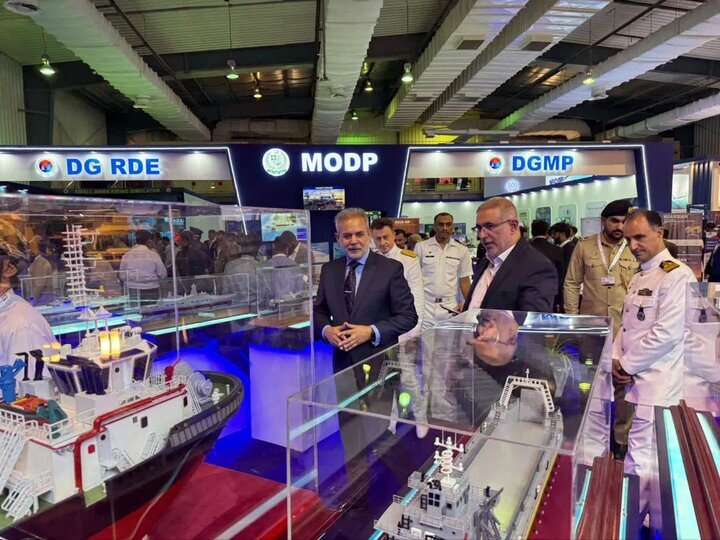
The four-day event had participants from 44 countries. A joint team of the Navy (part of Artesh) and the Ministry of Defense was deployed to Iran and assigned a large pavilion led by a representative of the Iranian Navy Commander.
“Iran’s pavilion was in some ways better than the host country’s pavilion. We had a wide range of maritime and naval equipment, all of which was made by Iranian youth,” said Captain Dariosh Eskandari, who was appointed head of the delegation directly by Rear Admiral Shahram Irani.
In the end, Iran won the Best Foreign Exhibitor Award. Captain Eskandari told the Tehran Times that the participating countries find it hard to believe that Iran manufactures its state-of-the-art ships and submarines entirely on its own, a level of self-sufficiency achieved as a result of decades of Western sanctions.
“In the maritime industry, it is extremely rare for a country to build ships without cooperation with other countries or relying solely on its own equipment. More than 90% of what is used in our boats, merchant ships, warships and submarines are Iranian-made, whereas in other countries this figure is usually only 30%,” he explained, stressing that despite this self-sufficiency, Iranian technology remains among the best in the world.
The most high-profile assets of the Iranian Navy were the Sina-class, a formidable missile warship capable of decisive strikes, and the versatile Moji-class, known as a master of agile coastal patrol.
The Iranian delegation held an important meeting on the sidelines of the exhibition to discuss cooperation and trade. Discussions with Pakistani officials were particularly fruitful.
“We discussed the possibility of launching a joint shipbuilding line in both Iran and Pakistan. We also held productive meetings with other countries, many of whom wanted to know more about our maritime industry and its potential benefits,” Captain Eskandari explained. He added that, overall, Iran’s presence in Karachi is expected to have significant positive consequences for the economic, diplomatic and military partnership.