
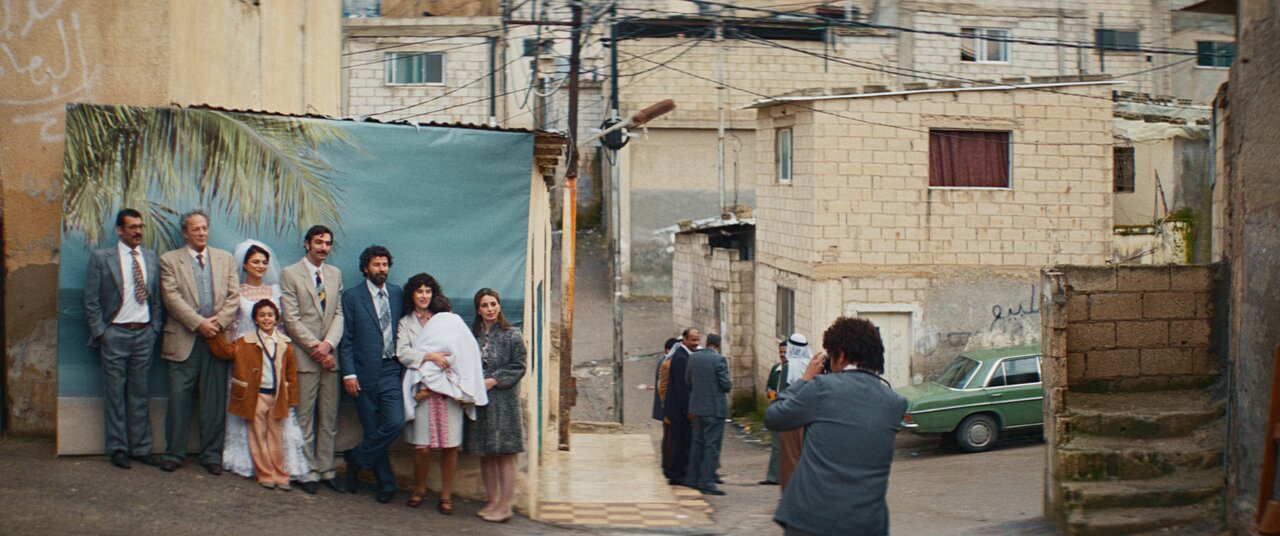
TEHRAN – “All That’s Left of You” is the latest work from Palestinian-American director, screenwriter and actor Sherian Davis. The film, which will be released in January 2025, takes viewers on a journey through history from the beginning of the Nakba War (1948) to present-day Palestine, following the story of one family to highlight the tragic fate of a people the Zionist army tried to erase from history.
All That’s Left of You, featuring Saleh Bakri, paints a multigenerational portrait of a Palestinian family shaped by exile, deprivation, and the lasting effects of these events, from the beginning of the Israeli occupation to the decades that followed.
The film begins with a bullet fired at a Palestinian teenager during a 1988 protest. This incident forces her mother, Hanan (played by Davis), to talk about her family’s past. How my grandfather was forced from his land and home, and how his displacement and life in a refugee camp cast a long shadow on subsequent generations.
Among the major recognitions, the film premiered at the 2025 Sundance Film Festival and was selected as Jordan’s official entry for Best International Feature Film at the 98th Academy Awards.
The Tehran Times conducted an exclusive interview with Davis, which is published below.
Instead of a linear narrative, a loop structure was used to depict the history of the 75-year occupation. What is the reason for this choice?
I wanted to start the film with an iconic moment of Palestinian teenagers participating in a protest, a familiar image you often see on the news. We’ve been watching Palestinian protests for decades, but I’m not sure that much of the world knows what we’re fighting for and why. I wanted to start the film with this symbolic image and tell people how that teenager ended up participating in the protests and how his family ended up in a refugee camp. Few people know this story because the Palestinian story is denied, erased, and censored. That’s how I got into this movie. We start in media res at the climax of the action, and then we move back in time to show how this particular family, and indeed all Palestinians, became refugees in one way or another.
I also wanted to use the bullet conceit as a way to focus the story. The film begins with a moment of violence at a protest, and the mother of the main teenager begins to tell the story of how her son ended up participating in this protest. But to tell his story, she has to tell his grandfather’s story. In other words, in order for people to understand her son’s rebellion, she must tell her family’s story, especially how her grandfather was stripped of his land. By focusing the film on the story of the son and his violent encounter, it was easier to choose which moments to highlight in the film. Because everything we show backwards is to explain who the teenager is and why he’s at this protest.
What challenges did the situation in Palestine after October 7th pose for filming?It appears that production continued in Cyprus, Jordan, and Greece as well.
We prepared for nearly five months in Palestine until we had to evacuate in October 2023. There were only two weeks left until the shoot. All work is complete. The worst part of the escape was leaving behind the Palestinian crew. They were very excited to work on a historical Palestinian film. We didn’t know what would happen to them or if they would be able to come with us.
After we fled, we were in a financial and logistical crisis. I didn’t know where or how to go or if I would be able to continue making films. We had to start all over again and raise even more money. I had to stop and start many times because I ran out of money or didn’t know where to go next to continue shooting. I was forced to look for Palestine everywhere but Palestine. In a way, this film was living what most Palestinians are living: war and exile.
We ended up shooting most of the film in two Palestinian refugee camps in northern Jordan. This was amazing. Because it involved the local refugee community in making the film and essentially telling their own story. The remainder of the film was shot in Cyprus and Greece. It wasn’t easy to make those places look like Palestine. The art department then had an even bigger task to do.
The most difficult thing for me was realizing that we were making a movie based on what was actually happening. Life and art seemed to blend together in this very surreal way, which resulted in an intense and emotionally draining experience. At the same time, this movie became a container for our sadness, anger, compassion, and love. We put our all into it because we knew what we were creating was going to be more important and meaningful. Looking back, it was a gift to be able to create during such a time of destruction. It definitely made us feel less helpless.
When you were eight years old, you had a traumatic encounter with an Israeli soldier. To what extent and how did this painful experience inspire ‘All That’s Left of You’?
That was my first memory of traveling to Palestine. My family was detained for 12 hours at the Jordan-West Bank border. The soldiers interrogated my parents multiple times and searched the contents of my suitcase. They ordered us all to undergo strip searches, including my little sisters, ages 3 and 1. When my father confronted them, they began shouting at him. I was sure they would kill him. For the first time in my life, I felt what it meant to be Palestinian. Such a painful experience had an indelible impact on me and made me want to tell our story. Especially since I grew up primarily in the U.S. in the diaspora and was keenly aware of how dangerously Palestinians have been and continue to be misrepresented in mainstream media, film, and television.
This particular memory inspired the humiliation scene that is the midpoint of “All That’s Left of You.” I wanted to explore how political events that we have been reading about for decades, in this case dispossession and violent military occupation, affect people psychologically and emotionally, how it shapes people and families, and even changes relationships within families.
Can you tell us how Javier Bardem and Mark Ruffalo came on board as executive producers? How did they first communicate their intentions to you and what did you think of their support?
When we went to Sundance in January, it was at the Eccles Theater during the hottest part of the festival: Saturday night. The premiere was packed and emotional. There were two standing ovations, the second lasting about 12 minutes, about twice as long as a typical standing ovation at Sundance. And our reviews were great too. Despite all this, the film still did not receive the attention it deserved in the press and within the industry. This was very disappointing. It feels like you worked so hard to make such an important movie at the perfect time and then it gets ignored simply because of its identity, subject matter, and lack of star power. That’s when we realized we had to find a way to change that. So we started thinking about who could help us raise the profile of this film. Javier and Mark were the first two on my list. I have long admired them not only for their extraordinary talent, but also for the fact that they have always represented humanity. I feel really lucky to have their enthusiastic support.
How do you think the censorship of All That’s Left of You on major platforms has affected the film’s visibility and ability to reach audiences around the world?
A larger pattern of censoring or ignoring Palestinian voices and stories is at work in the United States and around the world. It completely hampered my film prospects. Not just streamers. Additionally, sales companies in North America and other English-speaking countries are the most difficult to sell to. Several distributors openly admitted that they were afraid of the subject matter.
There is a pervasive idea that it is somehow acceptable to disrespect not just Palestinian lives, but everything about us: our stories, our perspectives, our art. And, of course, this is part of a deeper problem. Look at what’s happening in Gaza. If this were happening anywhere else in the world, there would be obvious and universal outrage. I’ve even been told point-blank that if my film had been made in any other part of the world, it would have gotten major mainstream distribution in the United States. It’s not just bigotry, it’s racism and censorship. And what should we call it? We have to hold the industry accountable.
That said, I do my best to avoid racism, and I have a lot of support. We have excellent distributors in Europe, Latin America, Indonesia and other regions. I’m also building a partnership with a boutique distributor in the US, where I’m hands-on with releases. I am determined to ensure that “All That’s Left of You” reaches a worldwide audience. This movie is worth seeing, and so are the people whose stories it represents. My goal is to get this movie seen by as many people as possible.
As a Palestinian filmmaker, if you were to make a film about the close ties and empathy between Iranians and Palestinians, which specific aspects or events would you focus on?
I’m married to an Iranian-American, so I’m very aware of that close bond and empathy, and I’m very grateful for it. To be honest, I would probably make a movie about marriage. The past few years have been extremely difficult for Palestinians and Iranians. It’s interesting to see how political turmoil affects relationships and brings people closer together while creating challenges. Perhaps I would like to explore that and dig into my own marriage for inspiration. In fact, I might as well!
Photo: A scene from All That’s Left of You by Palestinian-American director Sherian Davis
AH/SAB