
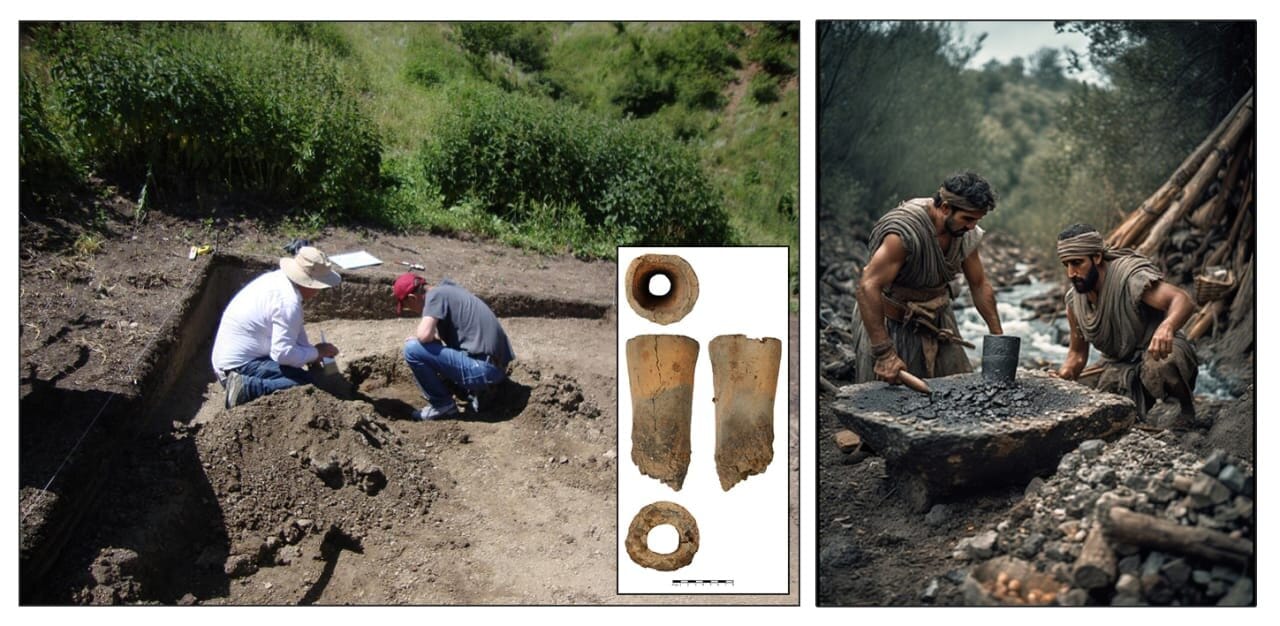
Tehran – The joint Iranian-China archaeological team has revealed an important early Islamic era settlement and a sponge iron smelting workshop at Kambazi Sarasite within the cultural landscape of Mazuure in northern Iran.
The discovery directly supports the urgent effort in Riyadh to strengthen the nomination of Mazuure’s UNESCO World Heritage Sites after the 2023 postponement. The postponement mainly stemmed from ambiguity regarding the site’s outstanding universal value (OUV), particularly the inadequate documentation of its unique metallurgical heritage.
The collaboration involves Chinese archaeologists from the Academy of Archaeology, affiliated with the Institute of Cultural Heritage (Ricci), and forms a relationship based on the historic Silk Road link between the Hailica region (Giran &…) and East Asia.
During two seasons of fieldwork, the team revisited a metallurgical site originally documented by Fereidoun Biglari of the National Museum of Iran. Six sites were selected for geophysical surveys by experts at Shahid Beheshti University. These reveal substantial underground evidence of iron production and established that the Mazuure landscape evolved from the Parthian and early Islamic periods to the Kajar period, shaped by complex industrial activities that formed a network of satellite sites around historic cities. In addition to the aforementioned iron smelting sites, a large number of workshops have recently been documented at Gilevand Rud. This discovery calls for a revision of the proposed core zone for World Heritage by Iranian cultural heritage authorities to further strengthen the industrial scale of the Mazuure metallurgical landscape and incorporate this important site complex.
The second season focused on Kambazi Sarah, confirming its importance as an early Islamic industrial settlement during the Seljuk period. The excavation demonstrated continuous technological evolution within the regional smelting network centered around Kohneh Masouleh. The critical trench revealed evidence for all four iron smelting stages, along with silica glass and copper residues from the central waste depot. Substantial iron slag volume and ceramic equipment have demonstrated workshop operations for centuries. These findings reveal the evolutionary process of multi-stage furnaces within the cultural landscape of Mazuure, with the early forms of Kambazi Sara preceding the more advanced designs adopted later in Kone Mazuure and historic town centres. Importantly, we address the original flaws of the nomination by demonstrating the technical significance of the mazuure through a multi-stage sponge iron furnace, a central component of the modified OUV argument.
The appointment of Mazuure’s cultural landscape was postponed at the 2023 session of the UNESCO World Heritage Committee in Riyadh, Saudi Arabia. This decision was primarily due to ambiguity regarding the site’s unresolved universal value (OUV). Although there was significant support among committee members for the “referral” decision, there was no evidence in the first and main files, making procedural changes to the decision difficult.
The initial preparation of the file coincided with changes in the Iranian government and leaders within the Ministry of Cultural Heritage. As a result, the relevant documents were inconsistent, lacking essential documents, and presented multiple, sometimes contradictory stories. Most importantly, the technical and historical significance of Masouleh’s multi-stage sponge iron smelting furnaces (its potential OUV core components) was underestimated.
In response, Iran’s cultural heritage deputies formed a dedicated revision team. In keeping with ICOMOS’ recommendations for international cooperation, Iran has secured a partnership between the Iranian National Museum and the Archaeological Research Centre and the Chinese Academy of Archaeological Research and the Archaeological Research Academy, which is leading domestic efforts. The revised strategy utilizes Khanbaji Sara’s findings and ongoing interdisciplinary research to clarify the technical significance of the region and how the industry’s heritage has shaped the cultural landscape of Mazuure.
With continued research and international collaboration, the revised file aims to succeed in the inscription at future World Heritage Committee sessions.
morning