
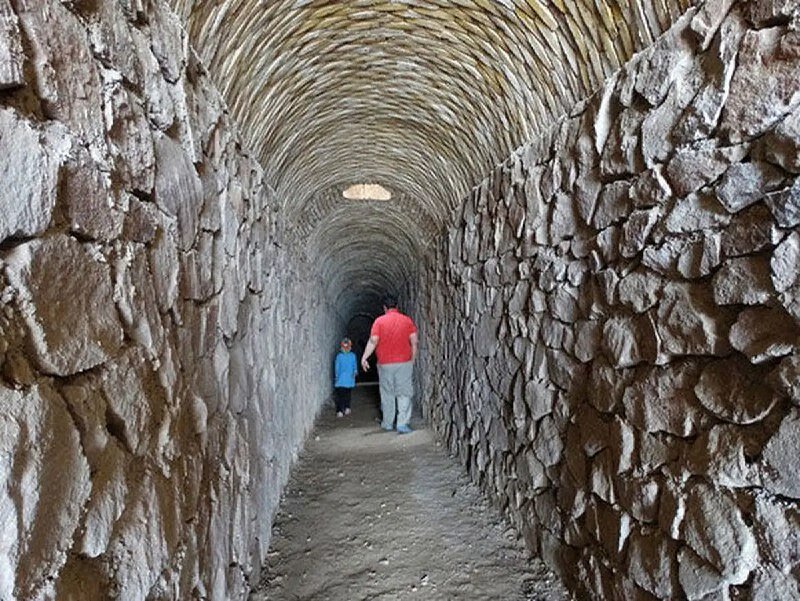
Experts in the field of Tehran-Kanut believe that such an ancient groundwater network remains one of the lesser known tourist attractions in the Karman province.
They believe that Kanat is an important agricultural heritage of Iran and the world, and traces the history of human coexistence at the beginning of human civilization and human dependence on water.
“The Iranian efforts in surface water engineering and exploitation have been highly praised for managing and directing it to farms and fields by digging canuts. Despite the climate crisis, it is a legacy that we will benefit from less profits than we do today.”
Mohammad Barshan, director of the Canat Centre in Karman and Iranian canat expert, told Irna that Kanat is not just a technology to access water resources, but a legacy of the economic, cultural and social life of most of the country relied on for thousands of years.
He said Qanat could adapt to ecological laws and helped ecological resistance in all regions.
Balshan continued, according to historians, that the Karman province was the original origin of Kanat in human history. The first canuts formed within the boundaries of this land. Without Qanats, cities like Kerman, Sirjan, Bam, Ravar, Kuhbanan, Zarand, Shahr-e Babak, and other cities in the state would not have been formed. “Therefore, those responsible for managing Qanats were proud of the work and considered their profession to be more sacred than the others. They believed that betrayal of the Kanat issue would lead to dryness.”
The tourism sector of QANAT civilization is effective when it takes into account the importance of tourism, in addition to increasing the level of awareness among tourists about the importance of kanato, he noted.
“Approaches such as empowering canuts in the job creation structure, localizing tourism reality and preventing canuts from drying out are very useful.
Also, paying attention to the sustainability of the human and natural dimensions as a repression of capitalism intertwined with tourism is effective in optimizing Kanato tourism. ”
Balshan emphasized that Kanat is part of the nation’s history and culture. Their loss, he noted, is not only a kind of disappearance and destruction of methods of water extraction and the exploitation of water, but also a loss of cultural characteristics and identity.
The expert said that given the recent drought and reduced rainfall and lower water in underground aquifers, the importance of kanats is more apparent than ever, with efforts to register Qanats nationally and globally and pay attention to Qanat tourism effective for continued activity and efficiency.
Barshan continued that Kanat was one of the environmental and artificial attractions and technological innovations of ancient Iran about 3,000 years ago, and is of interest to tourists, due to the exploitation of groundwater on the surface of the earth. Therefore, he added that tourists are very interested in the experiences they can gain as cultural experiences in tourist destinations.
He said: One of the socio-cultural aspects of Iranian kanat is the beliefs that Iranian people had throughout history about this important phenomenon, which includes certain customs and traditions related to kanat.
The Iranian people chose their spouses for them, believing in the nature of the male and females of the seas of Kanat, and the weddings of Kanat were held like regular weddings and sacrifices, and many Kanats were considered sacred.
KD