
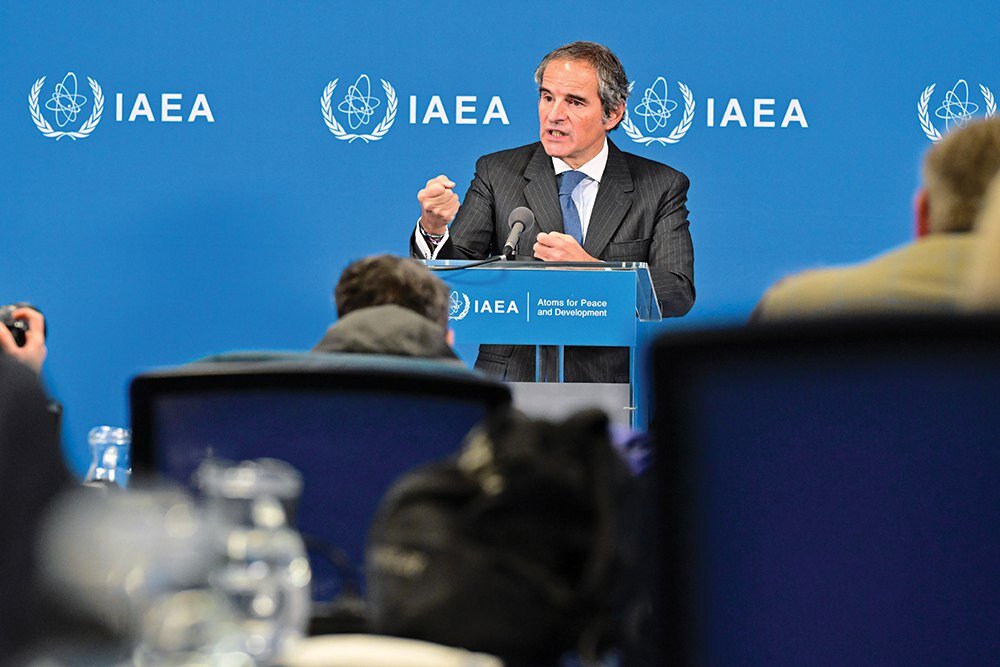
TEHRAN – It is increasingly likely that Iran will be forced to take drastic measures regarding its nuclear program, but Western ambitions to destabilize the country have not yet been frustrated. On Thursday, the IAEA Board of Directors passed a resolution drafted by the E3 (Germany, France, and the United Kingdom) and the United States calling on Iran to increase cooperation with the United Nations nuclear agency.
The resolution makes no mention of the U.S. and Israeli attack on Iran’s nuclear facilities in June, nor does it give assurances that allowing U.N. inspectors access would not herald a new attack. The bill, which was narrowly adopted by a vote of 19 to 3 with 12 abstentions, requires Iran to report on its enriched uranium stockpile and damaged facilities “without delay.”
On June 13, the United States and Israel launched a 12-day bombing campaign against Iran, targeting nuclear facilities in Natanz, Fordow, and Isfahan, and damaging homes and other civilian infrastructure across the country. More than 1,100 Iranians died in the war. The war began days before the Iranian government was scheduled to participate in the sixth round of nuclear negotiations with the United States.
President Donald Trump has regularly boasted about the military operation, which is illegal under the United Nations Charter, and has said the attack “destroyed” Iran’s nuclear facilities. It is unclear why he is seeking information about infrastructure that he claims has been completely destroyed. Analysts say there is no way to determine the full extent of the damage without a thorough investigation.
Iran suspended cooperation with the IAEA in June after the agency refused to condemn the US and Israeli aggression. A new framework agreement was then signed in Cairo, but this was quickly overturned by the Western powers, who decided to begin a process aimed at reimposing pre-JCPOA UN sanctions against Iran. The JCPOA itself was signed in 2015 with the aim of restricting Iran’s nuclear program in exchange for sanctions relief, but was thrown into disarray by the US government in 2018 when the Trump administration withdrew from the deal and reinstated sanctions against Iran.
reaction
The Iranian people strongly condemn the recent resolution. The Foreign Ministry said in a statement that it was an “illegal and unjust” move. “This reflects the bullying of the United States and the duplicitous behavior of the three European countries,” he added.
Foreign Minister Abbas Araghchi said Cairo’s understanding “virtually lost its basis” after E3 triggered the return of the aborted UN Security Council resolution, but that the Iranian government has now formally informed the IAEA director-general that the agreement “is no longer in force and is considered terminated.”
Iranian Foreign Ministry Spokesperson Esmail Bakaei also appeared on state television and announced that Iran would take “appropriate countermeasures.”
Iran’s strongest allies, China and Russia, also criticized the move. Russian Foreign Ministry Spokesperson Maria Zakharova announced at a press conference in Moscow that Western countries need to put aside threats and pressure and instead return to diplomacy with Iran. Li Song, China’s permanent representative to the IAEA, told the board Thursday that the Americans and Europeans had “severely undermined the good momentum of cooperation” between Iran and the IAEA.
what happens next
Iranian authorities have not yet specified the countermeasures the country plans to take. However, the resolution is likely to have two main effects: increasing distrust of both the West and the IAEA, and reducing the likelihood of a diplomatic solution, at least in the near future.
Distrust of the West runs deep in Iran, dating back to a 1953 coup orchestrated by the United States and Britain that overthrew the democratically elected government of Prime Minister Mohammad Mosaddegh. The June war, which occurred while Iran was navigating the diplomatic process, coupled with subsequent Western actions (triggering snapback sanctions and Thursday’s resolution), has perhaps left Iranians more skeptical than ever about whether genuine cooperation with the West will bear fruit.
Lawmakers are now urging Pezeszki’s government to move beyond diplomatic engagement with the West and reconsider the country’s nuclear principles. “The best response to the oppressive IAEA resolution is to withdraw from the Non-Proliferation Treaty (NPT),” Ebrahim Rezaei, spokesman for Iran’s parliament’s National Security and Foreign Policy Committee, wrote in X on Friday.
Opinions regarding the IAEA have historically been divided. Some, including the reformist Rouhani government, have argued that the Iranian government should cooperate as much as possible with the United Nations nuclear watchdog to deny any pretext for Western pressure. The subsequent conservative Raisi government was more cautious in its engagement with the agency, but still kept Iran among the most intensively inspected countries in the world. The current Pezeshikian government is comprised primarily of reformists and some conservatives, and they are almost unanimous in their distrust of the IAEA, especially Director-General Rafael Grossi.
In April, the Tehran Times reported that Grossi wanted to become the next UN Secretary-General and that Western countries had offered to support his appointment if he cooperated in putting pressure on Iran. In October, Grossi publicly announced that he would be a candidate for UN Secretary-General in 2026.
It was no secret that Mr. Grossi provided Western countries with anti-Iranian IAEA reports that were used to harass Tehran. The June strike came just one day after he released a report that recycled old accusations of opacity and suspicious activity.
Mohammad Eslami, head of the Atomic Energy Organization of Iran (AEOI), said last week that Israel had received information from the agency itself that was used to attack part of Iran’s nuclear facilities, the location of which he said was known only to Iranian authorities and the IAEA. One of the targets was a nuclear research center that performs important work producing medical isotopes. “The very laboratory that was bombed was supported by the IAEA, which made trust vulnerable,” Eslami said. “We are the only country whose data is being leaked, misused and used to justify invasion.”
This latest resolution has further fueled anger against the IAEA and Grossi. One Iranian lawmaker said the agency was “nothing more than a tool in the hands of the West.” His post on X received over 200,000 likes from X’s relatively small Iranian user community.