
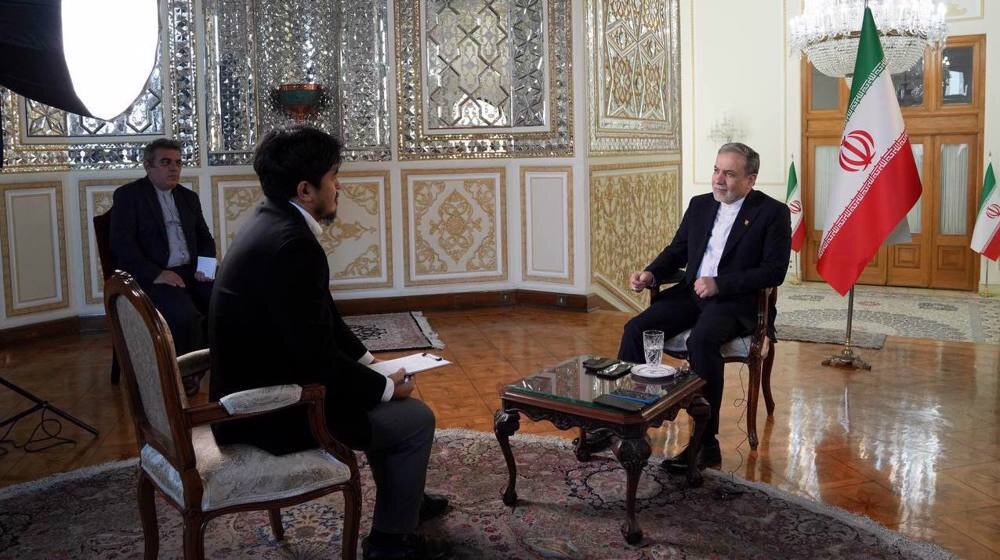
TEHRAN – Iranian Foreign Minister Abbas Alaghushi said Tehran remains unconvinced that the United States is ready to engage in genuine and serious negotiations over the future of the nuclear talks, but reaffirmed that Iran is ready to resume dialogue if the United States adopts a fair and balanced approach.
In an interview with Japan’s Kyodo News, Araghchi said Iran would be open to diplomacy, but only under fair and balanced conditions. “If they are ready to change their approach and engage in fair bilateral negotiations, then we are ready too,” he said. “But negotiations are different from dictation. For now, we are not convinced that they are ready for real serious dialogue.”
Araghchi said the dispute centers on the United States’ refusal to recognize Iran’s right to peaceful nuclear technologies under the Nuclear Non-Proliferation Treaty (NPT), including uranium enrichment. He pointed out that while Japan is a signatory to the treaty, Israel has never joined the treaty.
Despite these differences, Araghchi said the Iranian government is willing to accept restrictions on enrichment levels and the types of centrifuges it operates. He added that negotiations could move quickly if the US recognizes Iran’s peaceful nuclear program and lifts sanctions.
US President Donald Trump reimposed sanctions when Iran withdrew from the 2015 nuclear deal, in which it accepted limits on its nuclear activities in exchange for sanctions relief, and announced that they would only be lifted if Iran accepted a new deal that completely dismantled its nuclear program. Instead, Iran accelerated and expanded its nuclear activities.
Now, following the war Israel launched in June with support from the US government, President Trump has insisted that Iran must not only give up its nuclear weapons, but also sever ties with “resistance” groups and limit the range of its missiles. Iranian officials again rejected these demands.
Iran’s Foreign Ministry spokesperson said on Sunday that “changing long-standing habits is often difficult, even impossible,” and that the United States needs to fundamentally revise its approach if it seeks meaningful negotiations with Tehran. He added that the United States has a “very long history of interference in Iran’s internal affairs” and that Iran’s experience shows that American calls for “reasonable negotiations” often end in “dictatorship rather than dialogue.”
Araghchi also addressed the impact of the recent military escalation, saying that Iran was in talks with the United States when Israel suddenly launched its attacks. Israel’s June 13 operation killed senior Iranian commanders, nuclear scientists and civilians. More than a week later, the United States entered the conflict by bombing three Iranian nuclear facilities.
Araghchi said the facilities had been “bombed, destroyed and seriously damaged,” an act he said was “probably the biggest violation of international law” ever committed against facilities under IAEA oversight.
He said the attack exposed serious flaws in the IAEA’s procedures for inspecting and assessing peaceful nuclear facilities damaged by military attacks.
Earlier this year, Iran and the IAEA agreed to a cooperation framework during talks in Cairo to establish a mechanism for the inspection and stabilization of such facilities. However, Aragushi said this progress was undermined by attempts by the United States and the three European members of the JCPOA to reinstate previous UN Security Council sanctions against Iran.
The foreign minister also called on Japan to share its technical expertise, citing first-hand experience with nuclear accidents, including Hiroshima, Nagasaki and the 2011 Fukushima disaster. He said this cooperation could help Iran secure its nuclear facilities, which were damaged in recent attacks by Israel and the United States.
Araguchi stressed that cooperation with Japan will focus purely on technical safety. He said inspections remained the responsibility of the International Atomic Energy Agency. “Cooperation with Japan on the technical aspects of these security challenges is very beneficial,” he said.