
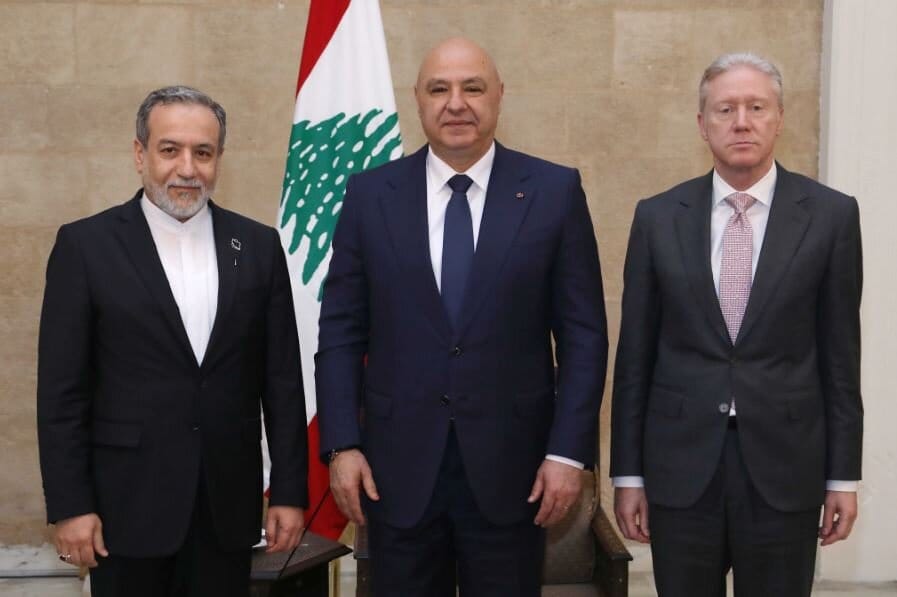
TEHRAN – Iranian Foreign Minister Abbas Araghchi said Iran is ready for dialogue aimed at promoting bilateral relations with Lebanon, while stressing that Iran will not interfere in its internal affairs and does not need a third party to coordinate talks with Beirut.
Indeed, Iranian officials are in close contact with Lebanese officials on a regular basis. Araghchi made an official visit to Beirut in June and met with Lebanese leaders, and a similar visit was made by Iran’s parliament speaker and security chief earlier this year.
“My dear friend Youssef Raji, Minister of Foreign Affairs of Lebanon, invited me to the negotiations in an interview on MTV Lebanon,” Aragushi wrote in Arabic on his X account in response to Raji’s invitation for a meeting. “We will not interfere in Lebanon’s internal affairs, but we welcome any dialogue aimed at developing bilateral relations between Iran and Lebanon.”
It is unclear why Raji thought it necessary to ask Araghchi to begin the talks on television, given that the country already maintains close and ongoing communication with Iran.
In a post on X, Araghchi added: “We don’t need a third country. I invite my colleague Yousef to travel to Tehran. If he is invited to travel to Beirut, he will gladly accept.”
Western countries and Western-linked Arab media have been actively trying to drive a wedge between Iran and Lebanon over the past few years.
News portal Asas Media reported last week that Lebanese President Michel Aoun said that Ali Larijani, the head of Iran’s Supreme National Security Council (SNSC), used “very harsh” words against him during a visit to Beirut in August. The newspaper claimed that Larijani tried to intervene in the affairs of Lebanon’s Shiite community, but Aoun told him that Lebanon’s Shiite problems were his responsibility, not Iran’s.
Asas Media removed the report shortly after it was published, but Iran still responded. Iran’s ambassador to Lebanon said the outlet was “known for its attempts to disrupt relations between Iran and Lebanon.” Al-Mayadeen reported that Iran’s SNSC denied the allegations of the meeting and asked the president to release video footage of the meeting.
Aoun’s office has not yet released the footage, but following last week’s controversy, a video taken by a journalist after the meeting resurfaced. In the video, Mr. Larijani is seen telling Mr. Aoun that he is “sorry that I had to speak up” and that he thinks Lebanon “supposedly knows everything.” Mr Aoun can be seen smiling and dismissing the concerns.
In separate remarks to Lebanese journalists during his visit, Larijani said that while some media outlets are trying to stir up hostility between Iran and Lebanon and pit the two countries against each other, the real enemy of both countries is someone else.
Lebanon currently suffers from near-daily air attacks by Israel, despite a ceasefire that took effect in November 2024. The regime has also captured several strongholds in southern Lebanon, and reports suggest it is preparing to launch a new wave of major invasions against Lebanon after thousands were killed in previous attacks.
The Israelis insist that Hezbollah will continue to attack the country and kill Lebanese until it is disarmed. Hezbollah is the most formidable force that has protected Lebanon from the regime over the past few decades. It was formed in 1982 in response to the Israeli invasion of Beirut. The group first established ties with Iran about 20 years after its formation. However, Israel appears to believe that weakening relations between Iran and Lebanon will lead to the dismantling of Hezbollah. The Iranians have repeatedly said that while they support anti-imperialist and anti-Israel forces in the region, they are not their arms suppliers or policy makers.
The Israelis ultimately aim to establish a “Greater Israel,” an idea for a Jewish state that includes several Arab territories, including all of Lebanon.