
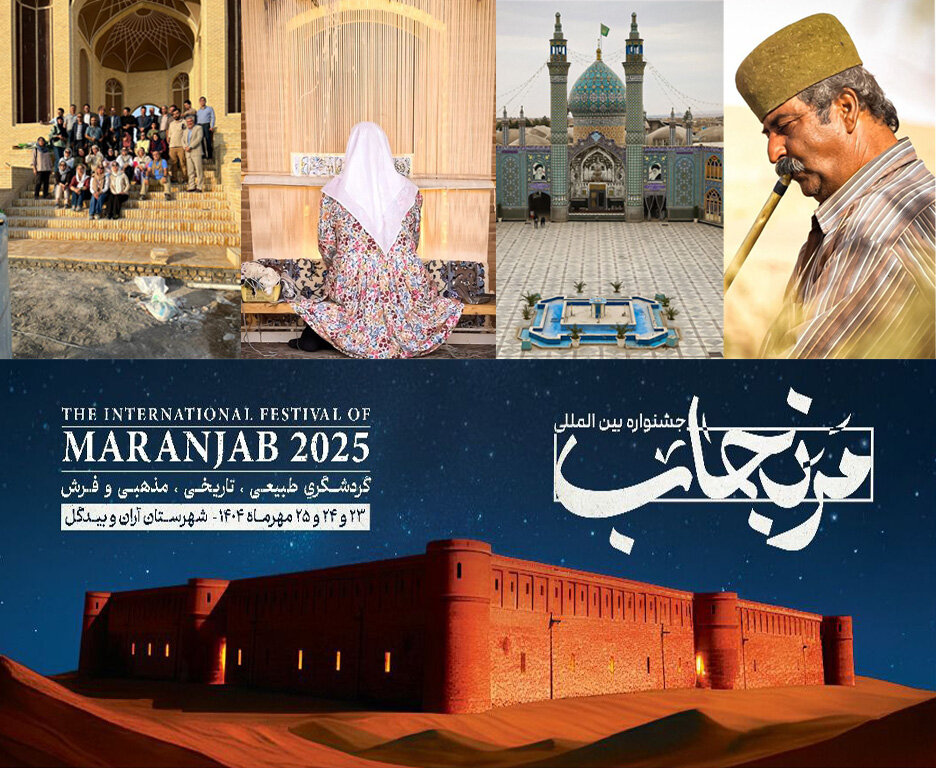
Alan Bidgol, Isfahan – Located just outside the famous city of Kashan, Alan Bidgol province offers a fascinating blend of vast desert landscapes, ancient history, and vibrant local culture, and is rapidly emerging as one of Iran’s most attractive travel destinations.
From the breathtaking sand dunes of the Maranjab Desert to the mysterious underground city of Nushabad, this hidden gem invites travelers and adventure seekers alike to experience an authentic Persian heritage with thrilling outdoor activities, making it a must-see destination for anyone looking to explore the heart of central Iran.
As part of its efforts to gain a foothold on Iran’s tourism map, Alan and Bidgol hosted the three-day Maranjab International Festival 2025, which concluded on Friday, October 17th. The event was essentially a family tour, bringing together a select group of travel agency owners, tourism and airline representatives, tour operators and journalists.
As stated by the organizers, the event aimed to take a closer look at the region’s diverse attractions, with a particular focus on the iconic Maranjab Desert.
During the Fam tour, visitors took in the impressive landscape of a tranquil desert that is part of the Dasht-e-Kabil basin, famous for its vast sand dunes, salt pans, and seasonal wetlands. The desert is also home to important historical sites such as the 17th century Shah Abbasi Caravanserai. It is an impressive remnant of Safavid-era architecture that provided shelter for travelers on ancient trade routes.

In addition to its natural beauty, Fam Tours introduced guests to a variety of cultural and historical landmarks in the county, including centuries-old mosques, historic homes, and boutique hotels that preserve traditional architecture and hospitality. Traditional restaurants served local cuisine, and visits to heritage sites such as the ancient Assarhane (traditional oil extraction house) highlighted the area’s historical role in providing versatile oil.
One of the highlights of the festival was a visit to the underground city of Nushabad. This labyrinthine complex of hand-carved tunnels, rooms, air ducts, and staircases dates back nearly 1,500 years. Widely known as a marvel of ancient engineering, this underground city was largely unknown until it was discovered by chance by local villagers just 10 years ago. Today, it stands as a testament to the ingenuity and resourcefulness of the region’s past civilizations.
The festival also hosted a series of panel discussions and conferences covering important themes such as preserving local heritage, sustainable tourism development and strategies to increase tourism’s contribution to the local economy. Experts and officials considered how to balance economic growth with environmental and cultural protection.

Alan and Bidgol Governor Ali Mohammad Yousefian Alani spoke at one of the conference sessions, highlighting the great potential of the Maranjab desert as a national and international tourism hub. He said, “With principled planning, proper infrastructure and wise management, the Maranjab desert can become one of the important tourism hubs of Iran and the world.”
Mr. Yousefian Alani emphasized the importance of tourism development in parallel with industrial progress, explaining that tourism is an important tool to meet future challenges and a platform to introduce Iran’s ancient customs and culture to a wider audience.
Highlighting the region’s charm, he said: “The Maranjab desert and the nearby Salt Lake region are among the most beautiful desert landscapes in Iran. The historic caravanserai combines history, culture and nature, offering visitors a unique opportunity to experience life during the Safavid era.”
He also detailed the natural and recreational attractions, including clear skies perfect for stargazing, vast sand dunes, and salt lakes, as well as activities such as desert trekking, off-road driving, and sand skiing. These are all valuable assets for promoting the county’s tourism economy.

Governor Youssefian-Alani emphasized the need for responsible and respectful tourism, saying: “The first condition for a pleasant experience for tourists is the creation of a safe and peaceful environment.Aran and Bidgor require healthy and responsible tourism, based on mutual respect between guests and hosts, the protection of cultural heritage and nature, and the observance of social ethics.”
He concluded his remarks by calling for a paradigm shift in the region’s approach to tourism, from simple tourism to “experiential, event-driven tourism that provides real and deep experiences.” He noted that achieving such development requires the collaborative efforts of local communities, government agencies, the private sector and national authorities.
Tour highlights
Handicraft Bazaar: Festival participants first visited a special handicraft bazaar. This bazaar was a live workshop showcasing the making of various handicrafts such as traditional locks, traditional clothing, different types of pottery and clay pottery, and hand-woven fabrics.
Maranjab Desert: Characterized by sand dunes, salt flats, and unique flora and fauna adapted to the harsh desert climate. While the site supports tourism activities such as stargazing, desert trekking, and off-road adventures, sustainable tourism practices are essential to minimizing environmental impact.

Nushabad Underground City: The largest underground city in Iran. It features an extensive network of hand-carved tunnels and chambers designed as a refuge against invasion, demonstrating the architectural and engineering ingenuity of ancient Persia.
Shrine of Imamzadeh Hilal ibn Ali: The shrine where the son of Imam Ali (AS), the first Shiite imam, is buried, attracts hundreds of visitors every day, including devout Muslims and tourists from all over the world. The shrine is surrounded by stunning Islamic architecture, including blue-tiled minarets, arched arcades, domes, and intricately designed halls and rooms. The shrine is especially beautiful in the late afternoon, when the last rays of the sun illuminate the blue tiles of the minaret and dome, casting a warm red glow around it. It is a noteworthy destination for those exploring Iran’s cultural and religious heritage.
Cultural Heritage: Includes the Vigor ruins, centuries-old mosques, historic residential buildings, boutique accommodation, traditional eateries, and ancient oil mining houses, which collectively reflect the region’s rich cultural fabric.
Regional Cuisine: The traditional cuisine of Aran and Bidgol, made with simple and natural ingredients, clearly reflects the lifestyle of the people of these cities. Some of the local dishes Fam tour participants tried were gousht rubia (white kidney bean stew) and shefte somak (sumac meatball soup). Goosht-e Loobia is one of the most famous traditional dishes in Alan and Bidgol, as well as in Kashan. It holds a special place in the city’s religious ceremonies and offerings. It is made with a combination of white beans, meat, onions, cinnamon, and saffron. Some people eat it like a thick stew with dill rice, while others eat it like a soup with sangak bread and fresh herbs. Shefte somak, also known as kofte ab e somak, is a meatball soup made with ground meat, chickpea flour, onions, and sumac. Soaked sumac gives dishes a tangy and appealing flavor. Chefte Somak can be enjoyed with rice or bread.
Alan and Bidgol, with the help of the local community and private investors, strive to attract travelers with its unique blend of natural beauty, cultural richness and historical significance and gain recognition as one of Iran’s most attractive desert destinations.
morning