
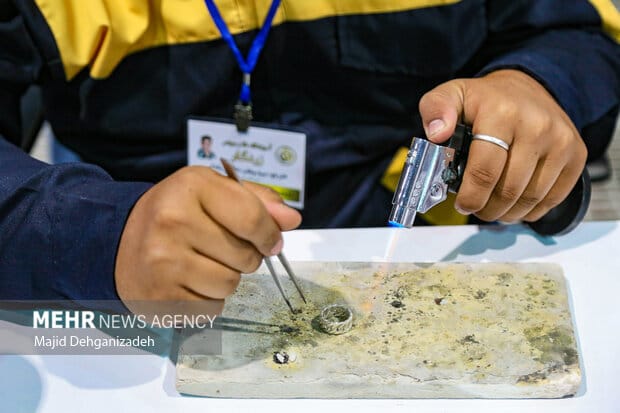
TEHRAN — Foreign buyers are looking for authenticity in handicrafts rather than mass production, so soulful pieces are more valuable to them, a handicrafts exporter in Yazd said.
Majid Yavari told Mehr News Agency that Yazd is a living museum of handicrafts. From weaving cloth to blowing gold with a hammer.
He said the city still has the potential to become one of the region’s handicraft export hubs if systematic planning and more serious branding are carried out.
He also said that the most important fields active in Yazd include termeh weaving, Darai weaving, Elami weaving, Meybod pottery, Jiro weaving, Khatamkari, calligraphy and metal art.
“Each of these fields is today not only a traditional art, but also forms part of the state’s creative economy and is utilized in a variety of fields. As a symbol of Yazd, terme is currently in high demand, along with traditional clothing, interior design, the production of official gifts, and the production of decorative items.”
He pointed out that Darai weaving is establishing a new position in the style design and interior decoration market due to its geometric design and bright colors. He added that Meybod pottery, which was once used only as consumer tableware, is now making its way into many homes among the younger generation in the form of modern dining sets, minimalist accessories and decorative items.
“Jir remains one of the cultural pillars of Yazd and is mainly used in mosques, religious spaces, cultural institutions and even modern tourist complexes. Meanwhile, Khatamkari, Karamzani and wooden artworks are also well known as elaborate products and gifts for organizations, and many foreign institutions use these products as special gifts during official visits to Yazd.”
He emphasized that the global market for Yazd handicrafts has experienced remarkable growth in recent years. “Termeh and Darayee have the largest number of customers in Europe, Canada and the Persian Gulf region. Foreign buyers mainly buy these products for interior decoration, hotel design and even the fashion industry.”
He says Meybod pottery is one of the most favored sectors, with Germany, the Netherlands, France and Australia being its biggest buyers. The muted colors and original patterns match the tastes of European and American customers.
Zilou is registered globally and has also gained important customers in Arab countries, Turkey, Indonesia and Malaysia, where it is often purchased for religious, cultural and artistic spaces.
In the field of Khatamkari and woodworking art, countries such as Qatar, Oman, China, Japan, and Singapore are also important customers, and these works are mainly used as official gifts and luxury ornaments.
The handicraft exporter, who has been active in the field of traditional goldsmithing for more than 25 years, believes that the market for traditional Yazd jewelery has reached a new stage in the past five years.
The combination of authenticity and modern design makes the product more attractive than ever to foreign customers. Traditional Yazd jewelery, with designs inspired by wind catchers, Qajar motifs, adobe architecture, and combinations of stones such as turquoise and agate, is currently sold in galleries and exhibitions abroad. Yavari said the largest overseas markets for Yazd jewelry have formed in Germany, Italy, the United States, France, Australia and the Persian Gulf countries. Customers at these markets typically seek pieces that are completely handmade, unique and grounded in local identity, he said. “Foreign buyers are also looking for authenticity rather than mass-produced items. For them, pieces with soul are more valuable.”
He pointed out that most handicraft workshops are still active in Yazd, Khan Bazaar, Zargalha Bazaar, Fahdan district and Meybod workshops, and emphasized that the majority of handicraft sales are now carried out through online networks.
He continued that many young artists are combining traditional small workshops with modern sales methods, which has led to Yazd products reaching foreign buyers directly.
The handicrafts exporter believes that the future of Yazd’s handicrafts is bright, but it is conditional, and said that in order to turn Yazd into an international handicrafts brand, issues such as standard packaging, continued presence in global exhibitions, creation of artists’ co-branding and support for exports need to be seriously pursued.
He said Yazd has the ability to find the same status in handicrafts as some countries have in carpets and decorative arts. “You just need to combine art with careful management.”
KD