
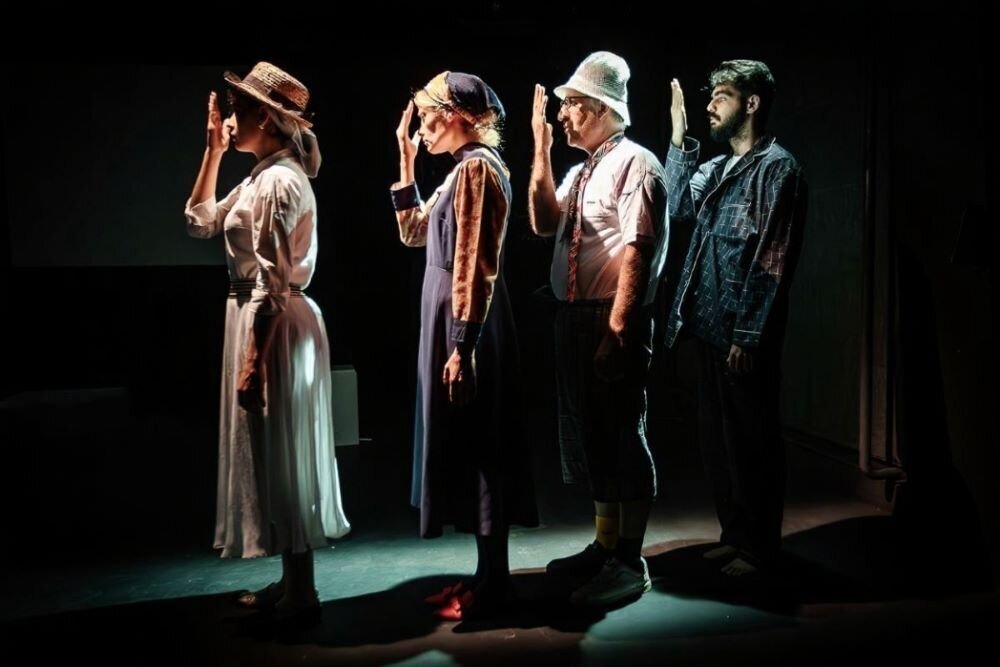
Tehran – The debut play of Romanian and French playwright Eugène Ionesco’s “The Bald Soprano” is currently being performed at the City Theater Complex in Tehran.
Farshid Hoda directs productions based on Ali Najimi’s translation of Persian language.
Mohammadreza Chaparian, Hossein Karami, Mojgan Hamedi, Farideh Dadashi, Fatemeh Sarlak and Amir Saeid Afshar are members of the cast who will remain on stage until August 22nd.
Written in 1950, “The Bald Soprano” centers around Smith, a London couple, and another couple who arrives for a visit, Martins.
The two families chat with meaningless jokes, tell stories, and associate meaningless truthism with poetry. They are later joined by Smith’s maid, Mary, and the local fire chief who is also Mary’s lover.
When Martins and Smith are alone, they begin to argue without any resolution or feeling. The play ends with Martins reciting the same line Smith spoke at the opening.
“The Bald Soprano” is considered a modern classic and original work in the theatre of absurdity. It holds the world record for plays that have been performed continuously in the same theatre for a long time.
The idea for the play came to Ionesco while he was trying to learn English in the Assamil method. Impressed by the content of the dialogue, he often very plain and strangely decided to write an absurd play called “The Trouble with No English.”
Other possible titles considered include “The Raining Cat and Dog” and “Big Ben Follies” literally translated in French.
The actual title was the result of an error in rehearsals by actor Henri Jacques Huett. The fire chief’s monologue initially contained a reference to “a blonde school teacher,” but Huett said “La Cantatrice Harve,” and Ionesco, who attended, decided to reuse the phrase.
The play has been viewed by many Iranian groups.
Eugène Ionesco was a well-known playwright and one of the leading figures in the Absurd Theatre. Born in Slatina, Romania in 1909, he later moved to France, where he gained international fame for his innovative and unconventional theatre.
Ionesco’s work is characterized by its surreal humor, existential themes, and its focus on the absurdity of human existence. His most famous play, The Bald Soprano, exemplifies his style with its meaningless dialogue and satirical criticism of social norms.
Throughout his career, Ionesco challenged traditional theatrical forms, highlighting the absurdity and alienation of individual communication in modern society. His writings often explore themes of identity, language, and meaning in life. Ionesco’s influence extends beyond theatres and influences literature, philosophy and art. He is a pivotal figure in 20th century avant-garde literature and is celebrated for his groundbreaking contributions to contemporary drama.
sab/