
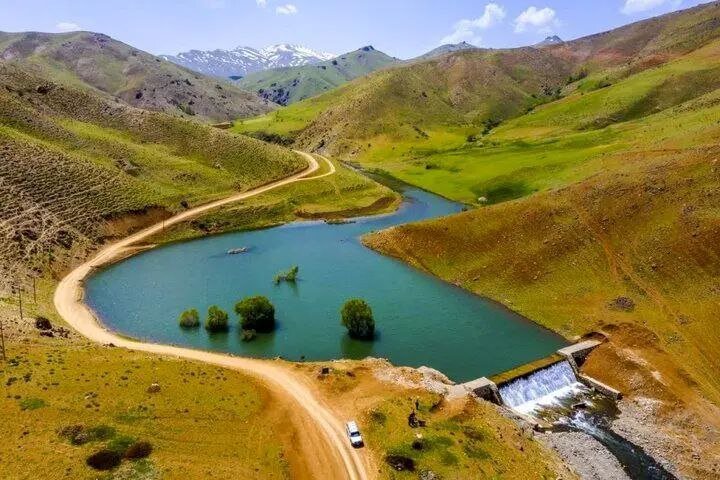
Tehran – The National Budget Bill for Basin Management in the current Iranian calendar year (March to March 2025) is 15 times the budget for the previous year.
Implementing basin and aquifer management projects can lead to rainfall penetration into the land, strong vegetation cover, reduced soil erosion, and improved land dynamics.
Referring to the reduction in rainfall and rising global temperatures that contribute to the contribution of sand and sandstorms, authorities said that while the Ministry of Energy is focusing on governance in water resource management, territorial sovereignty must be considered from the perspective of natural resources and basin management agencies.
Natural resources, vegetation, biodiversity, fauna, soil, and even air must be seen as interconnected wholesals. If the evaporation rate is neglected, decisions based on the amount of water remaining are not efficient.
Of the approximately 400 billion cubic meters of cubic meters per year, 280 billion cubic meters evaporates, leaving only 110-120 billion cubic meters of manageable water. The figure fell to 66 billion cubic meters this year, a 20-30% decrease compared to the previous year, Teimouri emphasized.
When only 10% of the water evaporating is managed through the method of basin and aquifer management, many positive changes are brought about.
Currently, around 6,500 villages and 450 cities are at risk of flooding. Managing upstream outflows in these areas is one of the obligations of natural resource organizations. Completely, approximately 25-28 million hectares of important land have been identified in countries with the capacity to implement basin management projects. They are at the top of the organization’s program agenda, Teimouri said.
According to the seventh National Development Plan (2023-2027), over five years, the basin management project is expected to cover 20 million hectares of the country’s land. This amounts to 4 million hectares each year.
Normal rainfall forecast for the next six months
The weather organization predicts that the remaining monthly rainfall will be lower than normal until early December.
The average summer rainfall is lower than usual in states north of Mount Alborz, south slopes and northwest. In some areas of the southeast, it tends to exceed normal. Other areas have low precipitation or no precipitation, Isna reported.
Summer precipitation is expected to close at 40% less than normal rainfall (September 22) in the current water year, as it contributes to a relatively small percentage of the total annual rainfall.
Fall rain is expected to begin later than usual. In the northwest, it is projected to be 60% less than usual, while in other parts it reduces precipitation by about 50-60%.
During the first two months of summer, temperatures will be normalized on the southeastern part of the country and on the Caspian coast. It is 1-2 degrees higher than normal in the northwest, and 0.5-1 degrees higher in other regions, respectively.
From September 6th to October 7th, average rainfall in most parts of the country is the same as normal long-term value. In the northwest, temperatures rise by 1-2 degrees. In other regions, it is 0.5 to 1 degree higher than usual.
From October 7th to November 6th, average rainfall is estimated to be lower than normal on both sides of the Alborz Mountains, the northwest, and the northern and southern Zagros provinces. There is no precipitation in other parts of the country.
Temperatures are 1-2 degrees higher in Zagros in the northwest, northwest, and central regions. In the eastern part of the country, the average temperature will be normal, but in other parts it is expected that the temperature rise will be above 0.5-1°C above normal.
From November 6th to December 6th, average rainfall tends to be lower than usual in North, Central and South Zagros east of Zagros.
The average temperatures are normal in parts of the East, Southeastern Dasht-e Kavir (Central Desert of Iran), usually 1-2 degrees above the Zagros and in the South, 0.5-1 degrees above the normal in the rest of the Zagros.
The biggest reduction in precipitation is expected to occur in the second month of autumn, especially during the mid-Zagros period.
mt/mg