
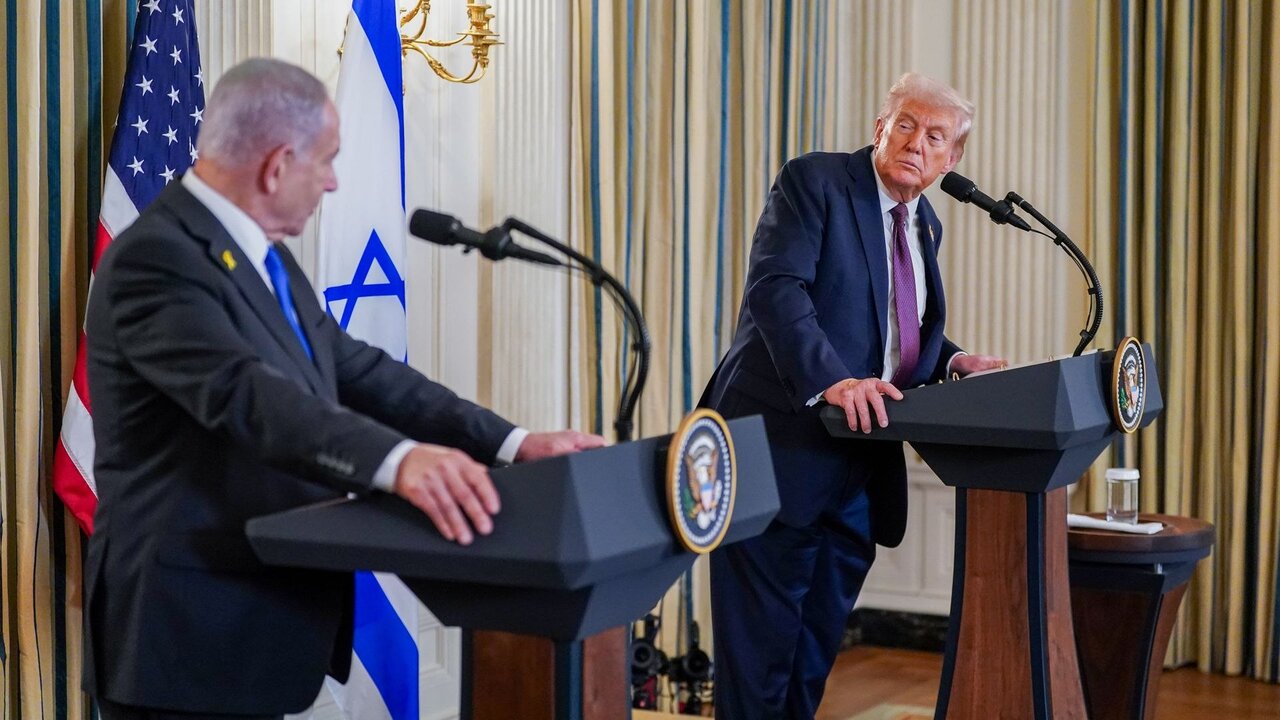
TEHRAN – Israeli Prime Minister Benjamin Netanyahu’s recent statements suggesting that Iran is preparing an attack on the U.S. mainland have alarmed the American public, but perhaps not for the reason the Israeli leader expected.
In an interview published on Monday, Prime Minister Benjamin Netanyahu told a prominent American Zionist that Iran could “blackmail” any American city. “Iran is developing an intercontinental ballistic missile with a range of 8,000 kilometers,” he told Ben Shapiro. “With another 2,000 miles, they will have New York City, Washington, Boston, Miami, and even Mar-a-Lago under their atomic cannon control. This is a real danger.”
Mr. Shapiro was among the conservative influencers who fully supported Israel’s 12-day war against Iran in June. Sources told the Tehran Times that Israel relied on American intelligence and assets from the beginning. Prime Minister Netanyahu ultimately persuaded the United States to directly intervene and attack Iran’s nuclear facilities in the final stages of the war to rescue Israel from the devastation caused in the occupied territories by Iranian missile salvoes, the sources added.
However, the Trump administration’s support for Israel’s war against Iran was harshly criticized by many influential Republican figures and strategists. Steve Bannon, former Trump chief strategist and current host of the MAGA podcast War Room, has been at the forefront of a growing rift within the MAGA coalition over Washington’s involvement in the war. Prime Minister Netanyahu’s recent comments also prompted a reaction from him. “They (Israelis) made up lies about the Persians,” he said on a recent episode of the podcast. “They don’t care about drawing the United States into a 20- or 30-year war,” Bannon said, adding that if Israel wants to go to war with Iran, it should go to war on its own.
Bannon was echoed by Americans who reacted to Netanyahu’s recent interview on social media. Many people shared a video of Netanyahu’s 2002 testimony to Congress, in which he told lawmakers that the invasion of Iraq would have a “huge positive impact on the region.” He also said that if Washington overthrew Saddam, it would pave the way for a future overthrow of the Iranian government.
“How many more times will we be fooled by Netanyahu,” one American asked on X. “Netanyahu went to war with Iraq for weapons of mass destruction that don’t exist. The United States lost thousands of soldiers and $2 trillion to make this murderer happy.”
In his remarks to Shapiro, Netanyahu offered no evidence that Iran is increasing the range of its missiles or planning attacks on American cities. He also defended Israel’s attack on the country in June, claiming it was done to stop Iran from developing a nuclear weapon, saying, without providing evidence, that Iran was “very close” to producing a nuclear weapon. International Atomic Energy Agency (IAEA) Director-General Rafael Grossi recently said there was never any evidence that the Iranian government intended to build nuclear weapons and that his report never suggested otherwise.
Although Prime Minister Netanyahu’s press conferences continue to provoke backlash, it appears that U.S. concerns do not actually extend to Iran. An American affairs analyst told the Tehran Times that Iranians never believed that the war between Israel and the United States ended after the June 25 ceasefire.
“Here in Iran, the consensus is that war is very likely to break out again. The lies that Prime Minister Netanyahu came up with to justify a new confrontation are not really a problem,” Amir Ali Abolfat said, adding that the goals that Israel and the United States set for themselves were not achieved during the 12-day war.
Experts cited three main goals: dismantling Iran’s nuclear and missile programs, creating public unrest, and forcing Iran to abandon support for resistance groups. “Given Washington’s current domestic challenges and feuds with Russia and China, a second attack on Iran seems illogical now, but it certainly wasn’t the first,” he said. “Whether the Americans mistakenly believe they can achieve their goals this time, or find pressure from Israel irresistible, a new attack on Iran remains very likely, even if it is not in America’s interest.”