
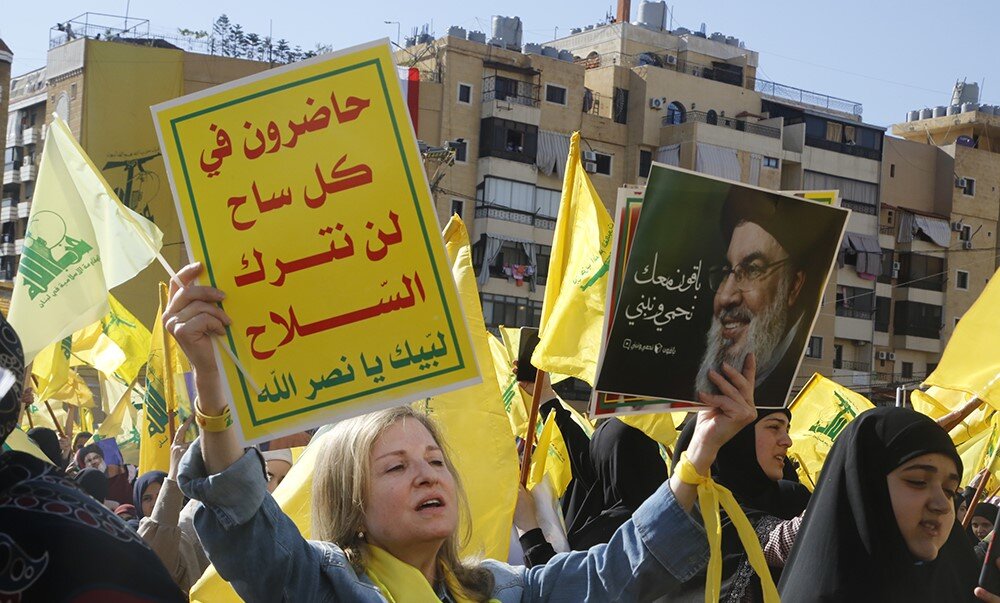
Israel, the main actor of disorder in the region, now abandoned even the pretense of moral restraint and attacked the Lebanese capital on November 23 without any warning.
The bombardment of the capital and the blatant violation of the ceasefire occurred at a time when all external parties, and even some Lebanese domestic currents, were pressuring Hezbollah to disarm, seduced by the belief that peace would return to Lebanon if it complied with the demands of the Zionist-American axis.
Sunday night’s targeted assassination attack on the southern outskirts of Beirut shows more conclusively than ever that the Resistance’s strategic reading of its enemy’s actions was right yesterday, it was right today, and it will be right tomorrow.
Those who promote the slogan “First disarmament, then peace and tranquility” are scrawling their fantasies on ice in the hot sun.
Hezbollah’s efforts are by no means limited to the military field. With Lebanon’s formidable resistance apparatus indisputably capable of cutting off Zionist aggression, the dignified cooperation extended to certain domestic political forces constitutes another facet of the resistance’s noble efforts to unravel and unravel.
The vague, directionless and completely futile appeals made by some of Lebanon’s most powerful politicians, including the president himself, to the “international community” (the same bystanders who have watched silently for months as the Zionists repeatedly violated the ceasefire in Gaza and Lebanon) now only serve to emphasize the soundness of the Resistance’s analytical framework.
From the beginning, the Lebanese Islamic resistance movement did not trust its Zionist enemy’s ceasefire or its American negotiators. The former pursues expansionism and the plunder of Lebanese rights on the ground. The latter promotes the same objectives through the political corridors.
Washington’s miscalculation was for Lebanese domestic factions to rally against the resistance. Hezbollah’s resolute action, despite the fresh wounds of the assassination, nullified the plan.
The back-and-forth of diplomacy had no appeal for the Resistance, who remained focused on the battlefield and preparing for the next inevitable round against the Zionist enemy.
But for some Lebanese political currents, they seemed seductive and attractive. Nevertheless, the resistance accepted all conditions set by domestic powers, including the military and government, so as not to give pretexts to the Zionist enemies.
Today it is clearer than the midday sun of midsummer. Enemies do not even honor the agreements they themselves sign.
The only language that can restrain the actors of this regional chaos is the language of power. These are the principles that the Lebanese Resistance and the entire Axis of Resistance have proclaimed over the past years, and have continued to uphold with undiminished determination since October 7, during last year’s Lebanon War, and during the 12-day war with Iran. Only a decisive and painful blow can force the Zionist body to reconsider its policies.
If a new order emerges in West Asia, it will not be imposed by an American logic centered on the Zionist regime, which is the main driver of regional disorder. It will be forged by the iron fist of the resistance and the imposition of its will on the enemy.
This is the unmistakable message conveyed by Sunday night’s assassination attack in southern Beirut.
Source: Sedaye Iran, Online Newspaper of the Islamic Revolutionary Institute of Iran, November 23, 2025