
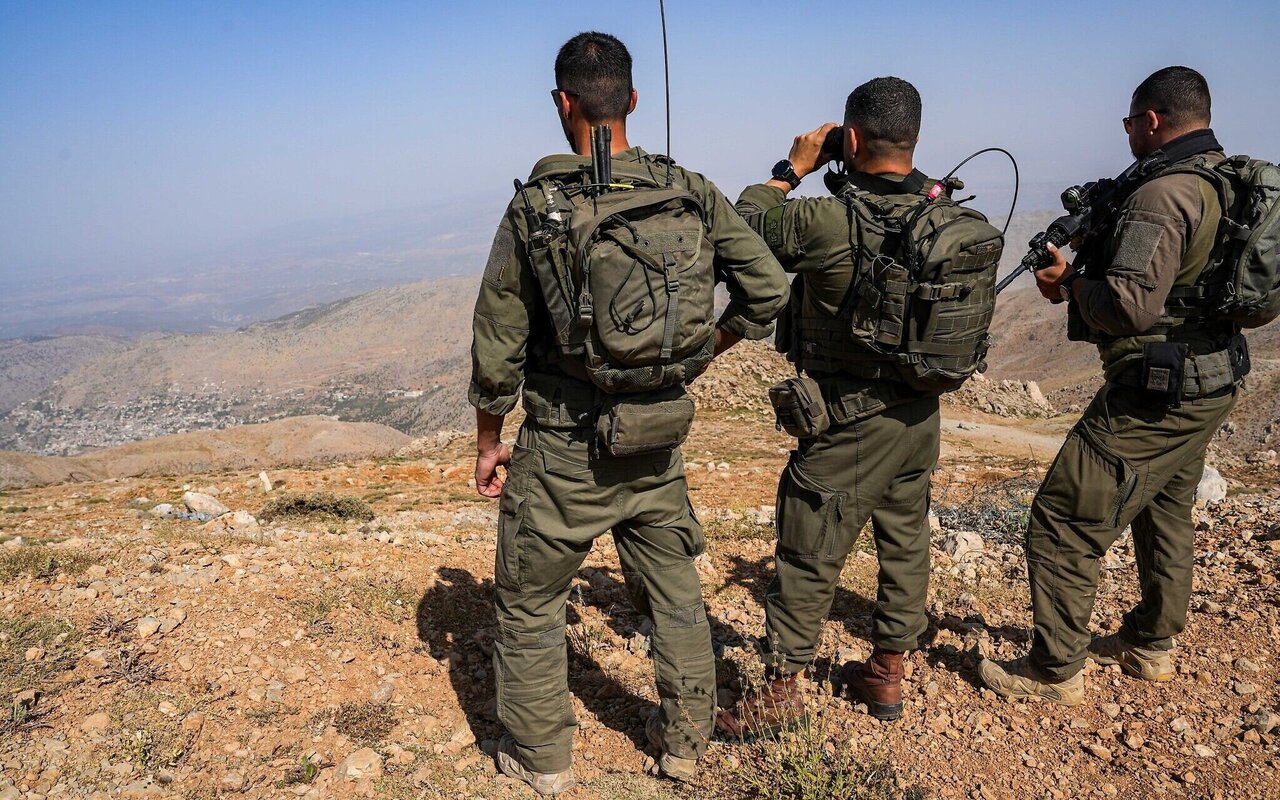
Tehran – Israel’s recent ground operations in Syria – reportedly moved about 38 km into Syrian territory, reportedly under the codename “Green White” and reached within about 10 km of Damascus.
Israeli and regional media said Israeli forces struck military locations near Hom, Latakia and Palmyra, and at the same time established fortified positions, road construction and construction bases within the United Nations demilitarized buffer zone in Golan.
Satellite images analyzed by Al Jazeera and the BBC have documented the rapid underlying structures in the buffer zone since December, giving fear in Damascus and in the region that these are steps towards strategic heights and persistent control of communication lines.
Escalations are separated by a series of attacks. In late August, an Israeli drone attacked in the Damascus countryside, killing six Syrian soldiers, a strike following a ground invasion reported by Syrian sources.
The next day, Israeli forces carried out landing work on a former Army site in Kiswa, southwest of Damascus, deployed dozens of troops and search equipment, and remained at the scene for hours before retreating.
On September 8, multiple airstrikes collided with sites in HOMS, Latakia and Palmyra. New reports of explosions in Damascus and Latakia continue with claims that these attacks have destroyed newly delivered Turkish equipment.
These operations are not occurring in a diplomatic vacuum. Damascus and Tel Aviv continue to rely directly on “security consultations,” which were intended to revive elements of the 1974 liberation arrangement, despite Israeli officials signaling a broader agenda that codifies the existence of sustained security in southern Syria.
Syrian leader Ahmed Alshara (Ab Muhammad Aljolani), established after the collapse of the Assad government in December 2024, will frame negotiations as an effort to restore pre-2024 borders and curb Israeli strikes.
In contrast, Israeli statements increasingly explain boundaries and infrastructure read like a long-term occupation.
Israeli supporters have described strikes and the former post base as defensive buffers. Many observers – diplomats, regional analysts, independent verifiers – look at something else: a permanent campaign of wards bleeding in territorial integration.
The line between “temporary security measures” and the de facto annexation begins to blur if roads, hardened locations, and if continuous patrols are required to block another state’s internationally recognized territory.
At the same time, since al-Assad fell in December 2024, Syria has been convulsing with horrifying internal violence.
Surveillance groups and rights investigators have documented widespread extrajudicial killings and massacres. Sweeda’s mass baths are the most visible example. It also documented a large, systematic attack that describes the Alawian community along the coast, the entire home where the survivors were born, and the villages targeted by religious groups.
Amnesty International, the Syrian Observatory of Human Rights, and other surveillance organizations document executions in hospitals, public squares, and homes. Independent investigations have reconstructed extensive evidence of mass murder.
Additionally, many reliable reports document the systematic killing of Alawian civilians along Syrian coasts, as well as new rulers and target villages where survivors have been executed and whose entire family has been torched and torched in their homes, and villages targeted.
These crimes were committed by regimes rooted in terrorist factions such as Haitt Taharil al-Sham (known as Syrian al-Qaeda), the Free Syrian Army, and the infamous Jaish al-Islam – stress the emphasis that Israel’s aggression should not be suppressed.
Clearly, Syrian civilians are now facing double detention. In one respect, deep Israeli penetration, repeated airstrikes and construction of previous posts will steadily erode the integrity of Syrian territory, increasing the risk of wider military escalation. Meanwhile, the security vacuum filled by militias and punitive internal security equipment has created sectarian crimes and collective trauma that demand accountability and protection.
That double bond provides an international response, both moral and practically urgent. The United Nations, independent human rights groups, and humanitarian organisations must launch parallel investigations into cross-border violations and internal atrocities, assert free humanitarian access and seek verifiable restraints on the use of force by all parties.
An alternative is an international verification or a restraint based on laws supported by permanent partitioning and Vulcanization. What we’ve seen so far — coupled with infrastructure, a steady push of repeated strikes in the sovereign realm, and a campaign of sectarian violence across the country — it looks like the latter.