
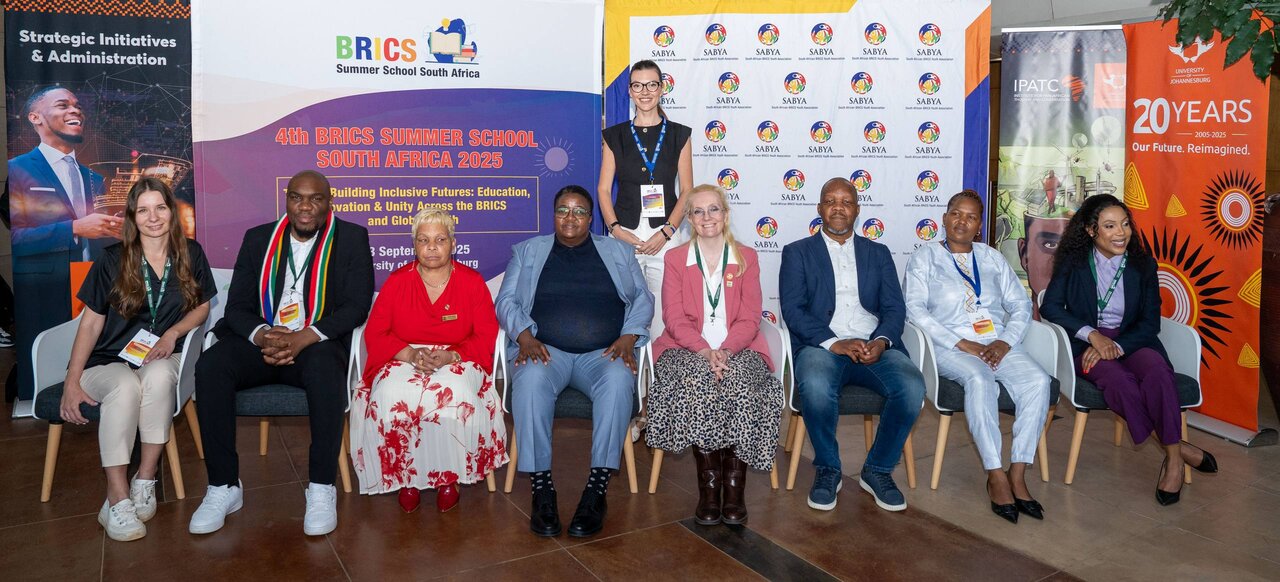
Johannesburg – The first day of BRICS Summer School in the urgency of Johannesburg, South Africa. Scholars and young leaders from across the Global South came together to discuss the deepening of international relations, intra-brick collaboration, and the role of young people in shaping the future of this rapidly evolving bloc.
The timing is hardly symbolic. As the Shanghai Cooperation Organization (SCO) summit was held at Tianjin (another forum for non-Western cooperation), the BRICS Summer School emphasized the growing momentum of multipolar institutions trying to balance the inequality of the current world order.
Fix today’s leader’s failures
Victoria Graham, an academic professor in South Africa, was opened up by highlighting that BRICS must not only criticize the failures of leaders today, but also build alternatives. “We need alternative perspectives in global politics, alternative narratives,” and involvement for young people to bring BRIC into the future, she argued.
Professor Siphamandla Zondi raised a provocative question: Why do BRICS countries continue to trade each other with the West? For many participants, this pointed to structural challenges that prevented BRICS from realizing its full economic potential.
For Margaret Sheron Arnolds, chairman of the city of Johannesburg, the Summer School is more than an academic gathering. This is a platform for young people to “challenge orthodox, disrupt the status quo and tackle a more just international order,” she said.
The political act of imagination
The most politically charged intervention came from activist Steve Letosique. Steve Letoshike set the tone with a strong statement. “This summer school is not only an academic gathering, it is not a cultural exchange, it is a political act of imagination.
She emphasized that BRICS is not just an economic or political bloc, but a strategic initiative for global change based on multipolarity, justice, inclusion and people’s self-determination.
Since its founding, BRICS has sought to reconcile the global order and has moved away from monopolar domination towards a more equitable system of governance. “The numbers themselves speak strong,” Letsike reminded participants. The original BRICS 5 accounted for 42% of the world’s population and 31.5% of the world’s GDP. With the latest expansion, BRICS currently covers 46% of the world’s population and 37% of global GDP.
Her conclusion was clear. BRICS must be understood as a declaration that the global South is no longer an audience, but the creator of the future.
Why Iran watches carefully
One of the core activities of this year’s Summer School is the BRICS model simulation of “Payment Systems and Financial Cooperation: the Use of Local Currencies in BRICS Member States.”
This topic is particularly moving for Iran, who recently joined BRICS and is facing the daily reality of unilateral Western sanctions. For Tehran, creating a resilient financial infrastructure that can bypass dollar-controlled systems is necessary, not an abstract idea.
The discussion in Johannesburg resonated with this urgency. A common BRICS payment system that reduces dependence on Western financial institutions could provide a country like Iran.
Slovak Voices in Global South Discussion

Participants at the BRICS Summer School will take photos in Johannesburg, South Africa. (Photo: Visual Studio)
As the sole participant from Slovakia, I take responsibility for bringing these discussions into our national conversation. In Slovakia, BRICS often encounters skepticism. This is considered distant, irrelevant, or incompatible with European commitments. But what I’m looking at here is not a threat, it’s an opportunity.
For small countries historically shaped by external forces, BRICS offers a platform for expanding their horizons, diversifying partnerships and building resilience in already massive worlds. It’s not about leaving Europe, but about ensuring that it’s not limited to a single geopolitical script.
The voice of the Global South
The convergence of BRICS Summer School and the SCO Summit in Tianjin show deep change. Global South is no longer satisfied with playing a secondary role. It builds its own institutions, sets its own agenda and asserts its collective strength.
For sanctioned countries such as Iran, this means opportunities to build financial lifelines outside of Western control. For the wider global south, it shows resolve to move from margins to the center of decision making.
If the first day of summer school makes one thing clear, then that’s it. The Global South does not simply inherit the future, it shapes it.
Lucia Hubinská is a Slovak university lecturer, activist, commentator and public relations officer who participated in the BRICS Summer School in Johannesburg, South Africa. (Photo: Visual Studio)