
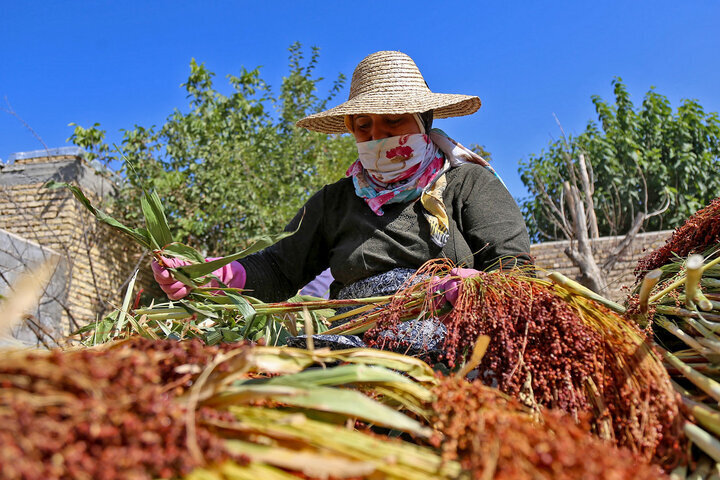
TEHRAN – Alireza Izadi, Director of Cultural Heritage Registration and Preservation at the Ministry of Cultural Heritage, Tourism and Handicrafts of Iran, said that the art and skill of broom weaving has been inscribed on the National Intangible Cultural Heritage List to identify, introduce, document and protect this craft.
He told IRNA that while broom making can be considered a category of handicrafts, its indigenous skills and knowledge are considered an example of intangible cultural heritage.
Izadi said the technique is common in areas with reed beds and vegetation suitable for broom weaving.
He added that broom weaving is well known in the northern provinces of Gilan and Mazandaran, in the southern and northern Khorasan provinces, in Fars province (especially in the villages around Neiris province and Alsancan), in Kerman and Sistan-Baluchestan provinces, and in Isfahan and Chahalmahal Bakhtiari provinces (areas with reed fields).
Izadi revealed that broom weaving in Iran has a long history and is completely indigenous. “In the past, weaving simple brooms from plant stems was a common activity in rural villages due to the abundance of reed beds and soft plants. With the development of agriculture and the establishment of villages, making brooms from reeds, soft leaves, and thin branches of trees became an occupation that complemented farming, and many villagers engaged in broom weaving during the agricultural off-season.”
“Depending on the type of native plants, different styles of broom weaving have been formed. For example, in Khorasan Razavi, hard and clustered reed brooms are woven, and in the south and southeast, brooms combined with branches are woven,” he said.
Izadi revealed that until the mid-Solar century, broom weaving was an important source of income in some villages, and was usually done as a home craft using simple tools and without formal workshops.
Although the advent of industrial brooms has reduced traditional production, many villages still maintain this occupation due to its affordability, durability, and indigenous identity, and in some areas it has been introduced as a botanical craft.
He said broom weaving is rooted in the old requirements of rural life and continues to this day as an enduring tradition and local technique.
KD