
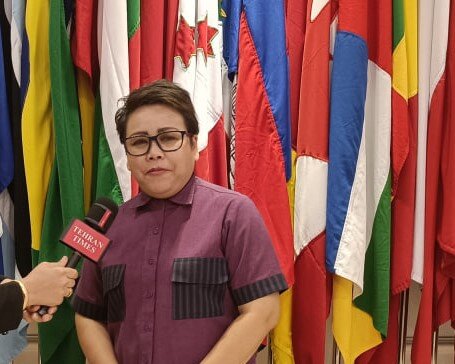
TEHRAN – Ani Nigeriawati, Director of Public Diplomacy at the Indonesian Ministry of Foreign Affairs, spoke at length about the strong and multifaceted relationship between Indonesia and Iran in an exclusive interview with Tehran Times.
Against the backdrop of the 75th anniversary of the establishment of diplomatic relations between the two countries, Mr Nigeriawati outlined a positive vision for cooperation. She detailed how cultural diplomacy, academic exchanges, a common commitment to the halal industry, and a common stance on global issues like Palestine are building a lasting partnership built on mutual respect and common Islamic values.
Below is the full text of the interview.
What role can cultural diplomacy and public diplomacy play in advancing Iran and Indonesia’s common goals in multilateral forums such as the Organization of Islamic Cooperation and the Non-Aligned Movement?
Cultural diplomacy and public diplomacy play an important role in promoting shared goals between two (or more) member states in multilateral forums. Both Indonesia and Iran are active members of the Non-Aligned Movement (NAM), founded in Bandung in 1955, and members of the Organization of Islamic Cooperation (OIC) since its creation in 1969. These two forums are very similar in that they adhere to the principle of defending and protecting the interests of the Islamic world in the spirit of promoting international peace and harmony.
One of its interests is to promote cooperation in the social, cultural and information fields between member states, in accordance with the OIC Charter. Within the framework of socio-cultural cooperation, OIC Resolution No. 11/51-C on the promotion of cooperation between OIC Member States in the field of culture and support for film production was adopted at the 51st OIC Council of Foreign Ministers (Istanbul, June 2025).
In line with this, Indonesia held a film festival titled “Arts Lumiere Indonesia Festival: Muslim World Film Screening 2025” with the theme of “Stories of Peace”, and Iran greatly contributed to the cooperation by participating in 15 films depicting Islamic values such as peace, humanity, women and youth, local traditions, and tolerance.
What opportunities exist for joint initiatives in higher education, academic exchange, and scientific cooperation between Iranian and Indonesian universities?
Opportunities for joint initiatives between Iranian and Indonesian universities are abundant and growing, supported by various initiatives at the government and university levels in both countries.
The Ministry of Higher Education and the Ministry of Science of both Iran and Indonesia are actively promoting bilateral relations in higher education, focusing on the benefits to be gained from the possibility of cooperative partnerships to carry out joint research projects in the fields of industry, medical devices, vaccines, artificial intelligence (AI) and biotechnology.
There is also strong enthusiasm for student and faculty exchange programs to deepen academic ties and increase cultural understanding between our peoples. Indonesian universities such as Brawijaya University and UIN Sharif Hidayatullah Jakarta have already entered into formal partnerships with Iranian institutions to expand exchange opportunities and joint academic ventures. There are also hundreds of Indonesian students continuing their studies in Iran in various fields such as social sciences, humanities, and medicine.
Particularly in the field of health and medicine, in conjunction with the visit of the Indonesian Ministry of Health delegation to Tehran in January 2024, a sister university cooperation memorandum was signed between Tehran University of Medical Sciences (TUMS) and Health Polytechnics Indonesia in Pontianak, Sorong, Surabaya, and Yogyakarta.
Regarding scientific cooperation, since the Memorandum of Understanding on Science and Technology was signed, the two countries have established a joint Science and Technology Committee to coordinate activities such as symposiums, researcher mobility programs, and academic networking. Both countries are committed to exploring and promoting cooperation in cutting-edge fields such as nanotechnology, biotechnology, stem cell research, and cognitive science, reflecting their shared dedication to scientific progress and mutual development.
How can Indonesia and Iran cooperate in the halal industry from a public diplomacy perspective, given their large Muslim populations and growing consumer markets?
Indonesia and Iran share a natural basis for deepening cooperation in the halal industry, as both countries have large Muslim populations and rapidly growing halal consumer markets. From a public diplomacy perspective, this cooperation not only promotes economic ties, but also cross-cultural understanding and common values, strengthening the friendship between the peoples of the two countries.
A concrete milestone in this cooperation was the signing of the Intergovernmental Memorandum of Understanding on Halal Product Assurance, which represents a strategic framework for harmonizing Halal standards and certification practices in 2023. This bilateral partnership aims to support increased trade volumes of halal food, beverages, medicines, cosmetics, and other halal-certified products, and position Indonesia and Iran as central players in the global halal industry and market.
How does Indonesia view Iran’s role in promoting cultural diversity and interreligious dialogue in Asia, and what avenues for cooperation exist?
Indonesia recognizes Iran as an important partner in promoting cultural diversity and promoting interreligious dialogue across Asia. Iran’s long tradition of embracing cultural, ethnic and religious pluralism reflects principles of respect, tolerance and peaceful coexistence rooted in a rich Islamic tradition, making it a valuable example for the region.
There are ample avenues for cooperation with Iran in this area, including joint cultural programs, interreligious dialogue platforms, and cooperation within multilateral organizations promoting peace and cultural exchange in Asia.
Both countries cooperate in the preservation of cultural heritage through multiple international platforms, and cooperation is ongoing to nominate the Iftar tradition as a UNESCO Joint Intangible Cultural Heritage. This joint nomination not only highlights the importance of iftar in the Muslim community, but also serves as a bridge for deeper cultural diplomacy and people-to-people ties between the two countries and the rest of the world.
What role can media cooperation and co-production play in shaping public perceptions and bringing Iranian and Indonesian societies closer together?
Collaborative production is also very welcome. In fact, the two countries have signed an agreement on cultural exchanges in 2023, and the exchange of cultural and artistic publications is one of the many areas of cooperation included in the agreement.
Through media cooperation initiatives such as co-produced films, documentaries, cultural programs and journalist exchanges, both countries can showcase their rich cultural heritage, shared values and diverse traditions to a wide audience.
For example, this year the Iran-Indonesia Film Week was jointly held, providing an excellent platform for cultural exchange where audiences from both countries could experience artistic expression through film. This type of collaborative cultural production fosters people-to-people connections and creates new opportunities for the creative industries of both countries.
How can Iran and Indonesia leverage digital diplomacy, including social media and online platforms, to strengthen cultural and people-to-people ties?
Digital diplomacy, including social media and online platforms, provides a powerful and innovative means for Iran and Indonesia to strengthen cultural and people-to-people ties.
A recent study trip organized by the Indonesian Embassy in Tehran was one concrete example of this. The program has invited Iranian social media influencers and prominent journalists to showcase Indonesia’s tourism and culture, including Bali’s traditional village life, traditional Indonesian cuisine, the beauty of Bali’s beaches, and the urban vibe of Jakarta.
Sharing their authentic experiences through social media and online platforms helps raise public awareness and foster closer cultural connections between people.
Given the global attention to Iran’s international standing, how can public diplomacy help convey Iranian and Indonesian perspectives to the wider world in a constructive way?
Public diplomacy is about countries presenting their own stories based on an emphasis on dialogue, mutual respect and cooperation. Indonesia sees its partnership with Iran as an opportunity to jointly promote common values such as peace, justice and respect for sovereignty on various platforms.
As Indonesia and Iran commemorate 75 years of diplomatic relations, the Public Diploma also plays an important role in highlighting the rich history and enduring partnership between the two countries. To commemorate this important milestone, plans are underway to host a public archive exhibition showcasing historical documents, photographs, and key moments that have shaped Indonesian-Iranian relations over the decades.
What joint strategies can Iran and Indonesia develop in cultural diplomacy to promote the values of peace, tolerance, and Islamic solidarity internationally?
Iran and Indonesia share a responsibility to promote the universal values of peace, tolerance and Islamic unity on the international stage, and cultural diplomacy provides a strong basis for achieving this.
Both countries have formally entered into commitments through the Agreement on Cultural Exchange and believe that the establishment of a Joint Cultural Commission will further facilitate, monitor and strengthen the implementation of this Agreement. We are optimistic that such cooperation will strengthen our joint strategy and bring lasting benefits to both countries.
How can Iranian and Indonesian youth and civil society organizations become more involved in public diplomacy efforts to deepen mutual understanding?
Engagement with youth and civil society organizations fosters grassroots connections that complement formal diplomatic efforts by fostering dialogue, cultural exchange, and collaborative efforts on issues important to youth and communities.
One of the key upcoming events is the Asia-Africa Youth Forum scheduled for October 15-18, 2025 in Bandung, Indonesia. The forum brings together youth leaders, activists, and civil society representatives from across Asia and Africa to discuss peacebuilding, leadership, innovation, and social development.
Given Indonesia’s historical role in supporting the Palestinian cause, what capabilities do you think Iran and Indonesia have for cooperation in mobilizing world opinion and providing political and humanitarian assistance to the Palestinian people?
Indonesia has a long-standing commitment to supporting the Palestinian people, reflecting our country’s fundamental values and foreign policy principles rooted in justice and human rights. We firmly believe that lasting peace in the Middle East can only be achieved through the realization of a two-state solution.
Indonesia and Iran share a consensus on the need for an independent and sovereign Palestinian state, and we are actively coordinating efforts within international forums to expand on these views.
We welcome all cooperation in supporting our Palestinian brothers and sisters in all available forms, including diplomatic efforts, cultural diplomacy and humanitarian aid, to contribute effectively to strengthening support for the Palestinian cause on the world stage, and we reaffirm our commitment to peace, justice and Islamic solidarity.