
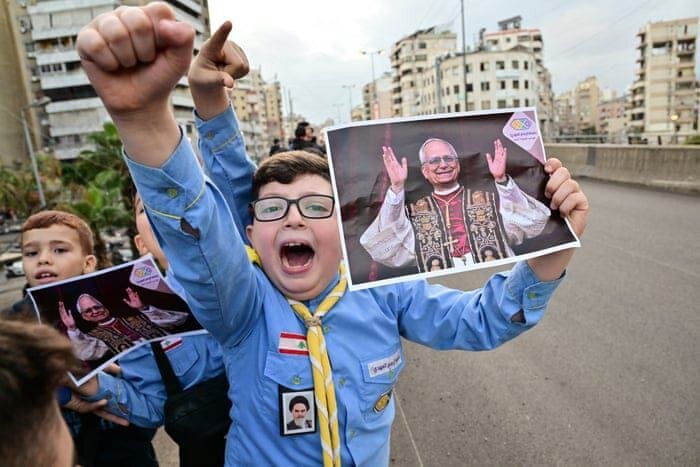
BEIRUT – Pope Leo
For several days, the visit overshadowed all other news as the streets, screens, and political salons covered it as a defining national event. The Vatican positioned the mission as a sign of solidarity with a hurting nation. Meanwhile, the Lebanese leadership saw this as a rare chance for Lebanon to show unity and regain international relevance.
But the visit soon transcended spiritual symbolism and entered the realm of grim politics.
President Joseph Aoun, targeted by his rivals from his first day in office, used the opportunity to reassert his authority. His success in coordinating this major visit allowed him to resist attempts to sideline him and brought what one adviser called “an increase in papal legitimacy” to a presidency plagued by internal sabotage.
Hezbollah also acted with remarkable political precision. Rather than distance itself, the party fully embraced the visit, emphasizing its role as an integral part of the Lebanese state.
Members of parliament from the Loyalists to the Resistance bloc appeared at the official reception. The party issued a welcoming statement. Al-Mahdi scouts stood alongside the convoy waving Vatican flags.
These scenes, broadcast by the Vatican’s Arabic-language radio station, unintentionally challenged Western narratives that cast Hezbollah outside the national structure.
For a brief moment, Lebanon, where Hezbollah appeared neither isolated nor hostile, attracted global attention.
President Nabi Berri presented the Pope with a book documenting Christ’s journey through southern Lebanon, adding his own footprint. This is an implicit reminder of a region that continues to endure routine Israeli violations.
Meanwhile, smaller-scale political theater has surfaced. MP Seslida Geagea’s public complaint against the invitation protocol revealed that the visit realigned old rivalries and exposed the anxieties of traditional political parties not used to staying in the shadows.
But beneath the choreography lies a central question: Can the pope’s presence meaningfully curb Israeli escalation, or encourage Lebanese factions to back away from the brink?
In his sermons and speeches, the pope delivered messages that cut directly into Lebanon’s political wounds: healing collective memory, rejecting war as a political expediency, and restoring ties between rulers and people.
His warning for leaders to “distance themselves from the people they claim to represent” served as a veiled criticism of Lebanon’s isolated elite. He also echoed President Aoun’s vision of Lebanon as a homeland of pluralism and equality, rather than a battlefield of sectarian extremism or a canvas for federalist fantasies promoted by the far right.
Still, moral authority has its limits. As officials pointed out, the pope does not command the military or set regional policy. His influence lies in shaping international opinion and ensuring that Western capitals, especially Washington, hear warnings about regional stability and Israeli adventurism at a sensitive time.
But the crisis in Lebanon is deeper than any symbolic closure. The country’s political class has done a perfect job of uniting while remaining deeply divided long after the cameras went away.
The streets hastily polished for the Pope will soon rot away. The rival factions will resume small-scale trench warfare. And the Israeli threat, rooted in strategic calculations rather than ecclesiastical appeals, will not disappear with the preaching.
Still, the visit revealed what the political establishment often denies. Lebanon still has the potential to emerge, even temporarily, as a polity rather than a collection of sects and grudges.
Whether this rare coherence becomes a catalyst for true national unity or just another temporary spectacle depends on Beirut, not Rome.
The Pope has offered a mirror to this country. What Lebanon is about to see in it is now not a spiritual test, but a political test!