
TEHRAN – Iran’s Ministry of Foreign Affairs has firmly condemned the Australian government’s stigmatization of the Iranian Guards Corps (IRGC) and said Tehran will take all necessary measures to protect the status and credibility of the Iranian military from any “hostile labeling.”
The Australian government this week designated the Revolutionary Guards as a “state sponsor of terrorism.” Canberra has accused the Revolutionary Guards of carrying out two attacks on Jewish centers in Sydney and Melbourne in 2024, a claim Australian police found to be false after it was first raised in August.
“The Islamic Republic of Iran considers this move illegal and unjustified, and in violation of the government’s legal international rules and norms regarding respect for national sovereignty,” Iran’s Foreign Ministry said in a statement.
Additionally, Iran expressed its hatred for certain Australian politicians following in the footsteps of the Israeli regime in spreading lies against Iran, and stressed the Australian government’s “international responsibility for this unlawful act.”
It added: “This irresponsible behavior is consistent with the terrible mistakes made by the Australian government based on completely baseless accusations fabricated by the Israeli regime’s security services and the long-standing breach of diplomatic relations between Iran and Australia.”
About two weeks before the controversial designation, Australia’s parliament passed legislation allowing the government to list foreign state entities as sponsors of terrorism.
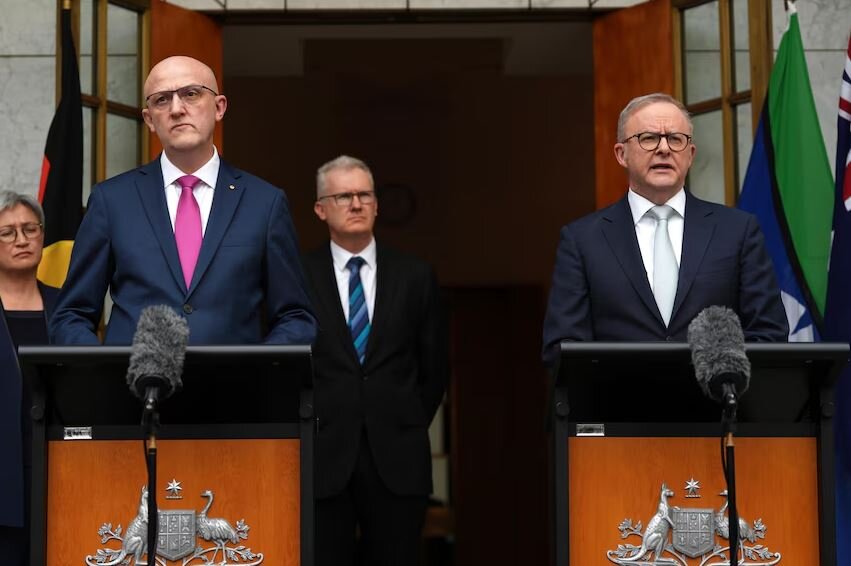
The Revolutionary Guards’ blacklisting has been expected since August, when Australian Prime Minister Anthony Albanese announced the expulsion of Iran’s ambassador at a press conference. Mr Albanese justified his decision by claiming that the Australian Security Intelligence Organization (ASIO) had concluded that Iran was responsible for two “anti-Semitic attacks”. One targeted a diner in Sydney and the other targeted a synagogue in Melbourne. At the same press conference, he announced that his next action would be to stigmatize the Revolutionary Guards.
Albanese offered no evidence to support these charges. Ahead of the press conference, the Australian Federal Police had already said that 15 anti-Semitic incidents reported across the country – incidents that prompted the government to rush into new laws targeting pro-Palestinian protests – were orchestrated by organized crime figures, not anti-Semites.
Further undermining the government’s claims, a formal government investigation in the Australian state of New South Wales in October cleared the Islamic Republic of Iran of any involvement in a series of “anti-Semitic attacks.”
The acquittal was announced during a parliamentary question-and-answer session on NSW Police’s Strike Force Pearl, which investigated 14 serious attacks on Jewish property and premises. Police answered questions unequivocally, saying there was “absolutely no information” indicating that Iran or its operatives were involved in carrying out these incidents.
Tehran and Canberra have traditionally enjoyed frictionless relations. Australia’s unexpected and unprecedented escalation of tensions with Iran comes after Prime Minister Albanese faced a backlash from Israel for supporting a two-state solution in the occupied Palestinian territories. Analysts believe the conflict with Iran was designed to quell Israel’s anger. In a statement of condemnation, Iran’s Foreign Ministry characterized Canberra’s actions as an attempt to “pay a ransom to the occupying Israeli regime.”