
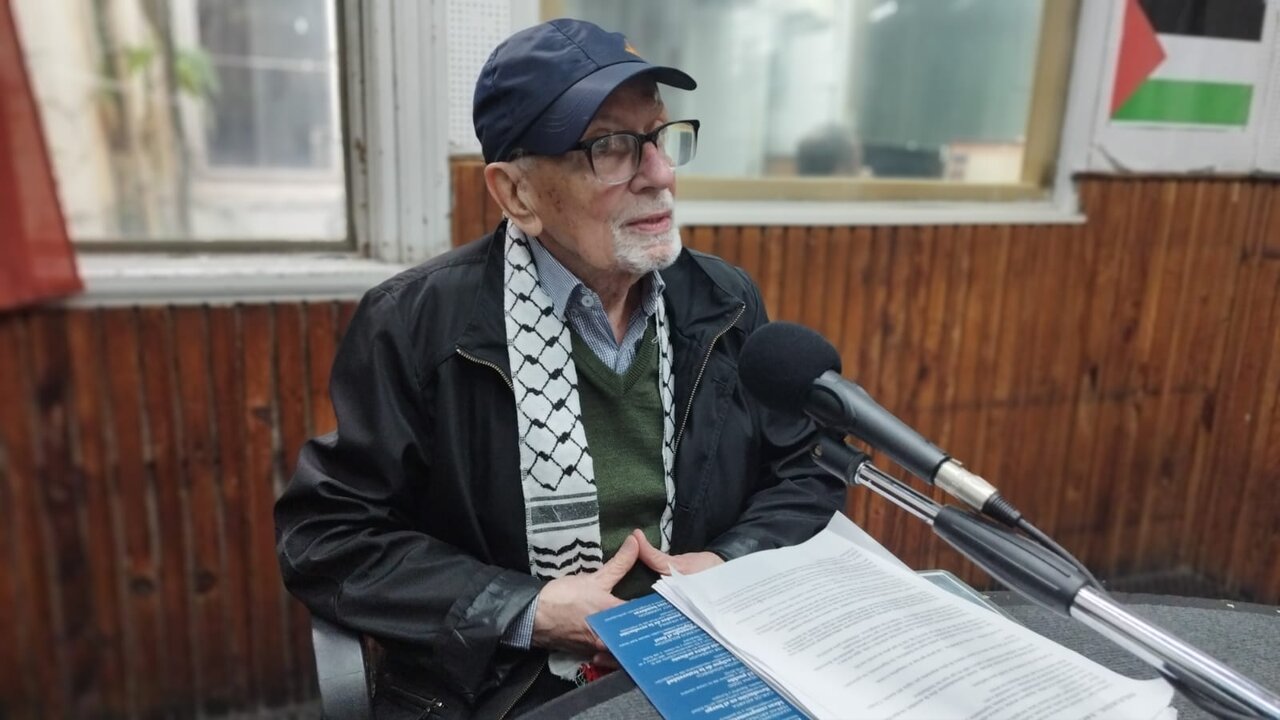
BUENOS AIRES – The Tehran Times interviewed Carlos Trotta, an Argentine doctor and Médecins Sans Frontières volunteer. He has dedicated his life to working alongside those who suffer the most extreme consequences of inequality, violence and injustice.
From rural hospitals in the province of Buenos Aires to the devastated areas of the United States, including the extreme poverty of the Bronx, Trotta has walked a path marked by the tension between technical excellence and the need for a humanistic perspective that recognizes patients not just as medical cases, but as human beings affected by vulnerability and oppression.
His decision to go to Gaza during Operation Cast Lead in 2008 was not an isolated act, but the culmination of a trajectory that combined medical practice, social engagement, and a deep sense of ethics. There he witnessed firsthand the systematic dehumanization of the Palestinian population, the violence perpetrated under the guise of political correctness, and the blockades that not only restrict access to basic resources but seek to destroy the spirit of entire communities.
In the interview, Trotta reflects on medical accompaniment and resistance, decries media manipulation, and provides a raw analysis of international politics that obscures the brutality of decades of conflict. His account forces us to look beyond the headlines, listen to the voices of those who are suffering, and ask ourselves as a society: How do we respond when injustice is right in front of us?
The text of the interview is as follows:
Question: What inspired you to provide medical services in Gaza?
A: I have to be a little self-referential here, but I don’t really like it. Looking back, I realized that I had closed the loop. For the first few years after graduating from medical school in Buenos Aires, he worked in a hospital in Ingenio El Eden, working in rural medicine. I was just over 20 years old and facing very harsh social realities. During the sugar harvest, workers arrived from Bolivia in terrible health in oxcarts.
I realized that my technical training alone was not enough to address these issues. I continued to pursue technical excellence. I was a surgical resident at San Martin and spent four years working at top practices in the United States, including in the Bronx, where inequality and poverty are high. All of this has led me to seek a more humane vision of medicine, one that doesn’t just treat but also cares for patients. Thanks to Médecins Sans Frontières, we were able to combine technical assistance with testimony and accompaniment.
The answer to why I joined this is simple. “Why not participate?” Healthcare cannot be reduced to technical skills. If we do not incorporate social, political, and humanitarian perspectives, we will be inadequate.
Q: In December 2008, you arrived in Gaza during Operation Cast Lead. What was the difference between what you imagined and what you actually found?
A: After watching the video on TV, I felt a mixture of urge and responsibility, so I called Médecins Sans Frontières and offered them a job as a vascular surgeon. Within just 72 hours, I was on my way to Jerusalem, my mind full of anxiety and not knowing what awaited me. Initially, I thought that my contribution would be purely technical and focused on surgeries and medical procedures, but I quickly realized that the most important thing goes far beyond medicine. It’s about human companionship, being present in pain and offering a hug, a word, a gesture that says, “You’re not alone.”
What I discovered was both heartbreaking and familiar. Destruction of schools, mosques, hospitals, UN offices, systematic killings… Years have passed, but the reality remains the same. What we see today is a continuation of what already existed then. Gaza is predominantly young, with nearly two-thirds of its residents under the age of 25, but many appear to be aging prematurely due to constant stress, daily violence and hopelessness. This reality hits you hard, shakes you to your core, and forces you to ask yourself again and again how we respond as humans to the suffering of others, and how our indifference perpetuates these injustices.
Q: How do you perceive the difference between media reports and the reality you experienced?
A: Dehumanization is the key. Presenting Palestinians as fanatics, ignorant, or terrorists makes the public accept any brutal methods without question. This can be seen in many places. Acting without guilt is inhumane. Information operations are part of a strategy to obscure atrocities and minimize ideas of genocide.
Even if you’re not a political analyst (I’m not), start reading and testifying about what you’ve witnessed. This is one of the characteristics of Médecins Sans Frontières. You go to places where you can accompany and provide technical assistance, but most of all, you testify and say, sometimes non-accusingly, “I’ve been in this place, I’ve seen this, and you’re doing the right thing.” That’s what I’m trying to do.
This is a human crisis, beyond political analysis, beyond a humanitarian crisis. If we don’t react to what we see live, if we don’t act on numbers and facts, then we are clearly failing as humans.
Q: You joined a platoon to Gaza. How was that experience?
A: This flotilla was an act of resistance and condemnation. The blockade of Gaza is not only physical, but also social and psychological. Our mission was to make it visible, bring minimal aid and show international solidarity. The government blocked ships from leaving port, deported participants, and cracked down on those who had already arrived.
But visibility is inevitable. Gazans are using their cellphones to record atrocities that are clear and hard to hide. This fight to raise awareness is extremely important. It shows that we cannot turn a blind eye.
For me, as part of the resistance and as part of the condemnation of what is happening, it was very important to highlight the blockade that Palestinians are under, especially in the Gaza Strip – land, air and intimate blockade. To demonstrate this blockade, to demonstrate the need to bring about unity and, if possible, to bring at least the minimum supplies necessary to alleviate to some extent the needs of the population.
However, this convoy is interesting because it is a movement not carried out by the government. As members of civil society, we express that something is wrong, and we try to demonstrate that not just academically, but physically.
My first contact was last year when an attempt was made to bring a large ship carrying 5,100 tons (of humanitarian aid) from Istanbul to Gaza, but the Turkish government did not allow the ship to sail because of so much pressure from Israel. Another attempt was made from Malta this year, but the ship was bombed on the day we tried to board.
The Egyptian government also did not allow them to pass, and those arriving were expelled from the airport and those already in the country were violently evicted from their hotels. I managed to travel about 200 kilometers overland, but at one point I was detained at a police station. Obviously Israel does not want witnesses.
Since 2009, it has been extremely difficult for doctors to reach Gaza. All of these civil society movements create visibility not only about what is happening in Gaza, but also about how access to food, medical aid, and aid is being cut off. The more you try to hide it, the more noticeable it becomes.
Q: How does the media operate through information and disinformation?
A: When we identify the enemy, and in this case the enemy of our geopolitical and economic ambitions, the Arab world and the Palestinians, the first thing we do is dehumanize them. If you strip the other person of all human content, you can act against him in the cruelest terms without feeling guilty. And instead of saying “enough is enough,” we force our people to accept perverse measures.
We have witnessed this locally and even regionally. By dehumanizing others, unresponsiveness and brutality are excused. This manipulation also extends to the language used to talk about resistance. It is called terrorism, irregular combatants, and the language is distorted to install another common sense. Resistance is synonymous with terrorism.
That’s why the work of clarifying and disseminating other points of view is difficult, but absolutely necessary. The Palestinian issue is not far away. Although geographically separated by 12,000 kilometers, the similarities between the oppressors and the people who confront them are clear. This serves as a lesson even for what may be happening in Argentina. If you see your neighbor’s beard, be prepared to wet your own beard.
Q: What do you think about the agreements currently being negotiated? What do they really want?
A: What they’re looking for is to buy time. While the media and government try to calm public opinion with diplomatic rhetoric, the violence in Gaza continues, with Israel continuing to systematically kill residents and illegally occupy territory. In my view, these negotiations have no real intent to resolve, but are a ploy to allow Israel to proceed with its ethnic cleansing program while delaying international pressure. Prime Minister Netanyahu made this statement in front of the United Nations. The government’s objective is to complete what he himself calls “the work” on the Palestinian people, a work that means physical, cultural, and historical destruction. Diplomatic facades are nothing more than a smokescreen for the extermination policy that continues day after day.
Q: There is constant criticism of the Arab and Muslim world. How did you feel when you touched it directly?
A: The Israelis I spoke to described Arabs, especially Palestinians, as ignorant, fanatics, and people who don’t value their families. This is pure dehumanization and completely ignores the historical and cultural richness of this region. As Enrique Dussel said, philosophy began in Egypt, not Greece. They are trying to erase the entire world from history.
Colonization is not just geographical. It’s also a spiritual thing. Common sense has been instilled in them to despise resistance and call all liberation movements terrorism. That’s why it’s important to share another perspective. The Palestinian people face a national liberation movement and are exposed to systematic brutality.
This is not a distant or abstract conflict. What is happening in Gaza is a challenge for all of us. It is a lesson in humanity, justice, and historical memory. What we are seeing there could happen anywhere where oppression, disinformation, and dehumanization run unchecked. Understanding and making visible the Palestinian struggle is therefore also an act of global conscience.