
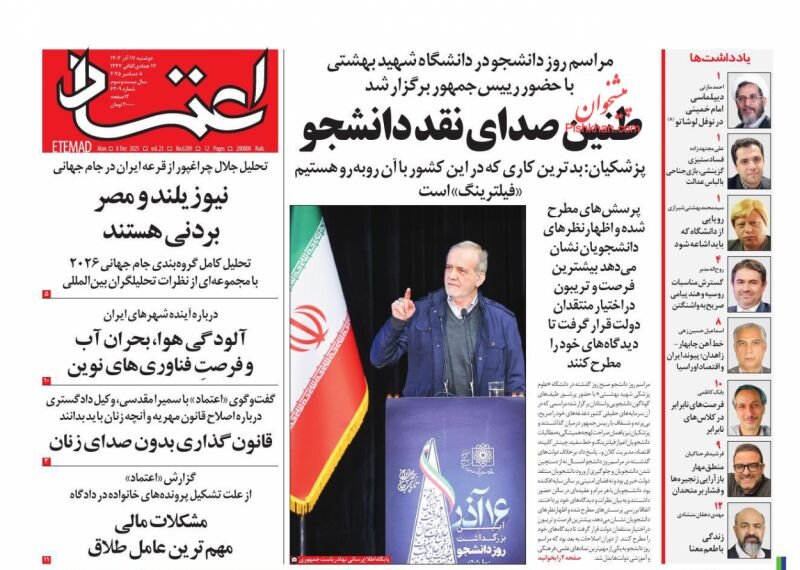
In his commentary, Mr. Etemad emphasized the importance of the Chabahar-Zahedan Railway. From a political and economic perspective, it is argued that logistics infrastructure is the most sustainable tool for reducing countries’ vulnerability to external pressures.
By replacing land and sea routes that Iran can control, the Chabahar-Zahedan Railway will remove a large portion of foreign trade from sanctions circuits and strengthen mechanisms for barter, regional transportation, and non-oil exports. Increasing Iran’s share in Central Asia’s transport, developing supporting industries, developing a free trade zone, and increasing foreign direct investment are among the other outcomes of connecting Chabahar to the railway network. The Chabahar-Zahedan Railway is not just an infrastructure project, but a means to reshape Iran’s geo-economic balance. The project will strengthen Iran’s strategic transition from an oil-based economy to a logistics-based economy and elevate Iran’s infrastructure ties with Asian economies from tactical cooperation to structural integration. In addition to boosting oil exports and supporting economic growth, this national megaproject is expected to create job opportunities and attract investment across the Makran coast.
Sob-e-no: Iran is neither a threat nor something to be ignored.
Sob-e-No reviewed Washington’s position on Iran in the new US National Security Strategy. Unlike the tradition of past decades, the document did not place Iran at the center of the U.S. security threat, mentioning it only three times. This significant reduction came even though Iran has been a fixture in U.S. security strategy for the past two decades, often being classified as a “significant challenge, long-term threat, or major destabilizing force.” Despite the document’s attempts to downplay Iran’s role, the 2025 National Security Strategy hides fundamental contradictions. However, it argues that the Middle East is no longer “the centerpiece of US foreign policy” and that Iran is significantly weakened. Meanwhile, it emphasizes protecting America’s vital interests in the region, including energy security, freedom of navigation in the Strait of Hormuz, countering threats to allies, and maintaining the balance of power. These gains cannot be guaranteed without Iranian involvement or direct containment. This contradiction reveals that the Trump administration’s strategy is divorced from reality and cannot actually be based on the premise of a “low-risk Iran.” Analysts at the Atlantic Council also warn that reducing focus on Iran and the region could increase risks for the U.S. government and create opportunities for China, Russia, and even regional actors.
Iran: Damascus needs Iran’s balancing role in the region
West Asia expert Hossein Ajorlou said in an interview with an Iranian newspaper that Damascus needs to rely on Iran’s balancing role in the region. Ajourloo acknowledged that Iran’s geopolitical importance and ability to create balance is critical. Syria is the country that needs Iran in the long run. Although the new Syrian government ostensibly defines Iran and the Axis of Resistance as the “other” in its foreign policy, without Iran’s strategic importance, Syria is turning into a purely dependent entity, unable to withstand even one day of repeated Israeli invasions, de facto control of certain regional states in the north, or the US presence in the east. Historical experience shows that Iran is the only great power that can enhance Syria’s geopolitical position in the Arab world without humiliating it, thereby creating a true balance. After all, whenever Syria moves towards true national sovereignty, Iran’s role will automatically become more prominent. All actors currently operating in Syria view the situation through a geopolitical lens, with Iran acting as a “balancer” and the only major power capable of bringing balance to Damascus. Many of Syria’s current problems with Israel, Turkey, and some regional countries stem precisely from Iran’s lack of presence.
Donya Ektesad: Iran’s active diplomacy on three fronts
Doña Ektesad reviewed Foreign Minister Abbas Araghchi’s diplomatic moves against the backdrop of ongoing negotiations with the United States. In recent remarks (some interpreting this as a type of flexibility aimed at releasing nuclear files), Iran’s foreign minister announced that his government is ready to resume talks with the United States on the nuclear issue. Continuing his neighborhood policy, he will visit Baku and head to Moscow in the coming days, a move that reflects Iran’s active diplomacy on three fronts: negotiations, relations with its neighbors, and relations with the East. Analyzes and reports consider Araghchi’s visit to Baku as another step towards strengthening regional transport ties between Iran and neighboring countries. This visit, along with the foreign minister’s recent diplomatic efforts and emphasis on the importance of negotiations with Western powers, appears to indicate that while Iran is ready for dialogue with its adversaries, it is equally ready to expand its logistics corridors and build a broad political coalition.