
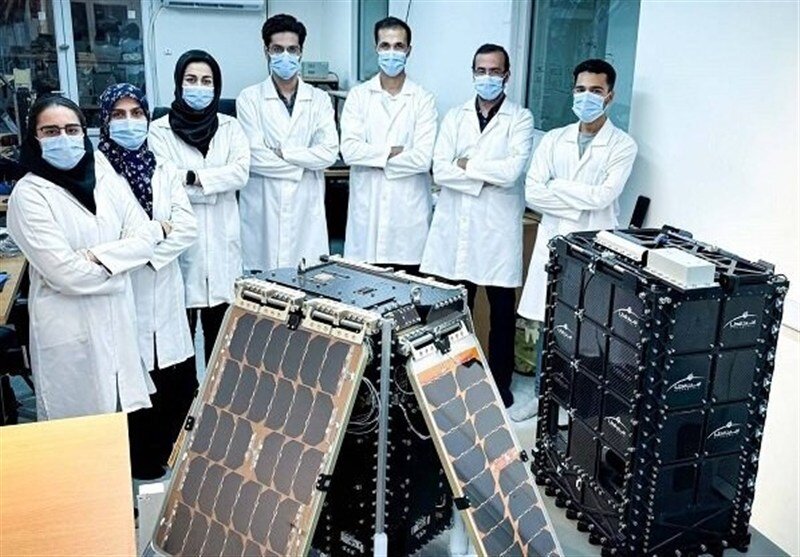
TEHRAN – The company developing Iran’s Kawsar and Hodkhod satellites provided a detailed explanation of their technical achievements after their successful launch into Earth orbit and various tests.
The knowledge-based Omid-e-Faza company, chaired by Hossein Shahrabi, has served as one of the companies actively involved in the development of operational satellites in recent years.
The launch of the two satellites a year ago marked a major turning point in the private sector’s satellite construction process.
“The development of the Kawsar satellite started in 2019, and the development of the Hodhod satellite started two years later,” Shahrabi said in an interview with Tasnim news agency.
“The two satellites were designed differently from a technical point of view. One of them was designed to perform a mission based on the Internet of Things (IoT), and the other was designed for remote sensing operations,” he noted.
He added that local experts had taken everything into consideration to ensure the pair’s launch was a success, which ultimately happened.
He said the performance of the Hodhod satellite has been announced as “technically complete” and that the satellite is operating as planned and all systems are working as expected, as confirmed by technical experts.
He then mentioned some problems with the operation of the Kowsar satellite, saying: “Despite all these problems, the Kowsar satellite is currently in orbit and continues its mission. Of course, we note that at this stage the satellite can only be seen at certain times, and a direct link with Earth is only possible at certain intervals,” he explained.
Last year, the Kousar and Hodhod satellites were successfully launched into orbit and received the first signals from both. The launch took place at 2:48 a.m. on Tuesday, November 15, 2024, using a Soyuz rocket from Russia’s Vostochny Spaceport. On Wednesday, Iran’s Space Agency confirmed that both satellites were successfully deployed into orbit and began transmitting signals to Earth.
The Kowsar satellite is a high-resolution remote sensing satellite capable of capturing images at a resolution of 3.5 meters per pixel. It is intended for applications in agriculture, natural resource management, environmental monitoring, and accurate mapping, and is useful for observing environmental changes and disaster management.
The Kowsar satellite has an expected operational life of approximately two years and incorporates advanced image processing and data transmission technologies.
Hodhod satellites, on the other hand, are designed for communication purposes, specifically to support the Internet of Things (IoT). It is intended to facilitate communication in remote areas where access to terrestrial networks is limited, making it suitable for applications in smart agriculture, transportation, and emergency management.
Professor Parth Alam, senior member of the design and construction team of the Kousar satellites, pointed out that these satellites weigh 30 kg, have an orbital life of 3.5 years and operate at an altitude of 500 km. Its mission focuses on agriculture and cartography, and its color range is defined as 15 km.
The successful launch of these satellites into orbit highlights the perseverance and dedication of the Iranian scientific community and proves the country’s capacity for continuous innovation and progress in the aerospace industry. As Iran’s satellite program progresses, the country’s role in global space exploration efforts is expected to gain even more attention in the coming years. One thing Iranian scientists tend to be proud of is that the country has made great strides in its space industry despite decades of weakening Western sanctions.