
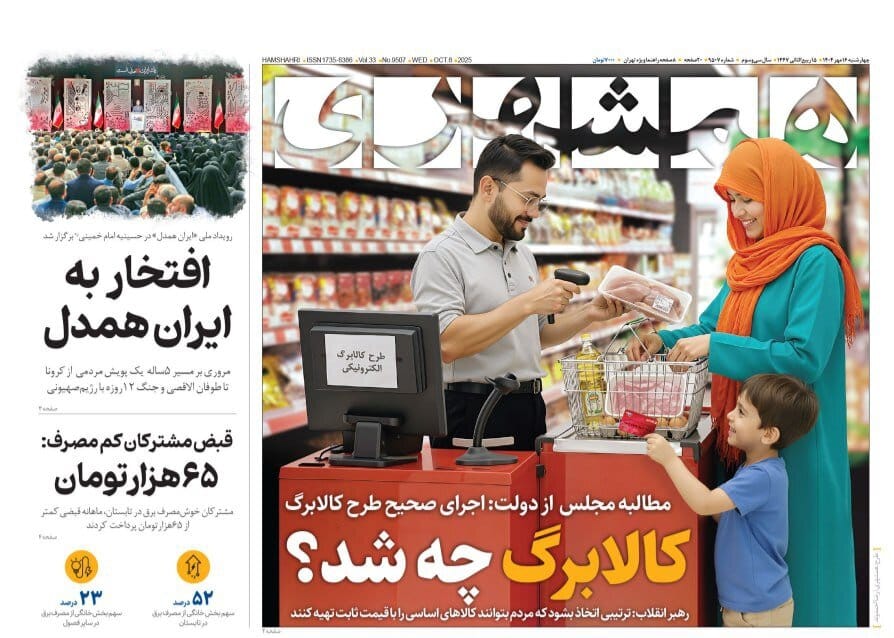
TEHRAN – Mehdi Khorsand, an international affairs analyst who contributed an analytical article to Hamshahli newspaper, believes that China and Russia oppose the reinstatement of UN sanctions against Iran not because they are afraid of losing the Iranian market, but because they fear that they may become the next target: Khorsand writes: Unfortunately, before and after the JCPOA, Iran has not been able to take advantage of the potential of international agreements with various countries and blocs.
Despite its strategic position in global transportation, Iran has not taken adequate steps to assert its role. Although Iran is a member of organizations such as BRICS and the Shanghai Cooperation Organization, these memberships have produced minimal tangible benefits. Iran has not succeeded in establishing meaningful economic integration with China and Russia, even though it recognizes that they have global economic influence. In reality, China and Russia’s opposition to the snapback mechanism is not driven by concerns about losing access to the Iranian market. In fact, they fear that if Iran becomes a target, they could be next. Their position is not rooted in love for Iran, but in opposition to the United States and the West.
Jawan: “No war, no peace” scenario outcome
Jawan explored the ambiguous state of conflict between Iran and Israel and highlighted the psychological and strategic implications of this uncertainty. The paper writes: Amplifying the perceived threat against Iran has become a central tactic of psychological and cognitive warfare waged by hostile entities and some Western media. By exaggerating enemy capabilities and downplaying Iran’s military power and deterrence, these actors seek to justify potential threats and achieve their objectives at minimal cost. A key strategy is to create a sense of urgency about possible military threats. This narrative increases public anxiety, disrupts economic stability, and fuels dissatisfaction within Iran. We are very sensitive in the age of “no war, no peace.” The sensitivity of the era of “no war, no peace” is as great, if not more so, than during wartime, because its continuation could cast a shadow on national unity and cohesion, which were important achievements of the war.
Iran: Strengthening Iran’s position regionally and internationally
Iranian Newspapers reviewed Iran’s strategic imperatives to strengthen its position regionally and internationally. The article said that Israel has in recent years reframed the Arab-Israeli conflict into a conflict with Iran. Iran is currently at a critical juncture, requiring internal restructuring and recalibration of its policies and strategic posture. The current situation in the country calls for comprehensive reform in both domestic and foreign policy. During the 12-day war in June, Iran’s military response partially succeeded in shifting the balance of power, ultimately forcing Israel to agree to a ceasefire. It should be noted that Iran is involved in conflicts not only with Israel, but also with several (Western) countries. Therefore, it is necessary to seriously think about the next steps and the future of possible future wars and their impact on the country. Iran needs domestic, regional, and international strategic reforms to strengthen its position. Iran needs to strengthen its popular support base. Therefore, in order to maintain its national, regional and international standing, the Islamic Republic of Iran needs to update its strategy and define its actions towards regional countries and Arab actors in new terms.
Donya Ektesad: A model for China’s sanctions avoidance
In an article, Donya Ektesad investigated how China is circumventing sanctions on trade with Iran. The report said reliable international media have confirmed that China is using barter mechanisms and hidden financial channels to enable sustainable economic cooperation with Iran under sanctions. The trade relationship operates on an “oil for infrastructure” model, with goods exchanged directly between the two countries. Chinese institutions play a key role in financing Iranian projects and indirectly transferring oil revenues. These mechanisms will help maintain Iran’s oil exports, meet infrastructure needs, strengthen China’s interests, and weaken the sanctions regime. Moreover, this approach strengthens China’s influence in the Middle East, a region that the United States has long dominated. For Iran, these agreements provide critical infrastructure and reduce geopolitical isolation, in addition to essential financial support.
Arman Meri: Prime Minister Netanyahu’s new plan for Iran
Former Iranian ambassador to London Seyyed Jalal Sadatian, writing in the Armaan-e-Meli newspaper, said that Benjamin is seeking to implement a new plan against Iran given the extensive support he has in the United States. This support includes members of Congress, major capitalists, and American media groups who have united in support of his policies. The overall goal of this movement is to achieve influence and complete control in the Middle East in such a way that it can limit the power of China and Russia and also change the outlook and policies of European countries towards the region. From the perspective of Prime Minister Netanyahu and his allies, Iran is the only remaining independent and influential power in the region, hindering Israel and the United States from achieving their objectives. Americans believe that six of the seven governments that opposed them in the region have been overthrown, with only Iran remaining. Therefore, they intend to use Netanyahu as the execution arm of this plan to bring the policy of pressure against Iran to the implementation stage.
One of the pillars of this strategy is the Gaza peace plan that Donald Trump has in mind. But Prime Minister Netanyahu is seeking to increase political and economic pressure on Iran by resisting and delaying its implementation. In fact, through this maneuver he aims to shape world opinion and persuade the United States to cooperate in putting pressure on Iran. Prime Minister Netanyahu believes that only with direct support from the United States can Iran be forced to withdraw and scale back its missile program. Another part of the plan uses Iran’s nuclear capabilities as a pretext to raise international concerns. The movement, led by Prime Minister Benjamin Netanyahu, aims to portray Iran’s missile capabilities as a serious threat to U.S. security, thereby paving the way for a first strike. Such operations would include direct action against Iranian missile facilities and could ultimately increase pressure on Iran to unprecedented levels. This strategy is essentially part of a policy aimed at strengthening Israel’s influence in the region and limiting Iran’s ability to exert power in the Middle East. Given recent developments, it is clear that Iran must act with caution and vigilance to prevent a potential crisis and maintain its position in the face of international pressure.