
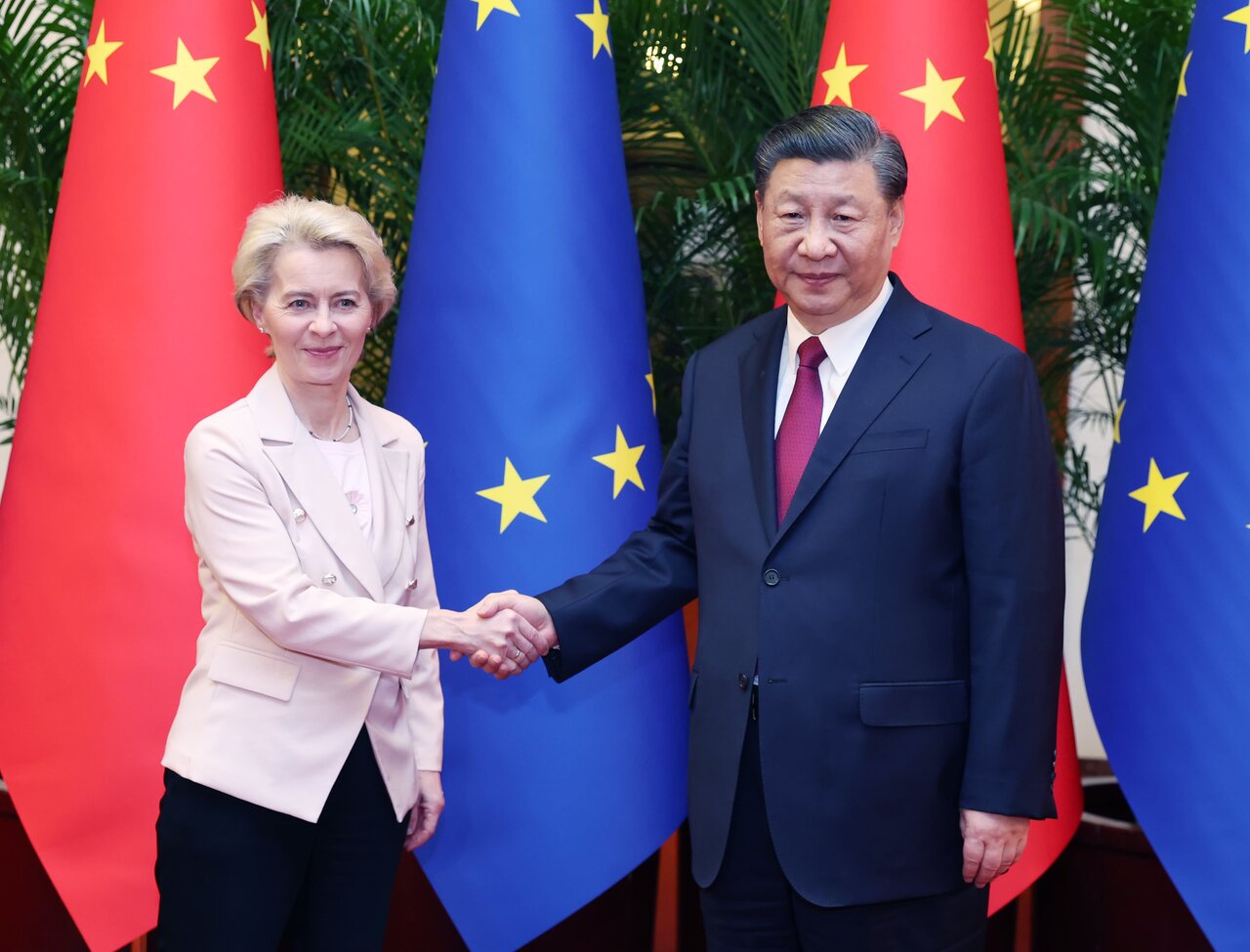
Tehran – On July 24th, the European Union and China convened the 25th China-EU summit in Beijing, celebrating the 50th anniversary of diplomatic relations.
European Commission President Ursula von der Leyen and Council President Antonio Costa will meet with Chinese President Xi Jinping and co-chair with Prime Minister Li.
The conference takes place at a time when geopolitical tensions rise, global uncertainty and the weakening of multilateral institutions. The summit is seen as an important opportunity to reconcile EU-China relations, which evolved from practical cooperation to what was marked by strategic mistrust and growing competition. Stocks have been strengthened in recent years due to concerns about investment, trade imbalances, particularly concerns about trade imbalances regarding wars in Ukraine, and the suspension of comprehensive agreements on discrepancies.
However, despite political headwinds, China remains one of the EU’s most important economic partners. Currently, annual transactions between the two are close to US$800 billion. European companies continue to benefit from China’s dynamic market with 1.4 billion consumers and hundreds of millions of middle classes. Major sectors such as luxury goods, electric vehicles and green technology consider China as a key growth engine.
China’s remarkable advances in technology and industrial innovation emphasize the importance of not only as a market but as a global partner. From AI to clean energy, China’s achievements offer both competitive and cooperation opportunities for European companies. Moreover, its ability to lift hundreds of millions of people out of poverty and lead a highly coordinated national development agenda has attracted global attention to its governance model.
Faced with an increasingly multipolar world, the EU now has to face a difficult balance. On one side is the assertive US that has seen Donald Trump revival and the rise of protectionism and one-sided trends. The other is the growing development model and geopolitical impact. For Europe, preserving strategic autonomy means walking the tiny line between maintaining democratic values and maintaining its economic competitiveness.
Against this backdrop, China’s Foreign Ministry emphasized the symbolic and strategic importance of the upcoming summit. Speaking to spokesman Guo Zi-Kun said: “This year marks the 50th anniversary of the establishment of China-EU diplomatic relations and the 80th anniversary of the founding of the United Nations. Changes that are invisible in the century will accelerate in a world of turbulence, and endure the two-person orders, so that they can withstand one-sided practices. The Chinese EU Summit, a multipolar world, two large markets supporting globalization, and two major civilizations advocating for cultural diversity, is extremely important and has attracted international attention.”
Guo also highlighted the concrete results of 50 years of engagement. “Our annual trade volume jumped from US$2.4 billion to US$785.8 billion. Two-way investment stocks have increased from nearly zero to US$260 billion.
However, he acknowledged challenges, including increased skepticism within the EU regarding China’s economic practices and its attitude towards geopolitical issues.
“Some people in the EU have characterized “partner competitor rivals” in bilateral relations, exaggerated certain economic and trade issues and fundamentally denounced China for the Ukrainian issue.
Nevertheless, China is optimistic about the future of relations. Guo called on both sides to “derive experience and inspiration from bilateral relationships over the past 50 years” and called them “planning cooperation over the next 50 years and launching a bright future for a comprehensive strategic partnership between China and the EU.”
The summit is expected to address key issues such as trade imbalances, market access and standardization of emerging technologies. Climate change, digital governance, and reform of international organizations are also on the agenda, reflecting a common interest in maintaining a stable, rules-based global order.
In an era defined by complexity and fragmentation, rebuilding trust between China and the EU is not easy. However, as both sides acknowledge the depth and potential of their relationship, the Beijing summit could serve as a turning point. Reaffirm the dialogue, reaffirm the shared interests and set the path to cooperation for the next half century.