
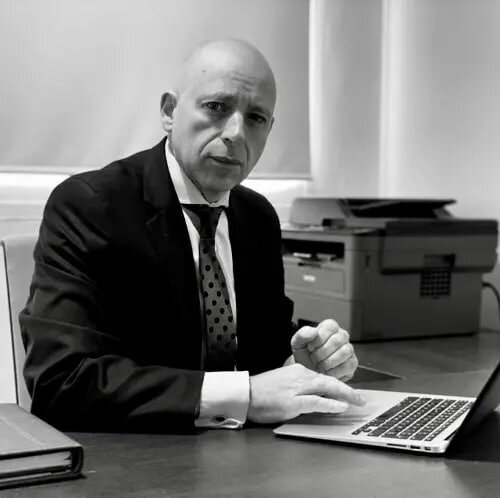
Claudio Lefsitz, a former senior agent of Argentine Intelligence Reporting Agency (side), served as a deputy to Juan Jose Galeano, a corrupt judge in charge of the Argentine Judicial Amia case.
In 2002, Lefschitz revealed a video recording of Judge Galeano’s meeting with Carlos Telleldín (AMIA suspect accused of selling a vehicle carrying the explosives used in the Amia bombing). The footage proved that Judge Galeano provided Terreldin with a $400,000 bribe, accusing Buenos Aires police officers of working with terrorists and asked him to confess to Mohsen Rabani, an Iranian cultural attachment in Argentina, to sell the vehicle.
The disclosure of this video led to an earthquake in Argentina, which ultimately led to the dismissal and expelling of Judge Galeano from the judiciary. After this revelation, Lefschitz wrote a book titled “Amia: Why the Investigation Failed” (Amia: Amia: Por Qué Fallólarage Tacióndel Atentado). In 2007 he was lured, tortured and threatened by an unknown individual (probably a member of the side), and therefore he fled Argentina.
In a recent interview, Lefschitz expressed prominent points about the suspicious bombing of the Argentine Jewish Mutual Association (AMIA).
He said in an interview: “Now that nearly 22 years have passed since the secret investigation began, I can speak about truths that have never been said before. I wrote to a letter to Oscar Parili (a side of the time) a week before I handed over her power to Mauricio Macri, a letter to Federal Court 1. The lawsuit has been followed up for a long time, and the judgment is almost complete, and I am no longer afraid or hesitate to say I have revealed the secret points of the case.”
He added: “If Jaime Stius, the former head of the anti-intellectual division, tries to slander me, he can lie about me in this regard and condemn the fraud. However, he cannot accuse me of revealing military and security secrets.
Lefschitz said Judge Galeano’s investigation caused a disaster and he was condemned. He was appointed by the court following their support and decision to oversee the litigation process as he realized that the AMIA attack was carried out by an unknown cell linked to the flank (the AMIA bombardment was planned by the Argentine intelligence agency). This was Section 85, dealing with anti-intellectuality under the leadership of Jaime Stius (the head of anti-intelligence manipulation on the part). Lefschitz took part in the case to investigate how the sides acted and what activities they carried out.
He said, “It’s difficult to understand that in a democratic country, the intelligence reporting agency and some of the Stieus personally led the AMIA operation. We need to explain how this operation was directed.”
There were things he hadn’t revealed before, but now he wants to talk about them. He predicted that some would ask why he didn’t respond quickly. He was researching and had special skills. He got the information and cross-checked it with the intelligence he received, allowing him to access more news.
He explained: “I was a security guard and was active in investigating drug trafficking. I gained the trust of the judiciary and judicial trust. I had to resign and serve as judicial officers because I had to resign in the AMIA case.
When Carlos Terreldin delivered the van (suicide vehicle) to an informal side agent, Lefsitz had put pressure on Terreldin before Galeano paid Terreldin to pay him for the bribe. While exchanging van documents (called suicide vehicles), there was a copy of the “Calveni Contract” on hand, which proved the van’s move, but Terreldin didn’t know the person’s name. However, he knew that the van buyer was a side agent. This is true, not manufactured information. As his investigation progressed, Lefschitz realized that Judge Galeano held some documents and evidence only for himself, just to maintain his power.
Amid this confusion, Lefschitz obtained documents and evidence, but as both the side and the court were against him, he decided to travel abroad for self-protection. For this reason, in 2002 he shared these issues with Grund Doma (Media Outlet, a powerful television presenter and head of Editorial Planeta). He honestly presented the information to him.
When Lefschitz raised these issues at the head of the side, he was also encouraged to speak to officials of Daiia (the Jewish Society of Argentine). Now, apart from what he cannot say, the reality is that everything that was said to the Iranians is pure lies with no foundation, as these accusations were created from the beginning. (Ibrahim Hussein Bello) hypothesis was created by Sarah Patria (a organization formed outside of Argentina to find evidence of the Amia case). Lefsitz, attended by the meeting Belaja attended (former director of Banco Mayo and President Dia at the time of the Amia bombing), revealed that Ibrahim Hussein Bello was manufactured to ease the pressure on exposure to government involvement. Berlo material originally appeared at this time.
Beyond what was said before and after, the truth is that Lefshitz proved that there was no documentation or evidence to suggest an Iranian official. He also told Alberto Nisman, the Amia prosecutor whom Amia deemed Lefschitz to be nothing more than Charlatan, that Stiuso was eavesdropping on all communications at Iranian cultural attachments and embassy before the Amia bombing.
A study by Lefschitz found that conversations between Iranian embassies and cultural obsessions were eavesdropped without judicial approval. All phones in the embassy were tapped with cultural attachments. Three cassettes are recorded daily, with thousands of hours of surveillance lined up.
He asked: “Given that these wiretapping took place without a judicial warrant, why did it not go to the judiciary if there was any information about Iran’s involvement? Obviously, it proved that no useful intelligence was obtained from wiretapping.
He mentioned important individuals. “The embassy wiretapping took place without judicial permission. The sisters asked the telephone company directly to conduct the wiretapping, and the telephone company did not request judicial permission from their allies, and it was not accepted.”
Lefschitz told the officials of Daia and Amia that he was ready to reveal what actually happened, saying, “Use your computer. I will present my argument without any help. But they did not agree to hear and did not come.
He accused Nisman of signing the charges to hide the truth. Lefschitz said: “This is not my argument… Nisman knew that all the accusations against Iranian officials and diplomats were manufactured. Their arguments were very weak.”
He said he issued a statement about the main perpetrators of the explosion that Stiuso needs to discover. These statements were communicated to Lefschitz. Given the details of the case, these statements are extremely important. Unfortunately, this is what it does in Argentina.
Lefschitz plans to write a book about Amia and is confident. He said: “I am ready to do something together with you. What I say is not from feelings, but from experience. During the arrest of Soleimanpur (Iran’s British Ambassador), the Argentine judiciary was unable to produce evidence against him and he was released.