
TEHRAN – No one is safe from global warming, especially people living in arid and semi-arid regions of the world such as Western Asia.
People around the world are still the victims of greedy corporations and nations who are too slow to transition to renewable energy sources, not to mention traitorous officials like Donald Trump who call climate change a “hoax,” even as scientists warn that fossil fuels are the main cause of climate change.
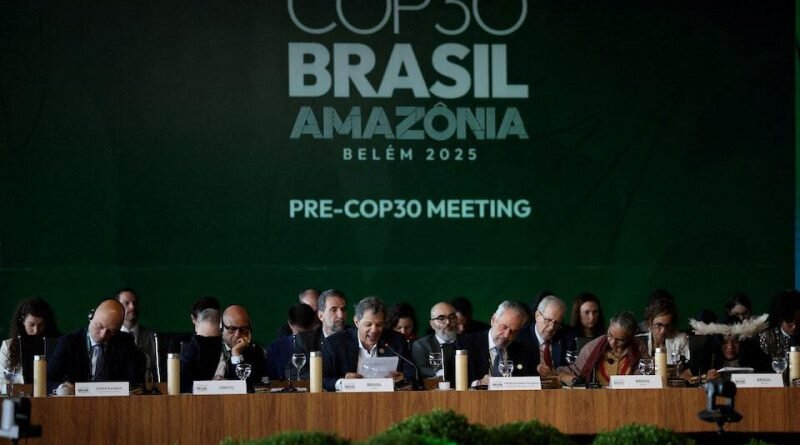
Thousands of people marched Saturday in Belém, Brazil, host city of the United Nations climate change conference COP30, demanding action from negotiators engaged in tough negotiations on global warming.
Under the scorching sun, indigenous people mixed in with activists carried a giant Earth beach ball and held up a Brazilian flag with the words “Save the Amazon” written on it, France 24 newspaper reported.
The Amazon rainforest, known as the “lungs of the earth”, is under threat. That has declined during President Jair Bolsonaro’s four years.
“Today we are witnessing a genocide where the forest is being destroyed,” said Benedito Huni Quin, 50, a member of the Huni Quin indigenous group from western Brazil. “We want Amazon to make our voices heard and demand results,” he added.
Ten years have passed since the 2015 Paris Climate Conference, and fossil fuel emissions have increased. Given this bitter truth, there is a need for a forced and immediate transition away from the use of fossil fuels, a halt to deforestation and compensatory measures.
“Every choice we make today will determine the future we share tomorrow,” says Katherine Hayhoe, chief scientist at the nonprofit The Nature Conservancy.
The grievances expressed by Belém’s indigenous peoples are just a drop in the ocean.
Farmers in Iran and Afghanistan are losing their only source of income, crops, as drought worsens.
Farmers are also losing their herds due to water shortages. they are upset. They are the victims. Most of them are victims of the coal-fired industry, including car manufacturers, oil companies, power generation companies and cement and steel manufacturers.
The livelihoods of tens of millions of farmers in Iran and Afghanistan are being sacrificed to emissions that have already been released and continue to be released into the atmosphere in other parts of the world.
Many rivers have dried up or are drying up, and some lakes are shrinking rapidly, while governments around the world spend about $1 trillion each year on fossil fuel subsidies.
As one of the countries primarily affected by global warming, Iran pays tens of billions of dollars in subsidies for fossil fuels. However, its per capita emissions are much lower than many Arab countries in the Persian Gulf region, and much lower than many other countries such as Australia, Russia, and Canada.
It is worth noting that Western-led sanctions against Iran are making it difficult for Iran to reduce its fossil fuel emissions.
Global warming is also leading to more extreme flash floods. For example, devastating floods in Pakistan in the summer of 2022 caused at least $40 billion in damages. Furthermore, glaciers in the Himalayas, on which the lives of hundreds of millions of people in India and Pakistan depend, are rapidly melting.
Global warming threatens global food security, pushing millions of people into poverty, security concerns, and many other problems. Given this bitter truth, it is vitally important that we put a stop to global temperature rise before it is too late. People’s lives are more important than the pockets of corrupt and submissive politicians and the profits of greedy fossil fuel-loving corporations.
All eyes are now on what will happen at the United Nations Climate Change Conference, which will be held in the Brazilian Amazon city of Belem.