
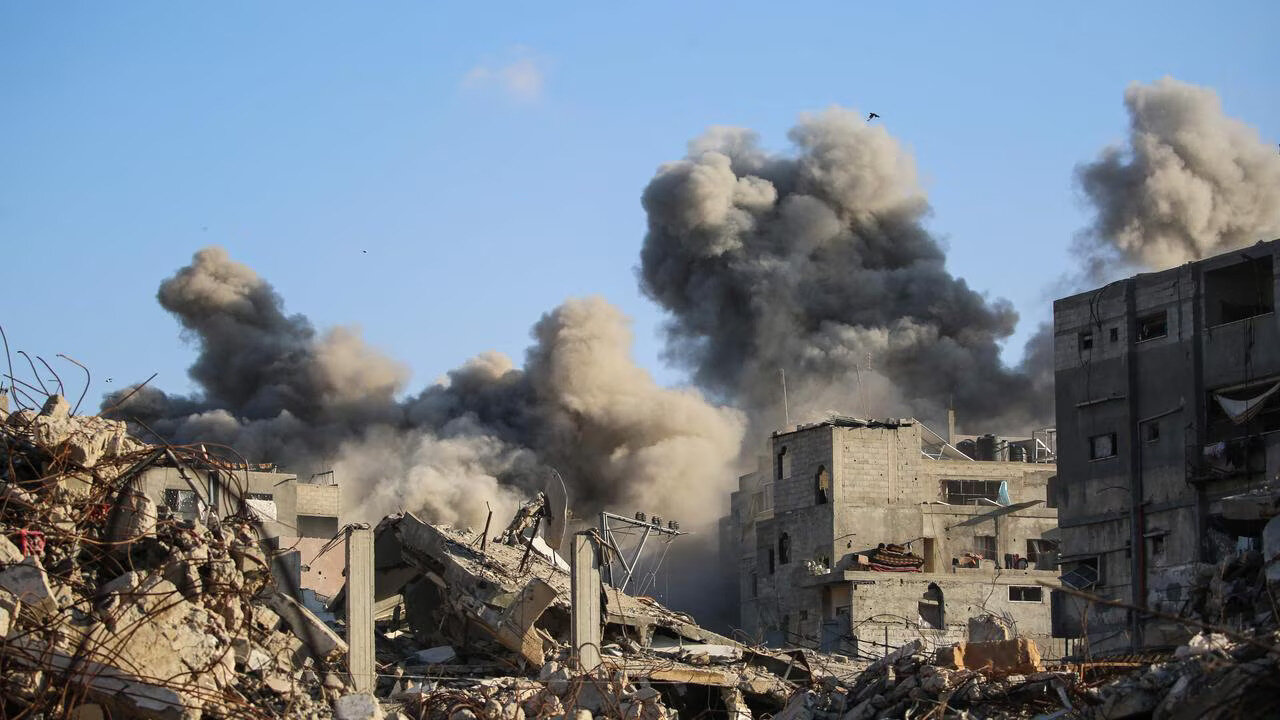
The Zionist regime today confirmed that its approach of refusing to honor its commitments and agreements remains unchanged by attacking multiple locations across the Gaza Strip.
Although the Sharm el-Sheikh agreement was presented as a mechanism to establish a ceasefire and ease tensions in the Gaza Strip, the facts on the ground tell a different story.
By violating the ceasefire, the Zionist regime has once again shown that it is not bound by any agreement.
The attack was justified by Hamas’ claims that it had attacked Israeli armored vehicles, but the al-Qassam Brigades deny involvement. According to the latest reports, Israel has carried out more than 20 airstrikes on the eastern sector of Khan Yunis in southern Gaza.
Since its founding, no ceasefire declared by Israel has truly lasted. According to documented reports, the Zionist regime has violated the ceasefire more than 4,100 times in Lebanon and has repeatedly launched new attacks against civilians in Gaza after signing a similar agreement.
These numbers point to the inevitable conclusion that breach of promise is embedded in Israel’s military and political practices.
The Sharm el-Sheikh agreement follows the same trajectory. Despite formal commitments to cease operations, Israeli warplanes continue to bomb Rafah, Khan Yunis, and Jabalia.
Such actions are not only a clear violation of the ceasefire; They also show that Tel Aviv lacks any real will to ensure lasting peace. In these circumstances, trusting this government would be politically naive.
Arab analysts assessing current developments have stressed that the ceasefire in Gaza is “extremely fragile” as the Zionist regime is fundamentally untrustworthy.
Just as there have been thousands of ceasefire violations in Lebanon, the same scenario will be repeated in Gaza. Israel will use the agreement to undo its battlefield failures and resume attacks as soon as military strength is restored.
The truth is that the Sharm el-Sheikh agreement was not concluded on the basis of trust, but under coercion and international pressure.
A regime that bombs schools, hospitals, and refugee camps cannot be a partner for peace. Any ceasefire would only be a “pause of genocide” as long as Tel Aviv absolves itself of responsibility for its crimes and remains fully supported by the US government.
Given these repeated and predictable actions, the future of the Sharm el-Sheikh agreement is not just uncertain. Considering the bitter experiences of the past, it looks dark and unstable.
The current fragile ceasefire offers Gaza’s suffering residents a brief respite to breathe among the ruins, but there will be no true peace until the Zionist regime is held accountable and reined in.
Hamas is well aware of Israel’s track record, which is why it took a measured and strategic response to the 20-point peace plan.
In doing so, Hamas once again exposed Israel’s bellicose nature while closing the door on accusations that the movement was unwilling to pursue political solutions or negotiations.
The world must now clearly see that the peace agreement between the United States and Israel is in many ways a mirage.
Source: Sedaye Iran, Online Newspaper of the Islamic Revolutionary Institute of Iran, October 19, 2025