
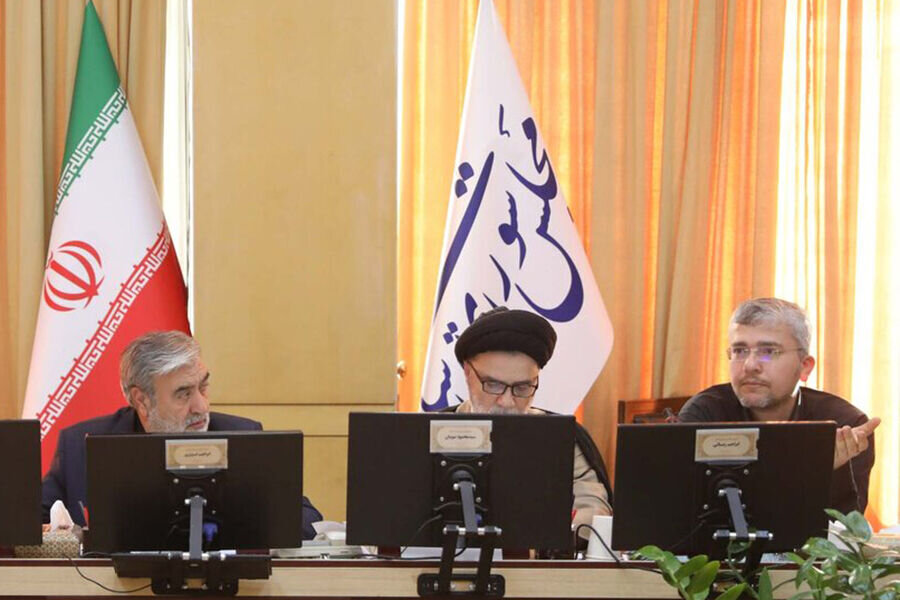
TEHRAN – A spokesperson for the Iranian Parliament’s Committee on National Security and Foreign Policy said the committee considered the Anti-Foreign Infiltration Bill at a meeting attended by representatives of major security agencies and approved several amendments.
Ebrahim Rezaei, a spokesman for the committee, told reporters that the committee convened on Tuesday afternoon at the National Security Committee headquarters in parliament with the participation of all members.
Rezaei said the session focused on “legislation to counter foreign infiltration.” Discussions were held with representatives of relevant agencies, including the Ministry of Information and the Revolutionary Guards Intelligence Service. Rezaei said several sections of the bill were amended based on expert opinion and then approved by the committee.
He said further evaluation of the remaining papers will continue in future sessions.
The Plan to Counter Foreign Invasion was drafted with the objective of adopting a prudent approach to countering enemy infiltration and strengthening the country’s defense and intelligence capabilities. The general provisions had been approved at the committee meeting on October 14th.
Iran has taken espionage and espionage seriously as part of its national security measures, especially after the June War. On June 13, 2025, the Israeli regime launched an unprovoked attack on Iranian territory, sparking a 12-day war that claimed well over 1,000 Iranian lives, including military commanders, nuclear scientists, and civilians. The United States also became involved in the war by bombing three Iranian nuclear facilities. The alleged justification for the invasion was to prevent Iran from acquiring nuclear weapons, but neither Israel nor the United States provided any evidence for that claim.
On November 12, the intelligence wing of Iran’s Islamic Revolutionary Guards Corps (IRGC) announced that it had identified and dismantled an anti-security organization led by Israeli and American spy agencies.
In mid-June 2025, Iran executed a man convicted of cooperating with the Israeli intelligence agency Mossad and attempting to share classified information with the occupying Tel Aviv regime in exchange for money. The execution took place after the Supreme Court upheld the death sentence.
The individual, identified as Esmail Fekri, was in close contact with Mossad operatives and was captured in December 2023 during a complex intelligence operation carried out by Iranian security services.
Following Israel’s recent military invasion of the Islamic Republic, Iranian authorities have also arrested a number of people suspected of being spies for the Israeli intelligence agency Mossad.