
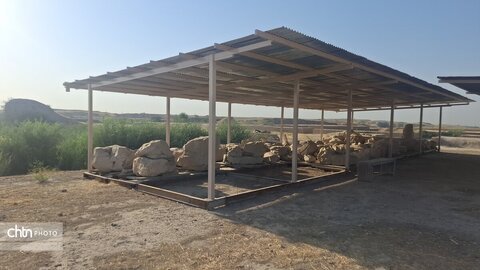
TEHRAN – The UNESCO-listed Susa conservation team has completed a project to protect and preserve 253 architectural remains from the Achaemenid Apadana Palace, the director of the Susa World Heritage Base announced on Tuesday.
Ali Bouyeri said the protection and rescue measures for the stone ruins of Apadana Palace have been an ongoing process for decades.
“Funded by the Khuzestan Department of Cultural Heritage, Tourism and Handicrafts, the project covered stone elements such as column capitals, column shafts and column bases.”
He said that in the 1970s, a French archaeological team led by Jean Perrault consolidated scattered stones in the southern part of the palace’s east portico to prevent further damage and facilitate research.
Mr Vuyeri said additional measures were taken in the 2010s to combat environmental degradation, particularly moisture. Two metal platforms with wooden surfaces were installed to hold the stone fragments, he added. One temporary protection structure built during this period had limited effectiveness during heavy rain events and had to be redesigned.
He stressed that metal structures and pitched roofs are insufficient to channel surface water and that technical improvements are needed for long-term conservation.
Vuyeri said a new project has been launched to standardize and ensure sustainable protection of the Apadana Palace site while maintaining its visual integrity. An upgraded shelter designed to match the historic environment has been implemented.
Located in the lower Zagros Mountains, Susa (identified as Shushan in the Book of Esther and other Biblical texts) is one of the world’s oldest continuously inhabited cities.
Visitors entering the archaeological zone can follow a marked path past date palm trees to the ruins of Darius I’s palace, built around 521 BC during the Achaemenid period. To the east is the Royal City, an area of deep excavation through 15 cultural layers. To the south of the site stands an eroded earthen tower overlooking a nearby vacant lot.
To the west is Chouchou Castle, built by French archaeologists in the early 20th century on the ruins of an ancient Elamite platform. The structure is not open to the public, but the path around its base offers views of the entire archaeological complex, including Daniel’s tomb to the south.
Susa is mentioned repeatedly in Biblical tradition. The Book of Esther describes events that supposedly took place in the city during the reign of a Persian king identified as Ahasuerus. This story is the basis of the Jewish festival Purim. The city is also mentioned in the books of Nehemiah and Daniel, which relate to the period of the 6th century BC known as the Babylonian Captivity. The shrine known as Shushu Daniel is traditionally associated with the prophet Daniel and features a conical dome.
Archaeological evidence shows that Susa has been inhabited since at least 4,200 BC, with traces of early settlement dating back to around 7,000 BC, and pottery remains dating back to approximately 5,000 BC. Objects discovered at the site include carved cylindrical seals, jewelry, clay artifacts, and cuneiform tablets containing administrative, commercial, and mathematical records.
In 330 BC, Susa was captured by Alexander of Macedon, after which the city became part of the Seleucid Empire and was known as Seleucia of Eureus. Greek-style palaces were built near the early Achaemenid complex, and inscriptions from that period have been found mainly in the southern part of the city. During the Parthian period, Susa served as a foundry center.
During the Sasanian period, the city had an important Christian community. Although it suffered damage during the reign of Shahpur II, forcing some of its population to migrate, Susa recovered enough to resist Arab armies in the 7th century and was eventually incorporated into the early Islamic world. This settlement remained an important regional center until the 13th century AD.
According to UNESCO, Susa has ruins of administrative, residential and palatial buildings, with archaeological layers spanning from the 5th millennium BC to the 13th century AD.
morning