
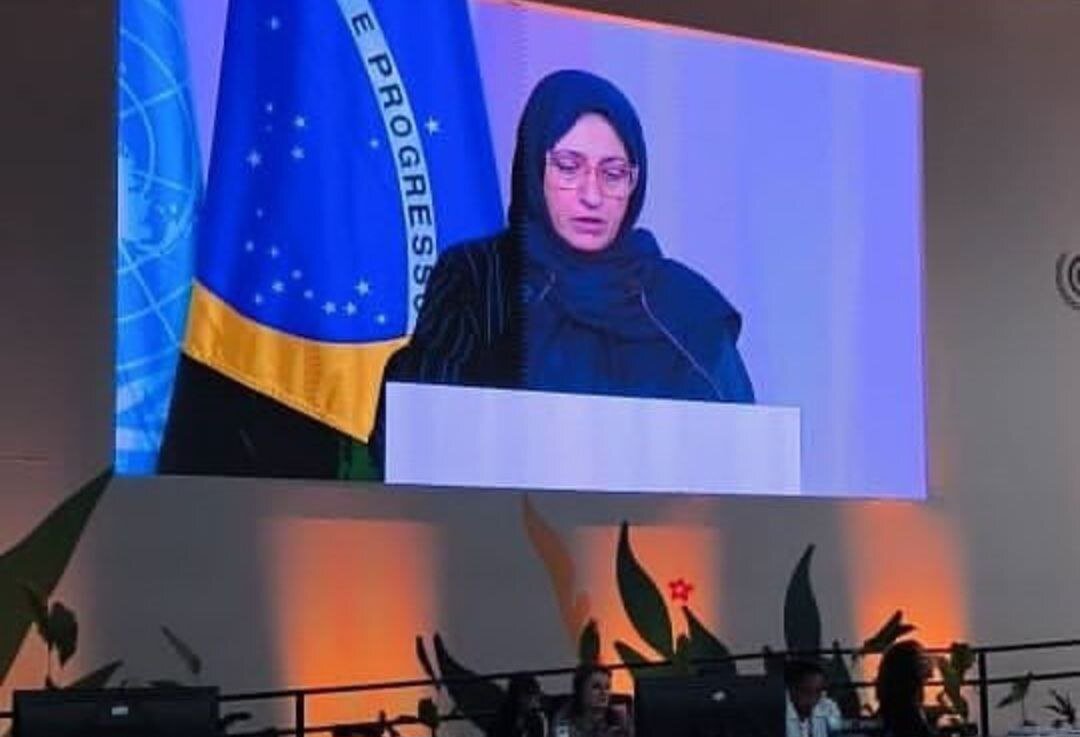
TEHRAN – Department of Environment (DOE) official Sedike Torabi stressed the need for sufficient and predictable financing for developing countries to implement climate change countermeasures.
Noting that the effects of climate change are intensifying in one of the world’s driest and most sensitive regions, Torabi said frequent droughts, water shortages, extreme heat, forest fires, as well as dust and dust storms are negatively impacting Iran.
She made the remarks on Tuesday, November 18, during the plenary session of the 2025 United Nations Climate Change Conference, known as COP30, which is being held in Belem, Brazil.
The official noted that Iran cannot support increasing the ambition of emissions reductions or new targets unless sufficient and reliable financing, technology transfer and capacity building is provided to developing countries. She said ambition must be matched by means of implementation.
He said adaptation is a critical priority for Iran and other developing countries, stressing the need to strengthen early warning systems, protect water resources and support vulnerable communities.
She stressed that indicators for global adaptation goals should be designed in a way that does not impose additional reporting burdens on developing countries.
Referring to the Common but Differentiated Responsibilities and Respected Capabilities (CBDR-RC) principle, Mr. Torabi called unilateral coercive measures the main obstacle to advancing the climate agenda, warning that these measures hinder developing countries’ access to financial resources, low-carbon technologies and international cooperation.
The official went on to announce the country’s readiness for constructive cooperation to achieve a balanced, fair and credible outcome that equitably promotes adaptation, emissions reductions, technology transfer and capacity building and prevents the politicization of negotiations.
COP30 brings together world leaders, scientists, non-governmental organizations and civil society to discuss priority actions to tackle climate change.
It focuses on the efforts needed to limit global temperature rise to 1.5°C, the presentation of new National Action Plans (NDCs), and progress on financial commitments made at COP29.
environmental diplomacy
On the sidelines of COP30, DOE Secretary Shina Ansari met with UN counterparts, officials, and representatives from other countries.
Doe.ir reported that Ansari met with the United Nations Framework Convention on Climate Change (UNFCC) Secretary-General Simon Steele and detailed the country’s steps to curb greenhouse gas emissions and expand renewable electricity generation capacity over the past year, despite unjust sanctions that have deprived Iran of access to international funding and cutting-edge technology.
Other measures the official mentioned include reducing flaring at oil fields and approving climate change management plans.
Mr. Steele praised Iran’s efforts and announced that the UNFCC Director-General would hear the country’s voice and support its measures and efforts.
In a meeting with Ana Claudia Rosbach, Executive Director of the United Nations Human Settlements Program (UN-Habitat), Ansari stressed the need for comprehensive urban planning to mitigate the effects of climate change and improve the sustainability and resilience of cities in the face of rising heat.
“Despite economic and climate challenges, Iran is doing its best to leverage regional and global scientific capabilities to make cities more sustainable,” she said.
Mr. Rosbach emphasized the effective role of the United Nations Resident Office in Iran. The official stressed the need to strengthen joint efforts in improving urban management and climate risk management, as well as improving the quality of urban life.
In a meeting with Croatian Minister of Environmental Protection and Green Transition Marija Vukovic, both sides emphasized the need to promote environmental cooperation between the two countries. IRNA reported that Ansari noted that promoting scientific interaction would improve national capacity in environmental conservation and expressed Iran’s readiness to share expertise on protected areas, water and wetland resources, and industrial pollution control.
Mr. Vukovic said that expanding environmental cooperation would help promote Croatian-Iranian relations. She invited Ansari on an official visit to Croatia.
Ansari also discussed environmental issues in a meeting with Amna bint Abdullah Al Dahak Al Shamsi, UAE Minister of Climate Change and Environment.
MT/MG