
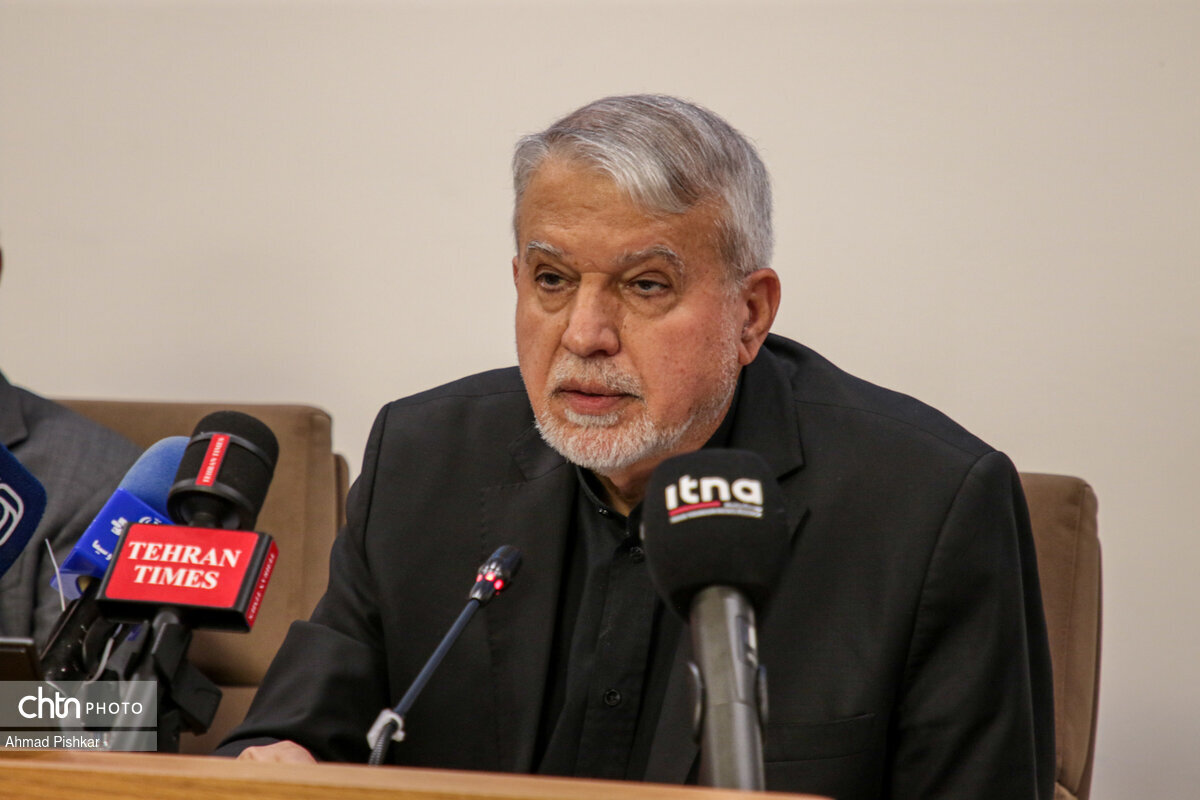
TEHRAN – At a press conference held on Tuesday afternoon, Iran’s Minister of Cultural Heritage, Tourism and Crafts, Seyed Reza Salehi Amiri, along with his agent, worked on the ministry’s role in shaping cultural resilience during the recent 12-day conflict with Israel.
The Minister describes the current situation as “not a full war or a lasting peace,” and calls for “cultural rationality, social cohesion, and civilized narratives” to help Iran navigate the ongoing crisis.
He further described recent conflicts as “a test of national maturation,” during which Iranians chose to resist unshakablely and exploited their deep cultural, national and religious identities.
He then condemned the shift from targeted assassinations in Israel to direct attacks on Iran’s infrastructure, including energy, defense and communication. Nevertheless, Iranian society said it had shown restraint, favoring strategic rationality over emotional responses, and hampered the plot of the enemy by distinguishing between internal criticism and external conflict.
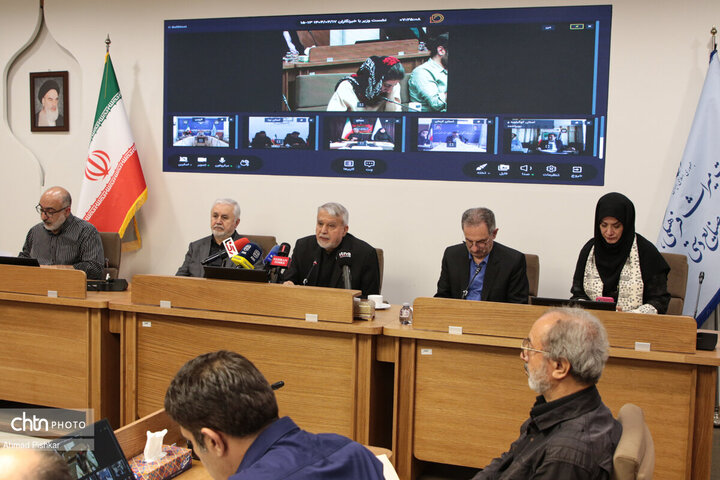
During an event involving the Director of the State Tourism Bureau through virtual participation, the Minister outlined three important responses to the recent military escalation by the Islamic Republic. The obvious and hidden message of war, the rapid efforts of governments to maintain social calm, and the provincial role in the preservation of cultural identity.
Elsewhere in his remarks, Salehi Amiri emphasized the importance of cultural diplomacy, saying that more than 100 Iranian scholars, artists and intellectuals had filed formal objections to global organisations following the Israeli attack. The ministry also sent official communications to UNESCO and the United Nations, demanding emergency response.
He then described Iran as the basis for national unity in an age of narrative fragmentation, fostering a stronger connection between youth and the country’s cultural heritage. He reflects the concepts of three guidelines: Iran, Iranian civilization, and cultural Iran (the Greater Iran).
“Iran is not just a land, it is a living spirit embodied in our architecture, art, mythology, and museums, Hafez, Sadi and Feldousi.
Referring to the importance of the tourism industry to the government, the minister noted that President Masuud Pezeschian personally oversees the removal of barriers to tourism, and that demands from industry stakeholders are being actively pursued in three key areas.
Additionally, Salehi-Amiri highlighted the mobilization of governments to protect everyday life, noting that over 800,000 tons of essential goods have been distributed from southern ports. He added that over 9 million people have traveled to Mazandaran during this period, and that the country’s tourism sector has only received 30 service-related complaints.
He noted that the Iranian Cabinet has approved a resolution requiring all government agencies to prepare damage assessments and submit legal drafts for potential international litigation against Israel’s Zionist regime. The Ministry of Cultural Heritage has already compiled its own detailed report, the minister added.
Additionally, he praised the exceptional acts of the private tourism sector, opening accommodations to citizens from Mashhad (the capital of Khorasan Razabi province in northeastern Iran) from Gilan (the country’s northern province), offering discounts of up to 90% and in some cases free work. “It was not a commercial gesture, it was a social and ethical gesture,” the minister said.
Discussing the current tourism scene, the Minister emphasized that 2,700 tourism projects are currently underway across the country, adding that a 14-point strategy has been drafted and converted into practical plans to revive the tourism sector. He also announced that the government law will add a special war insurance category to support damaged tourism sites.
He also revealed that the ongoing long-term rental ministry of historic property for qualified private investors is driven by goals of conservation rather than revenue generation. To date, 41 historic buildings have been transferred under a 90% lease scheme.
Salehi-Amiri added that cultural diplomacy has expanded to neighbouring countries, and new ties have been formed with Azerbaijan, Armenia, Tajikistan and Egypt. “If there hadn’t been any recent military escalation, (current year) 1404 (starting on March 20) would certainly have been a golden year for Iran’s tourism,” he pointed out.
The Deputy Minister shares sector insights
Deputy Minister of Cultural Heritage Ali Dharabi spoke about the ministry’s efforts to protect the heritage during the 12-day conflict, warning that the withdrawal of the US and Israel from UNESCO has disrupted international cooperation. However, Iranian heritage experts and ICOM continue to be involved through formal communications.
Dharabi added that Iran helped launch the Forum of Ancient Civilizations. Tehran’s Intangible Cultural Heritage Centre compensates 11 permanent members and 24 countries and plays an active role in cultural diplomacy.
Anusilvan Moseni Bampi, Deputy Tourism Bureau, highlighted on his part the recent impact of the Iran-Israel War on the tourism sector. “A full return to pre-crisis levels will take time,” he said, adding that the ministry has adopted 14 approaches to recovery.
The Deputy Minister emphasized that many states remained unaffected by the conflict and saw an increase in domestic travel. He noted that religious tourism provided stability during difficult times.
Regarding tourism pricing, he denied the rumors and confirmed that all services were priced based on Iranian rials for visitors both domestically and foreignly.
Mohseni-Bandpey also outlined the Arbaeen Pilgrimage Plans, including the creation of religious markets and eco-lodges along the walk route to Karbala.
“Religious tourism continues to be the most active and strategic segment of international tourism in Iran,” he emphasized, adding that Albain represents a great opportunity for bilateral and multilateral engagement.
He added that over 3.5 million pilgrims (mostly from Iraq) visited Iran this year for religious purposes.
Deputy Director of Handicrafts Mariam Jalali Dakordi explained the ministry’s cultural strategies throughout Albain. She said preparations were underway at the special craft market and exhibits at the ILAM and Mehran border before the outbreak of hostilities.
She said permanent bases to showcase Iranian handicrafts are also planned in Erbil, Suleimaniyah and Basra.
The Israeli war imposed began on June 13, 2025, when the Zionist regime launched a surprising attack on the Islamic Republic’s major military and nuclear facilities. During the opening hours of the war, Israeli forces assassinated some of Iran’s prominent military commanders and nuclear scientists.
morning