
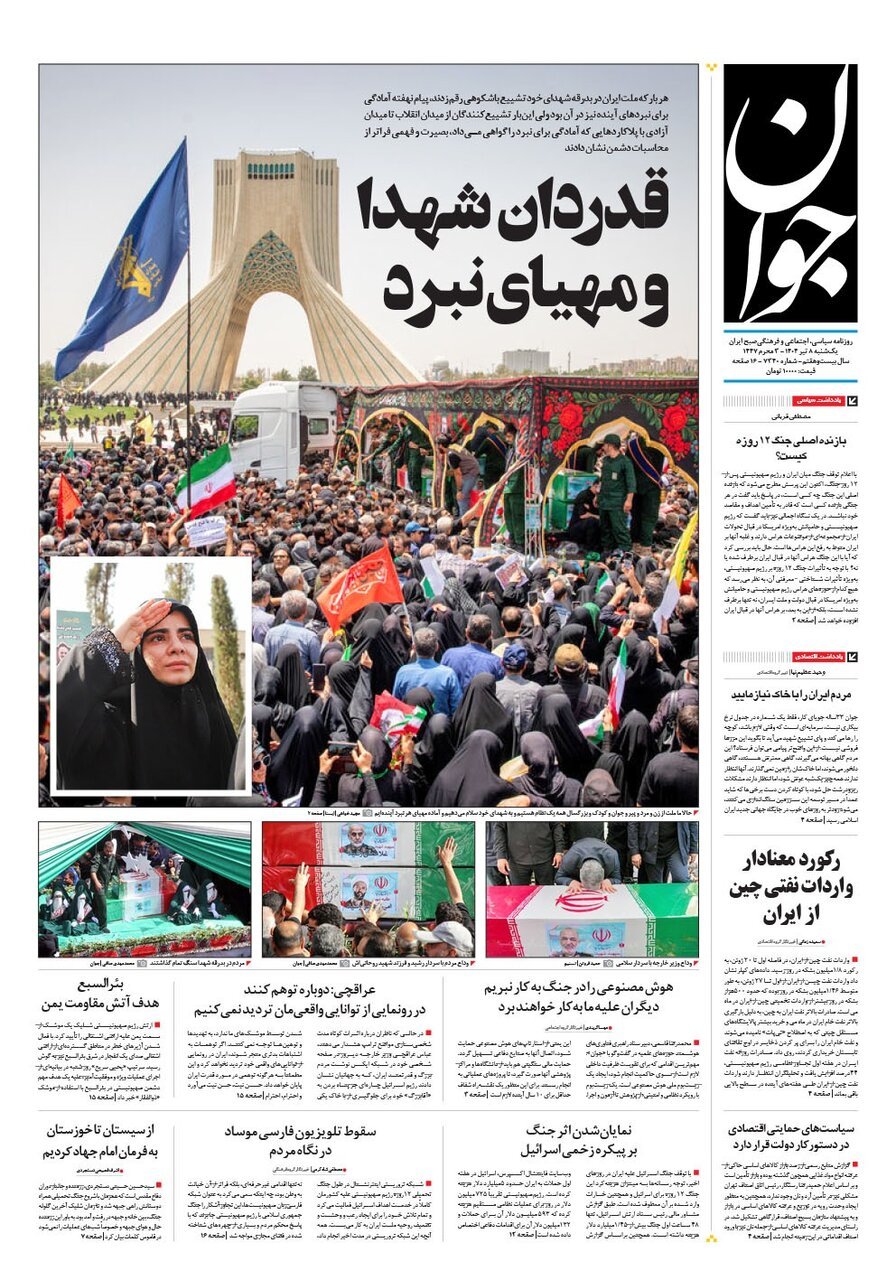
Tehran – In the analysis, Jawan discussed the defeat of Israel and the US in a 12-day war with Iran, and believed that the terrorist Zionist regime could achieve a decisive victory in the assassination of Iranian military commanders.
However, it turns out that it is in a serious situation that cannot be escaped that easily. As the US clearly stated, the goal of a joint operation with the Zionist regime was to surrender Iran. This is the target that Iran defeated by successfully firing missiles in Israel. Fearing the destruction of its political and social fabrics, Tel Aviv was forced to stop the war with Iran. In addition to political and military defeats, the American Zionist front has experienced defeat in public opinion. The Zionist regime’s attacks on Iran promoted the disgust of the Tel Aviv world. This is while the United States was trying to present Iran as a violation of human values and rights through a false propaganda campaign.
Hamshahri: Costly Miscalculation
Hamshali looked into Israel’s mistakes and investigated the reasons that caused the war with Iran on June 13th. It writes as follows: The Israeli regime’s reliance on the air force’s capabilities was eroded as the war extended. The next very important point was that Israeli air defense systems were impossible to protect Israel from advanced Iranian missiles and drones, causing major damage in Tel Aviv and Haifa. In this situation, and by bringing these points together, Netanyahu appears to have found a way out of this predicament and, despite his aggressive nature, was forced to agree to a halt of the war. Given the nature and course of Israel’s aggression, many analysts say the current situation is vulnerable and therefore one must be aware and watch out for the obvious and secret movements of the enemy.
Vatan-e-Emrooz: IMEC Hallway Failure
In the commentary, Vatan-e-Emrooz said that when Israel began its war with Iran, Iran was challenging Western macroeconomic plans in the region. It writes as follows: Iran’s missile and drone attacks on Haifa Port, the largest commercial hub of the Zionist regime, marked a turning point in the geopolitical and economic equations of the region. The port was thought to have served as a highway connecting India to Europe within the framework of the Strategic Arab-Chinese Corridor (IMEC) project, but has now become one of the most dangerous regions in the eastern Mediterranean. These missile and drone attacks are considered part of Tehran’s critical response to repeated attacks by the Zionist regime. The main goal is not merely physical destruction, but to disrupt the safety economic structure of the regime, which relies heavily on Haifa Port. Recent developments show that geopolitical security is a fundamental component of the success of transportation projects. Iran’s attack on Haifa was not only a military response to Israel’s attacks, but a strategic move. It was able to challenge one of the most important economic and geopolitical projects of the Western, Hebrew and Arab axis.
Ettelaat: Israel seeks another misfortune
In an interview with international affairs analyst Seyyed Jalal Sadatian, Ettelaat pointed to a volatile ceasefire between Iran and Israel. He said: A ceasefire or halt in war does not mean peace, and I think it is vulnerable. Israel is about to carry out further assassinations. Israel is also making an effort to identify the location of nuclear fuel that it removed from Fordow. Looking at the way Israel behaves towards Lebanon, we can conclude that the second stage of assassination is probably approaching. So we have to be vigilant to not take off guard again. In both military and offensive areas of defense, as well as diplomacy and narrative, we need to be able to maintain our authority in the possibility of new conflict with our enemies. This halt of the war is not a ceasefire that Israel could easily accept, despite a sense of defeat. In fact, Israel is looking for a first opportunity to make up for that loss as its plan is being destroyed. Therefore, we must strengthen ourselves so that vulnerabilities are reduced as much as possible.