
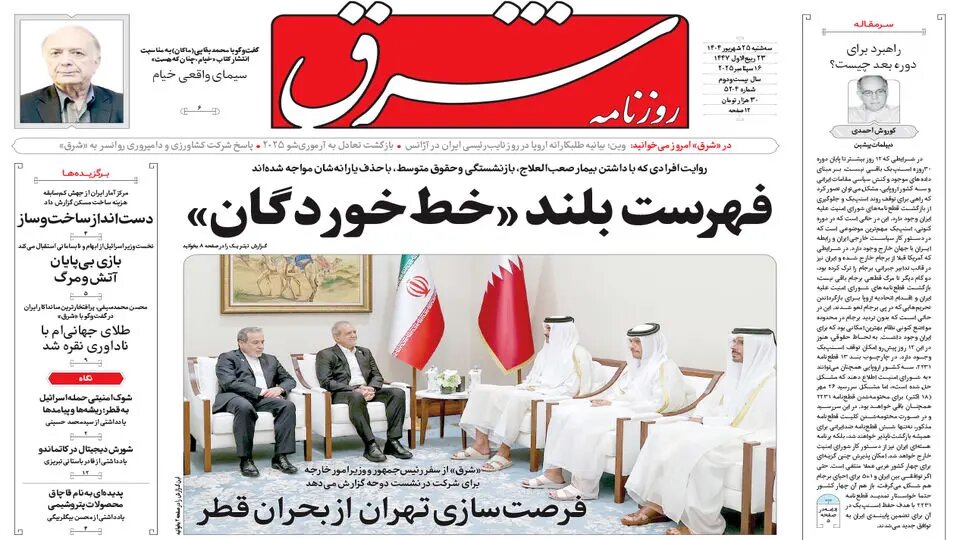
Tehran-Shaag wrote in his analysis: Based on Iranian officials and available data and political actions and European countries, in a situation where there are only 12 days left until the activation of a 30-day snapback period, it is difficult to imagine a way to halt the snapback process and prevent the return of the Security Council resolution against Iran.
This is the current period, and snapback is the most important issue regarding the agenda of Iran’s foreign policy and relations between Iran and the outside world. The proposed solution for Europeans to extend the snapback deadline included three prerequisites: Iran’s cooperation with the International Atomic Energy Agency, an audit of the amount of uranium abundant, and Iran and the United States will negotiate a new agreement. A positive and promising agreement between Iran and Cairo institutions may have paved the way for the realization of the first and second prerequisites, but it was later revealed that the timing of Iran, the institutions and the three European countries did not coincide. Therefore, due to the lack of three European conditions and opportunities, it appears that Europe has not seen any other way than activating snapbacks.
Siasat-e-Rooz: Arab countries cannot be trusted
Siasat-e-Rooz has dedicated his editorial to the top of Qatar’s Islamic cooperative organizations and the organizations of Arab countries, writing: The summit was held with a focus on examining the recent aggression of the Zionist regime on regional development, particularly Qatar. The summit emphasized the need to stand up to Palestine, facing Zionist regimes and, in a way, expressed solidarity with the views of resistance countries such as Iran and Algeria, but the final statement showed that these countries actually have no strategy to take practical action against the Zionist regimes and their supporters. This performance reflects the bitter truth, that Iran effectively cannot count on regional diplomacy and Arab countries. Interaction with them must be on the same level as traditional diplomacy, and the only option remains an approach that maintains the forefront of resistance.
Hamshali: Trump’s defeat in the oil war with Iran
In the memo, Hamshali discussed Trump’s defeat in the oil war with Iran. It writes as follows: Since he became US president for the second time last winter, Donald Trump has once again put maximum pressure on the Iranian economy. In the first step, he issued an order to reduce Iranian oil exports, and for the past nine months, the US Treasury has approved hundreds of different companies under the pretext of working together to promote Iranian oil exports. The Trump administration’s strategy was based on one principle. It completely cuts off Iran’s oil revenues, paralyzes the economy and forces Tehran to negotiate. However, a review of reports from Western institutions shows that during this period, it has not changed Iran’s oil exports and that the oil war against Iran has largely failed. Iran’s oil exports remained at the same level as last year, and have not witnessed a sharp decline in oil revenues like in 2018.
Iran: European Troika views on Iran’s Eair Agreement
The Iranian newspaper wrote: From the perspective of the European troika, the main issues are focused on Iran’s commitment under the NPT and comprehensive safeguard agreements. European troikas have no impression that they will not activate the snapback mechanism due to the agreement between Iran and the IAEA. Another point related to the European troika position is its serious reflection on the media. Raphael Grossi emphasized that the agreement could prevent war. In theory, this assessment is correct. If the agreement is quickly finalized and implemented quickly and Iran simultaneously begins consultations with the US, it could prevent the crisis from escalating. However, one thing that should not be ignored is the different views of Europeans. From the start, they announced that they had not considered a specific timetable for the implementation of the contract. It is very important for Europeans to know the state of 60% of Iran’s enriched uranium. This is a particularly important issue for Tehran. Because Iran doesn’t want to easily lose this card, it prevents the snapback mechanism from coming back. In contrast, Europeans are trying to improve the current situation through diplomatic channels between Iran and the US before a deadline that could activate snapback sanctions next week, paving the way for a permanent agreement.