
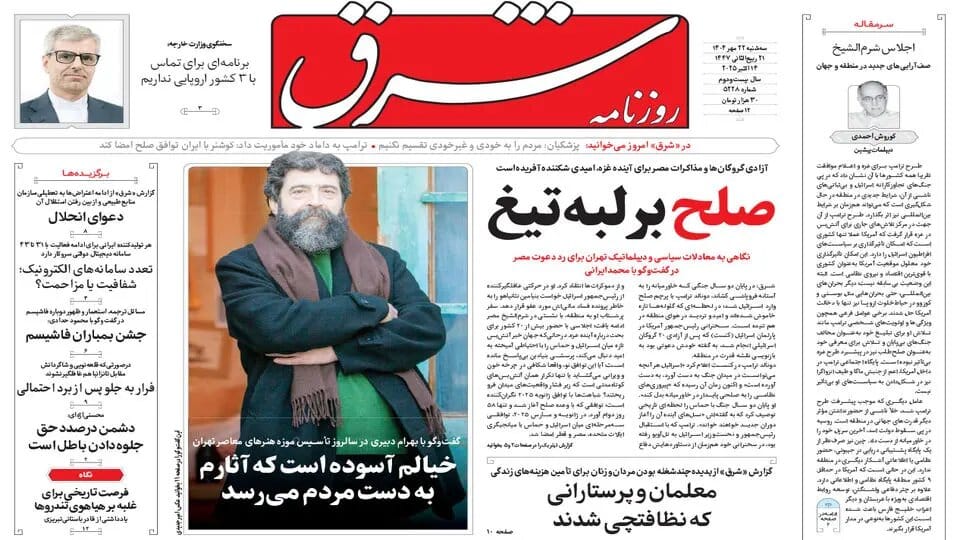
TEHRAN – Foreign Minister Shahg said in a memo that the European troika of Britain, France and Germany has been sidelined on the Iran nuclear issue because it has turned from a mediator to a “pressure partner” by invoking the snapback mechanism to return UN Security Council sanctions against Iran.
The paper wrote: In a statement, the three countries called the snapback “a right and necessary step.” The European Troika’s actions in invoking the snapback mechanism effectively moved the three countries from the position of “mediator” toward Iran to that of “pressure partner.” In the Iranian government’s view, the reinstatement of sanctions means that Europe no longer has new tools and tools to exert influence and that Iran has no incentive to engage in dialogue. Therefore, even if new negotiations begin, it is not expected that Iran will be inclined to put Europe at the top of the negotiations. The Iranian government appears to be redefining its paths of interaction based on cooperation with non-Western countries such as Russia, China, and some countries in the region. At least from the Iranian government’s perspective, these actors are following an approach based on mutual interests rather than a policy of intimidation and sanctions.
Etemad: Rebuilding trust in the FATF and the global financial system
Etemad wrote about the disadvantages of being on the FATF blacklist and the advantages of joining it. The paper argues that in recent decades, Iran’s political and economic relations have become deeply intertwined with the rest of the world. After the tightening of sanctions, Iran’s economy suffered in two major ways. For one, the country’s trade transactions faced widespread restrictions. Second, Iran’s inclusion on the FATF blacklist effectively excluded its banking and financial sector from the international banking network. In such circumstances, joining the FATF could be a positive step from an economic perspective. However, unless new avenues for financial exchange with the world are opened at the same time, implementation of the FATF alone is not expected to solve economic problems. If Iran can revitalize its banking relationships through indirect but legal means, the implementation of FATF could be a positive sign in rebuilding confidence in the global financial system. Today, this measure remains on the right track, but its effectiveness depends on the political situation and the government’s will to restructure international relations.
Batan-e-Emroos: “Iran will not surrender”
Vatan-e-Emroos examines the US strategic policy towards Iran and writes: The US government currently has Iran at a crossroads in its policy: surrender or resistance. Through its actions, Iran has demonstrated its readiness for win-win agreements with the West, whether in the form of nuclear negotiations with the United States or in the form of negotiations related to the snapback mechanism. The JCPOA proved that, contrary to the US and Zionist regime’s propaganda efforts, Iran never sought to militarize its nuclear knowledge. The Islamic Republic did not back down from red lines in any of these negotiations, demonstrating that Iran remains firmly committed to defending the country’s nuclear rights, especially despite the US’s miscalculations. Iran is well aware of the security concerns regarding its 60 percent uranium reserves. In any case, the Islamic Republic has shown, both in its declared position and in its policies, that it is not ready to surrender.
Iran: Middle East after the end of the Gaza War
The Iranian newspaper discussed the Middle East after the end of the Gaza war in an interview with foreign policy expert Mostafa Najafi. “Since the ceasefire, we are seeing an increasing role for the United States in the political and security affairs of the region,” Najafi said. Therefore, Iran will be the most important issue in the Middle East for the United States. Iran remains a major challenge to U.S. and Israeli interests in the region, and plans such as normalization of Arab-Israeli relations and a NATO-backed security alliance may conflict with Iranian security interests in the long term. Iran should therefore tread a path of prudent balance by leveraging its regional diplomacy capabilities, relying on hard and soft deterrence to prevent security pressures, and turning its geographic location into a lever for economic and transportation development. In general, the Middle East after Gaza is not necessarily trying to establish a new order. Rather, they are going through a phase of redefining their roles. The main challenge for Iran is the choice between joining other countries’ orders and cooperating with others to form the desired order. In particular, the future of the region will be determined not by winning wars but by states’ ability to manage order transitions.