
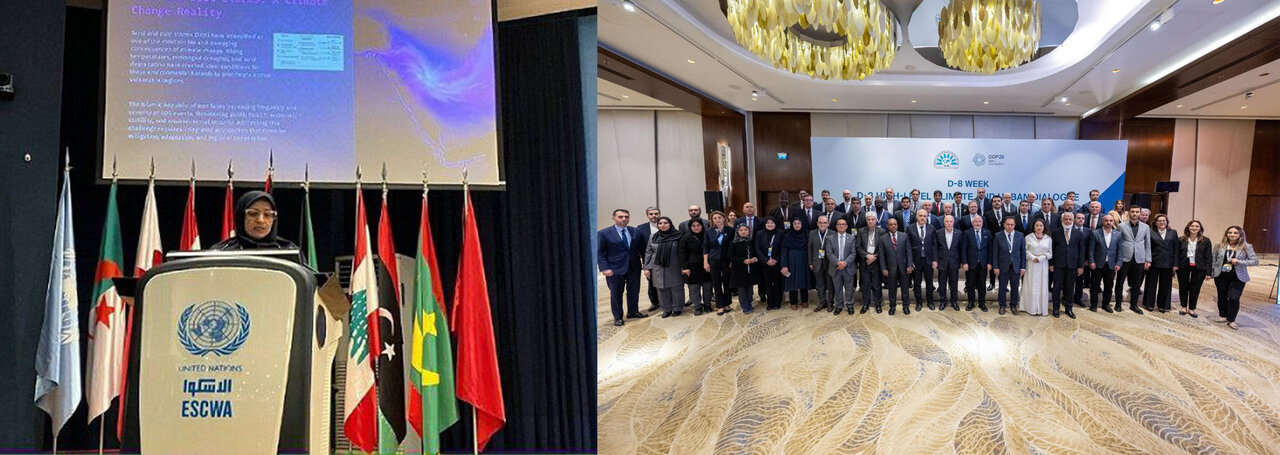
TEHRAN – The Department of Environment (DOE) participated in international conferences in Lebanon and Azerbaijan to brief on activities to combat sandstorms, dust storms and climate change.
DOE official Sediqe Torabi, who attended the Forum for Promoting Regional Cooperation on SDS held in Beirut, Lebanon from October 7 to 8, gave a speech titled “Integrated Policy and Community-Based Approaches to Combat SDS in Iran,” enumerating Iran’s efforts and expertise in comprehensive management of SDS, revegetation, and community engagement, Mehr News Agency reported.
On the sidelines of the event, the official met with representatives from the United Nations, the World Meteorological Organization (WMO), the United Nations Environment Program (UNEP), UN-Habitat, and the Economic and Social Commission for Western Asia (ESCWA) to discuss ways to strengthen scientific and technological cooperation.
The United Nations Coalition on SDS Action was jointly organized by and hosted by ESCWA and the Economic and Social Commission for Asia and the Pacific (ESCAP) as Co-Chairs of the Coalition for the period 2025-2026.
The meeting considered the work program of the Union’s five Working Groups on Adaptation and Mitigation (FAO). Forecasting and Early Warning (WMO). Health and Safety (WHO); Policy and Governance (UNCCD); Regional Cooperation and Mediation (ESCAP and ESCWA), and activities and work being carried out by coalition partners.
They also discussed plans and organization for the United Nations Dust Storm Preparedness Decade (2025-2034) and future joint events.
The D-8 High-Level Climate and Urban Dialogue was held in Baku, Azerbaijan from October 13th to 17th. The D-8 members evacuation meeting, organized by the Ministry of Foreign Affairs of the Republic of Azerbaijan, brought together D-8 members and their accompanying personnel from member states (Bangladesh, Egypt, Indonesia, Iran, Malaysia, Nigeria, Turkey, and Pakistan) in an informal strategic environment.
Delivering a lecture titled “Towards resilient, low-carbon cities: integrating climate action and sustainable urban development,” Torabi shared Iran’s experience in tackling air pollution, optimizing energy and water consumption, and promoting urban resilience to climate change.
The official referred to the National Environmental Policy document, which aims to standardize environmental requirements and incorporate them into urban planning.
Toravi also met with representatives of D8 member states and UN-Habitat to exchange views on smart energy management, monitoring greenhouse gas emissions and sharing green technologies.
The D-8 Week, the first since the organization’s founding in 1997, featured two important high-level events: the D-8 Committee Retreat and the High-Level Climate and Urban Dialogue to align climate and urban action with the D-810 Roadmap 2020-2030.
Both meetings were held within the framework of the D-8 week in Baku and were important milestones in advancing the Organization’s vision of deepening cooperation, sustainable development and strengthening institutional linkages among Member States.
The main objectives of the meeting were to foster an open exchange of opinions and ideas on key organizational issues and to jointly explore new approaches to strengthen the cooperation framework of the D-8 organizations.
MT/MG