
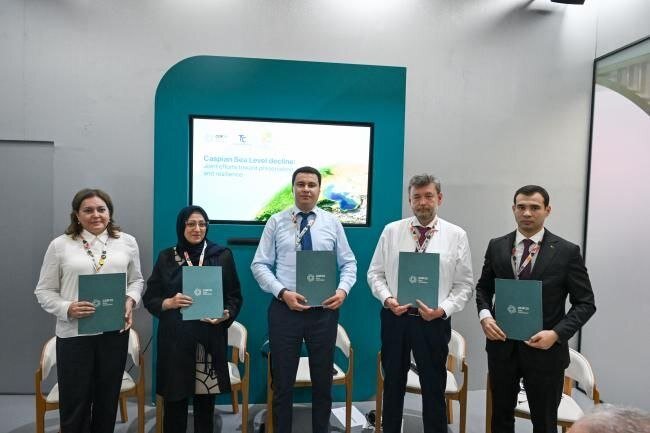
TEHRAN – Department of Environment (DOE) official Sedike Torabi called for implementation of the regional action plan drafted by five coastal countries for the conservation of the Caspian Sea.
“This is not just a scientific statistic, but a real threat to the economy, ecosystem and social security of coastal populations,” IRNA quoted Toravi as saying.
The official made the remarks on Monday, November 17, while speaking at a high-level panel discussion on the serious decline of the Caspian Sea. The panel was held on the sidelines of the 2025 United Nations Climate Change Conference, also known as COP30, which was held in Belém, Brazil, from November 6th to 21st.
“No single coastal state can cope with the impact of the crisis. What is needed is a collective response,” she said.
The officials also proposed establishing a permanent joint scientific institute to accurately monitor, model and predict sea level changes.
Other issues raised by the officials included integrated watershed management, fair water management of rivers that flow into the Caspian Sea, and implementation of joint projects to restore coastal wetlands and create alternative habitats for endangered species.
The high-level event “Caspian Sea Level Drop: Joint Efforts towards Conservation and Resilience” was organized by the Ministry of Ecology and Natural Resources of the Republic of Azerbaijan and the Tehran Convention Secretariat, and concluded with the adoption of a declaration reinforcing regional commitment to joint action.
In addition to Toravi, high-level representatives from four other Caspian states, the United Nations Environment Program (UNEP), UN-Habitat, and the World Meteorological Organization (WMO) delivered important speeches.
This has succeeded in fostering important dialogue between the Caspian Sea littoral states and international partners. The discussion highlighted the urgency of addressing transboundary environmental issues and provided avenues for future cooperation.
Climate change measures are impossible without funding
On November 18, Mr. Torabi also addressed the plenary session, stressing the need for sufficient and predictable financing to help developing countries implement climate action.
Noting that the effects of climate change are intensifying in one of the world’s driest and most sensitive regions, Torabi said frequent droughts, water shortages, extreme heat, forest fires, as well as dust and dust storms are negatively impacting Iran.
The official noted that Iran cannot support increasing the ambition of emissions reductions or new targets unless sufficient and reliable financing, technology transfer and capacity building is provided to developing countries. She said ambition must be matched by means of implementation.
He said adaptation is a critical priority for Iran and other developing countries, stressing the need to strengthen early warning systems, protect water resources and support vulnerable communities.
She stressed that indicators for global adaptation goals should be designed in a way that does not impose additional reporting burdens on developing countries.
Referring to the Common but Differentiated Responsibilities and Respected Capabilities (CBDR-RC) principle, Mr. Torabi called unilateral coercive measures the main obstacle to advancing the climate agenda, warning that these measures hinder developing countries’ access to financial resources, low-carbon technologies and international cooperation.
The official went on to announce the country’s readiness for constructive cooperation to achieve a balanced, fair and credible outcome that equitably promotes adaptation, emissions reductions, technology transfer and capacity building and prevents the politicization of negotiations.
MT/MG