
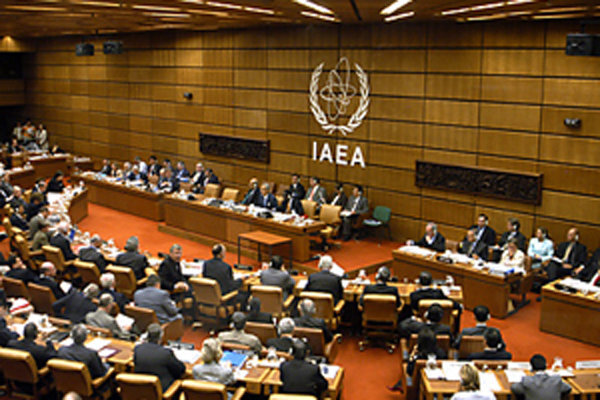
The IAEA Board of Directors will hold its regular November meeting starting Wednesday at IAEA Headquarters in Vienna.
A correspondent for Vienna-based Tehran-based Press TV confirmed on Friday, citing diplomatic sources, that a new anti-Iranian resolution is expected to be tabled at E3. The move follows IAEA Director-General Rafael Grossi’s November 12 report on Iran’s nuclear program, which focused on estimates of its uranium stockpile.
However, he noted that the draft resolution has not yet been submitted to the IAEA and is currently being discussed in the capitals of three European countries.
He added that it is still unclear whether the United States will co-sponsor the resolution.
He pointed to Russia’s reaction to the E3 decision, saying Mikhail Ulyanov, Russia’s permanent representative to the international organization in Vienna, warned that the European signatories to the 2015 nuclear deal were bringing the situation to a “total stalemate.”
The reporter added that Ulyanov said Iran would again be a “main topic” on the 35-member council’s agenda next week.
The senior Russian diplomat also stressed that the Iranian side “has shown a very constructive approach, which is a big plus.”
Mr. Grossi’s latest report covers the period since the Director-General’s last assessment in early September and reviews the impact of the Israeli and U.S. attacks on Iranian nuclear facilities in June.
Following the attack, the Iranian government suspended all cooperation with the agency, citing “politically motivated” resolutions and the agency’s refusal to condemn terrorist attacks on nuclear infrastructure and personnel.
The director-general focuses on verification issues that have arisen since Iran legally suspended cooperation in late June, citing domestic legal and security concerns.
The report includes the agency’s estimate of Iran’s enriched uranium stockpile as of June 13, just before cooperation was suspended. The IAEA values the total at 9874.9 kg, of which 9040.5 kg is in the form of UF6.
Grossi declined to comment on the illegal attack by the United States and Israel on protected Iranian nuclear facilities in June, but called on Tehran to cooperate with the Iranian government and allow inspectors access to affected sites.
On June 25, just one day after Iran’s retaliatory strike ended a 12-day offensive, Congress unanimously voted to suspend all cooperation with the IAEA.
Lawmakers argued that the decision arose from concerns that the authorities’ resolutions, in particular the Board of Governors’ June 12 action, had laid the foundations for an Israeli attack.
Talks with the IAEA resumed in September, but Tehran warned that moves by Britain, France and Germany to trigger the UN’s “snapback” mechanism in the wake of the Cairo deal had introduced “new conditions” that would effectively invalidate the framework.
However, the agency has not criticized the E3 decision and continues to press Iran to honor its safeguards obligations under all circumstances.
MNA