
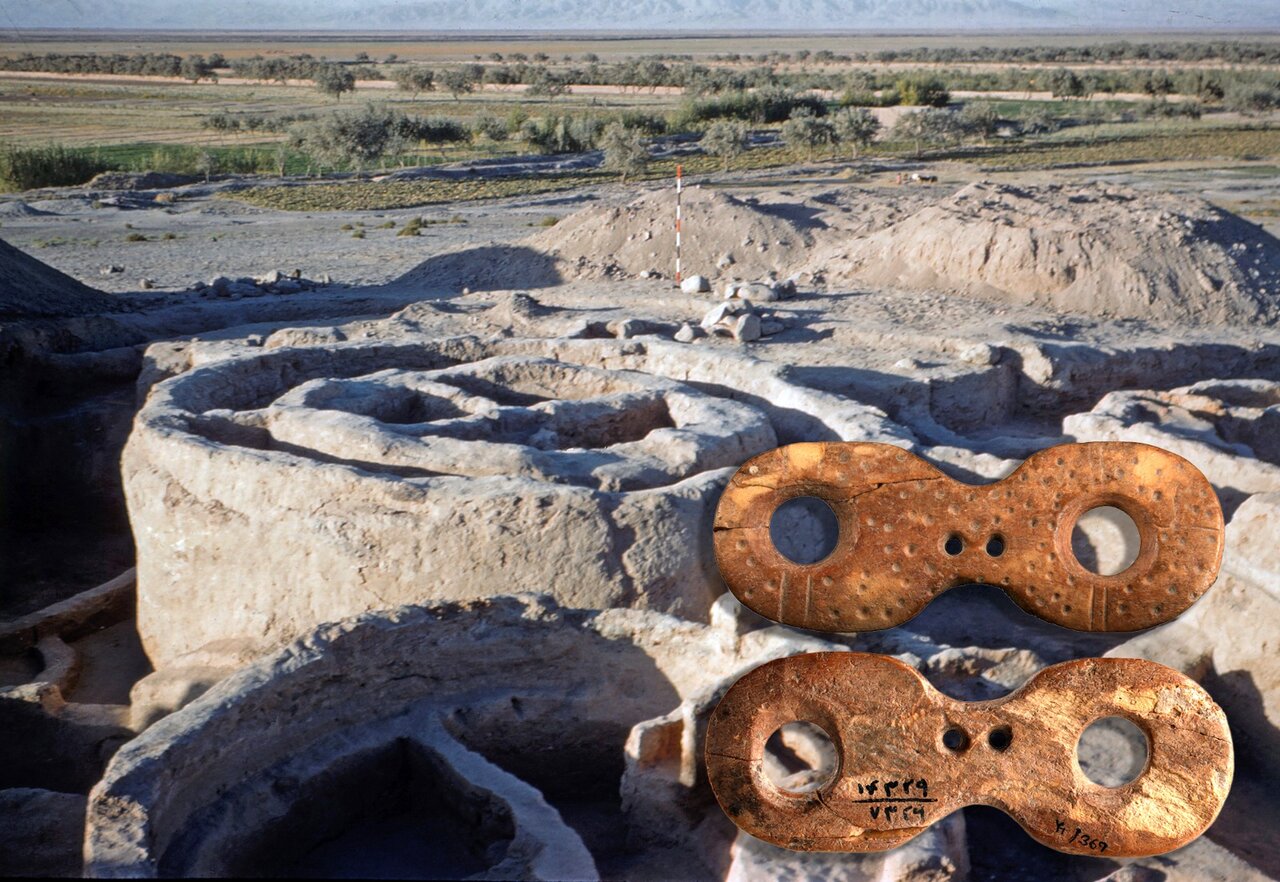
TEHRAN – Small, carefully crafted Neolithic bone objects discovered at Yanik Tepe in northwestern Iran’s East Azarbaijan province have intrigued both scholars and the public for decades.
Their striking resemblance to modern glasses has led to speculation that they may have once been an ancient visual aid. However, recent interdisciplinary research has revealed a more plausible story behind this mysterious artifact.
The ruins of Yanik Tepe, near the city of Khoda Afarin, are an important settlement for understanding the prehistory of northwestern Iran. Excavated by British archaeologist Charles Burnie in the early 1960s, the site revealed a long series of occupations, with layers spanning the Neolithic, Chalcolithic and Bronze Ages. Excavations uncovered evidence of adobe architecture, pottery, and a wealth of small finds depicting early village life in the area and the transition to a more complex society. Characteristic bone objects were recovered from these Neolithic deposits.
Excavated in 1962, the object was originally described by Barney as a pendant or amulet. Made from the long bones of medium or large mammals, it is just over 10 cm long and features two hollow circles connected by a thin central rod. Two small side holes suggest that it may have been screwed or fixed, perhaps as part of clothing or ornamentation.
Through detailed microscopic analysis and comparisons with similar finds from sites such as Turkey’s Catalhöyük and several Neolithic cultures in the Balkans, the researchers ruled out the possibility that they functioned as glasses. The asymmetrical shape, small aperture size, and lack of lens settings make such use highly impossible. Instead, the object may have been an ornament, perhaps a belt buckle, a clothing fastener, or a symbolic ornament. Traces of wear and intentionally smoothed marks indicate practical use, perhaps as part of personal clothing or ceremonial costume.
This artifact is a testament to the technology and symbolic expression of Neolithic communities in northwest Iran. Its importance has been officially recognized by the Iranian Ministry of Cultural Heritage, and the National Council of Recorded Antiquities has placed it number 1257 on the Iranian National Heritage List.
The object is currently on display at the National Museum of Iran. It also serves as a warning against interpreting ancient objects through a modern lens without scientific support. Far from being “the world’s oldest glasses,” Jannik Tepe’s bone objects are fascinating examples of early craftsmanship and cultural identity.
morning