
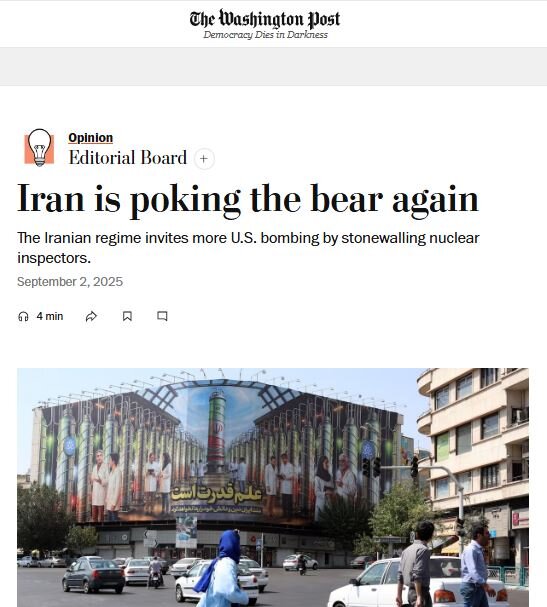
MADRID – The recent publication, published by the Washington Post editorial just days before Iran agreed to resume cooperation with the International Atomic Energy Agency (IAEA), reflects recurring narratives in Western media, but far from providing a balanced, contextually nuanced analysis.
The Washington Post editorial, entitled “Iran is thrustting the Bears Again,” fits into a long-standing discourse portraying Iran as an actor outside of the international order. The film suggests that Iran is “snatching” more US bombings after a nuclear site was attacked in June in June, in the midst of a diplomatic process with Washington, as it suspended cooperation with the IAEA.
While politically useful for certain strategic interests, this structure simplifies, distorts reality and excludes more nuanced understandings.
Iran’s “other” construction: Beyond stereotypes
In the dominant Western perception, Iran is inevitably a dangerous “other” and an actor who lacks legitimacy or validation for its security and development aspirations. The story ignores basic structural causes, including the historical influence of Western interventions, the regional context of intense rivals, and, importantly, the unilateral actions of several allies that shaped the tensions between the US and the region.
This simple portrayal not only hinders a deep understanding of Iran’s motivations, but also serves as an implicit justification of offensive policies, from harsh economic sanctions to the use of military force. In many ways, “other” is more than just a label. It is a debate tool for obscuring external responsibility and building internal consensus around the “Iranian threat.”
Lack of serious analysis of the crisis after the US withdrawal from the JCPOA
It is essential to remember that the current context arises directly from the unilateral US decision to withdraw the 2015 Joint Comprehensive Action Plan (JCPOA) in 2018. This agreement represents historic multilateral efforts to contain nuclear proliferation and normalize relations between Iran and the West.
The editors respond with a “completely condemn Iran” approach, ignoring the devastating effects of the US withdrawal. The re-challenges of severe sanctions on Iran’s oil sector and the broader economy have taken a strategic blow, urging Tehran to reconsider its cooperation and adopt a assertive attitude to protect its sovereignty.
From this point of view, Iran’s so-called “stubbornness” should be understood as a state response to witnessing major interlocutors violating international agreements, while applying unilateral economic and military pressures. The decline of unified mutual trust in the editorial is a highly breeding ground for current escalations and doubts surrounding the nuclear program.
Another particularly important point omitted by the editor is the paradox of US airstrikes over Iran’s nuclear facilities during ongoing negotiations. This action is grossly contradicted with the US rhetoric of “willing to engage” and reveals diplomacy with simultaneous military pressure and formal dialogue.
Such double in and outages undermine trust and perpetuate a vicious cycle of mutual doubt. Historically, US diplomacy often relies on superficial negotiations or broken promises, discouraging counterparts. A notable example was mediation over the release of Eden Alexander, an Israeli-American soldier held by Hamas during the Gaza Massacre. The concessions were agreed for his release, but Washington failed to support subsequent promises, undermining credibility and generate deep skepticism about the integrity of its diplomatic commitment.
These practices of “pressure diplomacy and the broken promise” have led Iran and other regions to take defensive or avoidant positions in negotiations and adopt extreme caution as a legitimate response to past experiences. To condemn Iran alone without realizing this dynamic perpetuates a biased, ineffective view for conflict resolution.
Controlling Iranian uranium
The editors critically support the Western demand for full IAEA access and accurate knowledge of the location of uranium in Iran. From an Iranian perspective, these demands raise legitimate concerns. Such information is feared that Israel could be diverted for military purposes, particularly by Israel, a regional actor with a documented history of attacks on Iranian nuclear sites, based on information provided by international organizations.
The IAEA is being viewed with suspicion of Iran by sharing sensitive reports or locations that led to military operations. This history undermines the IAEA’s estimate of full objectivity and reinforces Iran’s careful approach and desire to protect strategic data.
The sovereignty and security of a state is the legitimate rights of any state, especially in the context of a secret attack. As a result, claiming thorough surveillance without express and mutual guarantees is one-sided and interferes with the possibility of rebuilding trust.
The editorial also ignores the highly mediated and politicized US airstrikes that completely or long-term destroyed Iran’s nuclear program. Experts and information assessments showed that actual damages are limited and that Iran can quickly resume its essential capabilities. This is an assessment that led to the firing of the US Defense Director’s chairman, which contradicts the official narrative.
Iran’s nuclear programme must be understood primarily as an expression of strategic autonomy and national sovereignty. Iran sees it as a tool to assert the right to decide on its own technical and energy developments amid external pressure, beyond private applications. Maintaining a nuclear energy cycle that includes specific uranium reserves reflects the desire to maintain an independence and regional balance.
Furthermore, Iran’s restrictions on access to inspectors after an attack on critical facilities should not be considered merely “diving,” and not as a defensive response to attacks that violate its sovereignty and threaten the safety of critical infrastructure.
The impact and contradictions of economic sanctions
The editors acknowledge that economic cooperation between Iran and China and Russia limits sanctions, but do not explore how these sanctions affect civilians or contribute to radical positions rather than mitigating them.
Economic sanctions are designed as strategic pressure tools, but tend to indiscriminately punish the most vulnerable and erode internal political dialogue. Ignoring this factor overlooks the reason why Iranian resistance resists social and political sieges rooted in what is perceived as social and political sieges rooted in social impulses rather than merely political.
Given the complexity of the situation, it is clear that a stable and lasting solution can only be achieved through true diplomatic engagement, through respect for unilateral concerns and legitimate concerns of all parties.
Iran’s nuclear programme is subject to legitimate scrutiny, but must be understood within the framework of national sovereignty and the right to self-determination. Requiring unconditional submission without any concrete assurances of non-attack and mutual respect limits the prospect of settlement.
A realistic analysis must recognize that US diplomacy is often ambiguous, overlapping, eroding trust, and that traditional pressures and multilateral sanctions schemes that do not openly restrict the conflict are ineffective in suppressing conflict.
In attempting to present a “objective” overview, the edited by the Washington Post recreates a biased, simple story about Iran. The current crisis ignores complex decisions, mistakes, unilateral actions, particularly withdrawal from the JCPOA and selective sanctions and military strikes.
Building Iran as an irreparable enemy. It lacks analytical rigor, ignoring the dynamics of power, history, local context, and Western actions that sparked the crisis, and irritates realistic prospects for solutions. Supported by contradictory diplomatic practices, mutual distrust in ignorance of Iran’s sovereignty cannot be overcome without a deep reassessment of general policies and narratives.
Ultimately, recognizing the legitimate interests and rights of all parties, restoring channels of trust, and pursuing policies that avoid military and economic escalation is the only way to stabilize regions that suffer significantly and are critical to global security.