
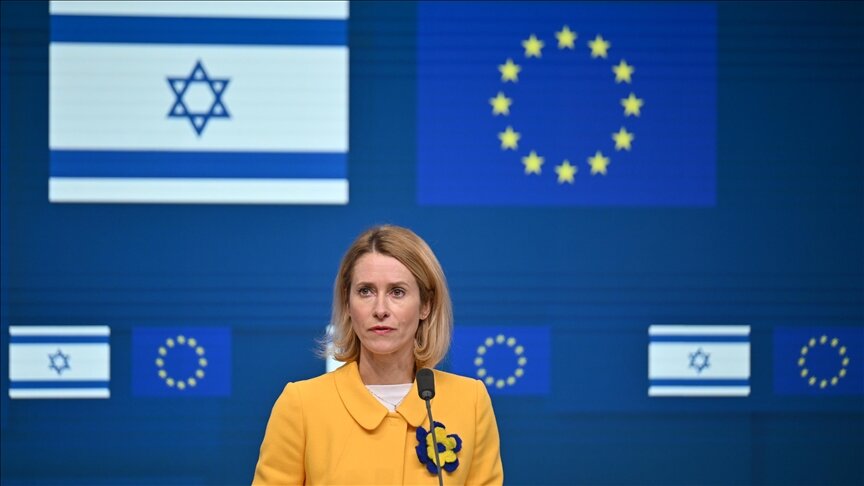
The EU has been criticized for suspending sanctions against Israel in response to Donald Trump’s Middle East peace efforts, with a fragile ceasefire under threat.
Following Monday’s meeting of EU foreign ministers, European Union foreign policy chief Kaja Karas announced a suspension of efforts to halt preferential trade with Israel and sanctions against those responsible for instigating the conflict between the two countries, the Guardian reported.
Karas said the situation has changed since the measure was proposed last month. He cited “differences of opinion” and said ministers agreed “we do not agree with this measure at this time, but we also do not take it off the table due to the vulnerability of the situation”.
Two former EU officials spoke separately to criticize the decision not to proceed with sanctions.
Sven Kühn von Burgsdorff, the former EU representative for the Palestinian Territories, told the Guardian that Mr Karas had missed “the point” of legal liability.
“Sanctions are not just a means to induce or compel third parties to change or adjust their behavior. Restrictive measures are part of the tools the EU has given itself to respond to violations of both European and international law,” he said.
The EU concluded in June that Israel had breached its human rights obligations under the Association Agreement governing trade and cooperation between the two countries. Lawyers said the EU has an obligation to ensure its policies comply with the International Court of Justice’s non-binding opinion, which calls on Israel to end its occupation of Palestinian territory as soon as possible in 2024.
Burgsdorf co-sponsored a statement last week signed by 414 former senior diplomats and officials, urging strong EU action “against spoilers and extremists on both sides” whose actions jeopardize “the establishment of a future Palestinian state.”
The statement welcomed President Trump’s plan, but noted that the issue of Palestinian self-determination was “only vaguely addressed.”
Nathalie Tocci, a former adviser to two EU high foreign policy representatives, said waiving sanctions would be the worst outcome for the EU.
“That’s the last thing we should be doing, because this is the moment when we need to keep up the pressure, because we all know it’s not a foregone conclusion that this plan will be implemented,” Tocci told the Guardian, noting that the first phase of Trump’s plan was marred by violence, sparking a diplomatic scramble to shore up the deal.
“I am concerned that… European governments and institutions… will revert to old, familiar patterns,” she added.