
TEHRAN – Foreign Minister Sobueno reviewed a joint statement calling for the restart of stalled nuclear negotiations with Iran and the United States, more than a month after the three European powers Britain, France and Germany activated a mechanism to reinstate U.N. sanctions on Iran for the first time in a decade.
“The recent statement is indeed a symbol of a ‘defensive’ shift in European foreign policy,” the newspaper said. The leaders of the three European countries know that they cannot manage the energy crisis or maintain their influence in the Middle East unless they return to a path of engagement with Iran. After two decades of negotiations, sanctions, and resistance, the Islamic Republic of Iran has reached a point where it can change the dynamics of the region. Europe is in a strategically weak position in confronting Iran, meaning it is unable to build a global consensus against Iran or define policy independent of the United States. However, Iran relies on its domestic power, active regional diplomacy, and Eastern relations (close ties with China and Russia), and is becoming an actor that can no longer be deterred by threats and sanctions. In these circumstances, for Europe to return to threatening language would be to repeat the mistakes of the past and admit the failure of its strategy of “smart pressure.” This strategy has now lost credibility even in Western countries.
Armand et Meri: Active diplomacy to prevent war
In an interview with Armand-e-Meri, international affairs analyst Qasem Mohebali suggested that active diplomacy is needed to prevent war. Analysts say: Given the current situation in the region, the ruling elite must explore all possible ways to prevent war. Currently, despite all the surrounding issues and the 12-day war, diplomatic avenues between Iran and the West are still open. It is extremely important to continue negotiations regarding the nuclear program. Research shows that while we must prepare for the worst-case scenario, active diplomacy should also remain on governments’ agendas. We should engage in active diplomacy, prevent conflicts, and ensure win-win national interests. Diplomatic silence or passivity can mean giving opportunities to competitors and enemies. Therefore, a proactive approach in foreign policy is not only necessary to prevent military conflict, but could also pave the way to increasing Iran’s bargaining power in the international arena.
Jam-e-Jam: A historic opportunity to overcome sanctions
International affairs analyst Mohammad Marandi explained the possibility of Iran’s global transition in an interview with Jam-e-Jam. He says: The activation of the snapback mechanism has been a pre-planning by Western countries since 2015. Given the Zionist regime’s pressure and Europe’s efforts to curry favor with the Trump administration, the current posture of European countries is a sign of their declining position in the global equation. The current situation represents a historic opportunity for Tehran. This is an opportunity for Iran to strengthen the BRICS and the Shanghai Area, neutralize the pressure behind the global economic war, and take advantage of the decline of Western hegemony. Therefore, the current situation is not suitable for direct or indirect negotiations with the United States. Americans should not be given the impression that attacks on Iran will come for free. To curb sanctions, Iran should focus on strengthening ties with regional countries such as BRICS, Shanghai Cooperation Organization member states, Central Asia, the Caucasus, West Asia, and the Indian subcontinent.
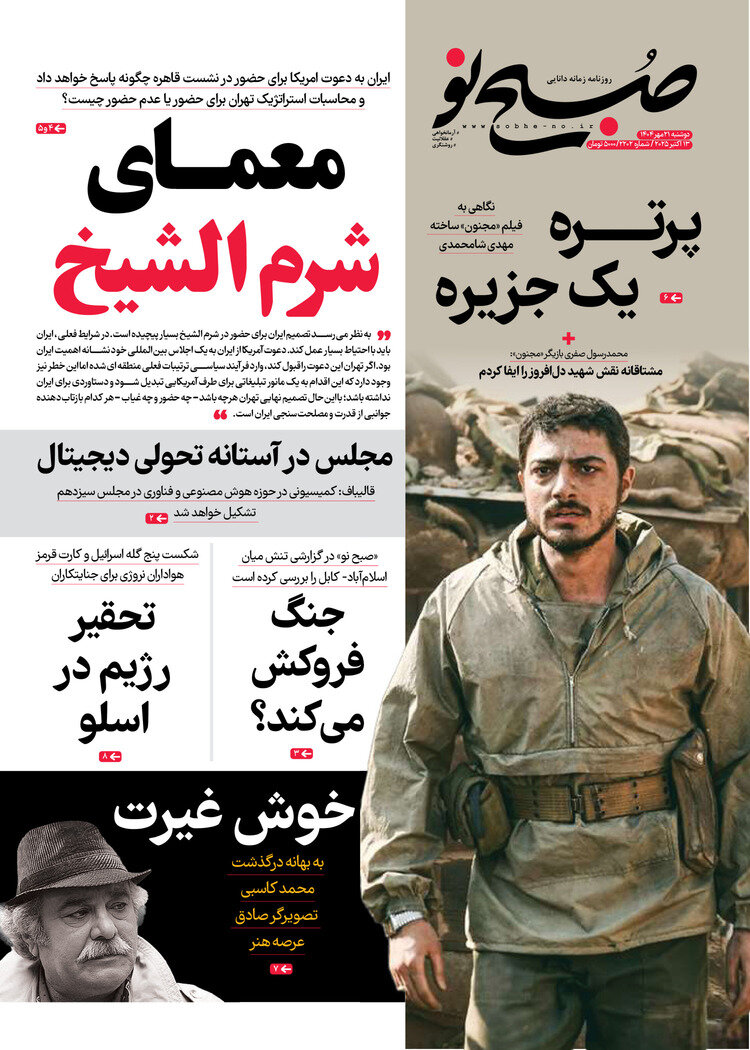
Khorasan: Washington invites Iran to Sharm el-Sheikh, planned move to complete Trump’s show
In his article, Khorasan discussed the Sharm el-Sheikh summit and the US government’s invitation to Iran to attend the summit. The paper writes: Just days after the ceasefire announcement in Gaza, the announcement of a summit between Donald Trump and more than 20 world leaders in Sharm el-Sheikh has once again focused attention on the Middle East. But beyond the confines of a “peace conference,” the summit appears more like a stage for restoring American political power than an effort to achieve justice and lasting peace. Sharm el-Sheikh has in fact become a showcase for Washington’s symbolic return to the region. A return that is a kind of image engineering and expression of authority. The US government’s invitation to Iran to attend the Sharm el-Sheikh summit is not a change in behavior or a sign of political respect, but a calculated move to complete the show for President Trump. For the White House, the Iranian government’s presence at the summit, even if it appears as a critic or opponent, is to solidify the image that President Trump wants of “the United States returning to its position as the final arbiter of the Middle East.” Without independent initiative and its own narrative design, Iran’s presence could inadvertently legitimize the US government’s narrative.