
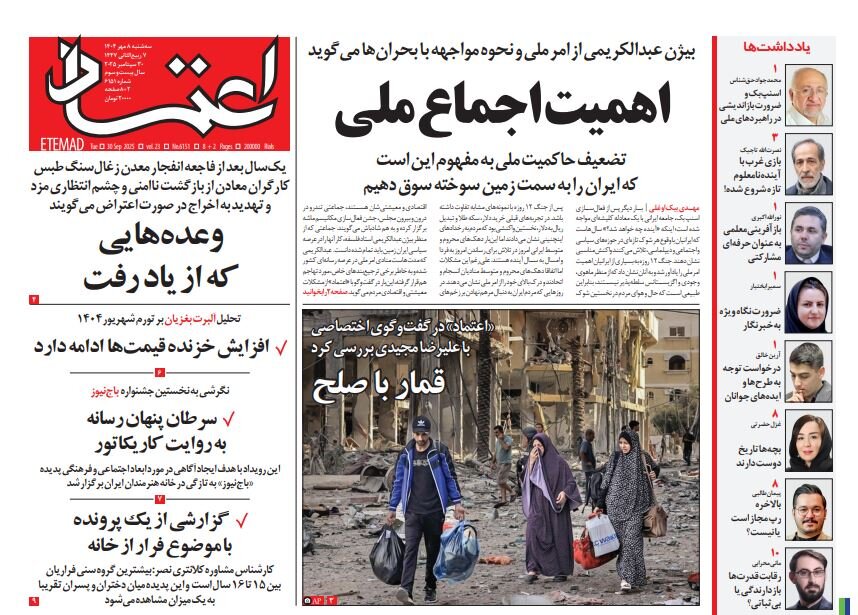
Tehran – In an interview with Etemad, international affairs expert Ahmad Shirzad says Europe will not play a role in Iran’s nuclear issue in the future.
Shirzad said: Things have changed today. Despite all the mistrust, hostile actions and the one-sided relationship of the US, it is at least clear that Washington is the leading political party in the nuclear incident, and negotiations through Europeans are essentially useless. As Mr Araguchi stressed, future decisions on this issue will effectively eliminate Europe’s meaningful role. Therefore, the main party, the dialogue and agreement with the US, will be far more fruitful than relying on European mediation. On the other hand, we must not forget that Europe’s weight in this case is very low. At some point, they even play a destructive role. The role of Europeans in recent years on Iran’s nuclear issue has had a major impact, rather than positive. Therefore, Iran will not have any particular interaction or consultation with Europe in the future.
Hamshahri: Weakening sanctions pressure
Hamshahri writes: The revitalization of the snapback mechanism (by the European troika in Britain, France and Germany) has resulted in reimposed UN sanctions on Iran. The main question now is whether these sanctions can stop Iran’s nuclear program, or simply increase diplomatic and economic pressures. It must be said that political consensus is the first condition of validity. Whenever Russia or China is likely to oppose a dramatic measure or reject a solution, the effectiveness of sanctions and the Security Council’s decision will weaken. Implementing sanctions requires monitoring of technical legal cooperation in third countries to prevent sanctions from being avoided. Countries that want to avoid that can rely on alternative tools and paths. Ultimately, the pressure and unilateral actions of Chapter 7 allow the other side to return to the negotiation table, but the sustainability of the agreement requires structural and political assurance.
Kayhan: Israel is worried about growing engagement bonds with Tehran
In the memo, Kayhan addressed growing concerns about increasing relations between Iran and its allies following the return of sanctions. According to this paper, in recent years, China has become one of the world’s most influential forces, expanding its influence in the world’s economy, technology and security. Currently, Beijing’s harsh tone and consistency with Iran is an issue that has increased the difference between Tel Aviv and Beijing. China’s relations with Iran are the main source of Israel’s concerns, as Beijing accounts for 91% of Iran’s oil exports. This issue has reinforced US and European pessimism about the effectiveness of sanctions against Iran. Expanding economic and military cooperation between China and Iran has become a concern for Israel. China has developed close ties with Iran and has in recent years deepened these relationships by signing strategic and military agreements with Tehran. Joint naval training between Iran, China and Russia is an example. The cooperation between Tehran and Beijing has transformed the balance of power in the region into damage to the Tel Aviv regime.
sobh-e-no: We need to know the enemy of deceit
Sobh-e-no writes: Despite the agreement between Iran and the IAEA in Cairo that met European demands, European trioes in Britain, France and Germany have energized the snapback mechanism. And now, with the revival of sanctions, they say they are talking about diplomacy and are ready for dialogue with Iran. In such circumstances, negotiations and conversations lose their effectiveness, making it more clear to the leader’s meaning of the revolutionary statement that “negotiations are a complete dead end.” Now, instead of finding out about Western intentions, some political conflicts are being strengthened at home. The lesson you can learn from this agreement is to find out about the “natural” of the enemy. This does not prey on their traps as they must be careful in decision-making and policy making. Tehran’s nuclear diplomacy is always based on negotiation, interaction and trust building. From the intensive negotiations that created the JCPOA to its contacts with Europe, the International Atomic Energy Agency, and even the US, everything shows that Tehran has always sought a political solution. It is important to understand the “properties” of the other side. This way, it is important to avoid a simple view of the other side, not taking anyone’s signature as a guarantee, and not be fooled by the other side’s trickery through negotiation.